Tree Near Power Lines in Waxhaw NC: Who Trims It, Who Pays
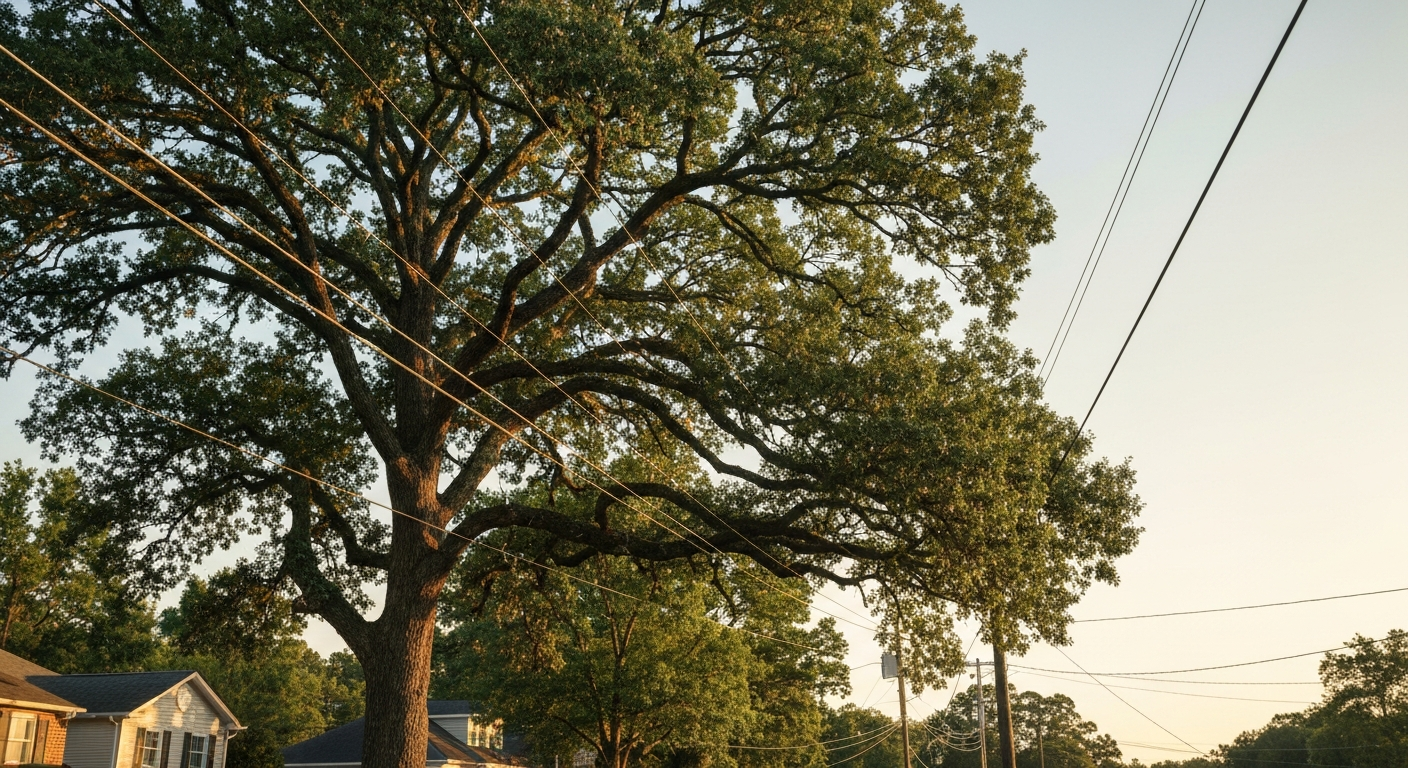
If you have a tree near power lines, Waxhaw NC homeowners need to answer one question first: which wire is it? The heavy line along the road or a rear easement is your utility's, cleared at no cost to you. The thinner line from the pole to your meter is the service line, and both utilities serving Union County assign routine pruning around it to the property owner. That decides who you call and who pays, but it does not let you pick up a pole saw, because a crew that is not line clearance qualified may not work within ten feet of an energized conductor. The part almost nobody knows is the part that solves the problem: both Duke Energy and Union Power will de-energize or physically drop that service line, at no charge, so the work can be done safely.
The short version
- Primary lines (along the road or easement) are the utility's. Report them, do not touch them.
- Service lines (pole to meter) are yours to keep clear, with hazard exceptions the utility handles free.
- Ten feet is the federal floor for anyone not line clearance qualified, and it grows with voltage.
- Ask for the free wire drop first. Duke de-energizes at no cost, Union Power drops the wire with 48 hours notice.
- A downed line is always live. Stay away, do not touch it, do not drive over it.
The Two Wires Over Your Property
Most properties in Waxhaw and the surrounding Union County communities have more than one type of wire crossing them, and they are not equivalent. Duke Energy sorts them on its tree pruning request page, and two of them decide almost everything.
| Feature | Primary or distribution line | Service line |
|---|---|---|
| Where it runs | Along the road or easement, pole to pole | From the pole or transformer to your meter |
| Who keeps it clear | The utility, on a scheduled cycle | The property owner, for routine pruning |
| Who pays | The utility | The owner, with free exceptions for specific hazards |
| What to do | Report the risk and let them schedule it | Request a free de-energize, then hire a qualified crew |
Communication, cable and telephone lines are not maintained by the electric utility at all, so those go to the cable or phone company.
Who Is Responsible for a Tree Near Power Lines in Waxhaw and Union County
Both utilities operating in this county state the split independently, in nearly the same words. Duke Energy writes that "service lines carry electricity from the utility pole to the meter" and that "property owners have primary responsibility to keep these lines clear of trees and vegetation." Union Power Cooperative's 2026 vegetation management document for service lines describes the service drop as "the responsibility of the Member to maintain in way of routine tree pruning."
This is company program policy rather than state statute. We could not find a North Carolina statute or Utilities Commission rule assigning the service drop, so the accurate statement is that both providers serving this area assign it the same way in their published programs. This article also will not tell you which one serves your address, because both operate in Union County. Check your bill or your meter, then call that provider.
Ten Feet, and Why You Cannot Judge It From the Ground
Federal law sets the number. Under 29 CFR 1910.333, an unqualified person must stay at least 10 feet from energized overhead lines rated 50kV or below, and that distance grows by 4 inches for every 10kV above 50kV. The rule covers the person and the longest conductive object they might be holding, so a pole saw, an aluminum ladder or a wet rope counts as part of your reach.
Working inside that distance is not merely riskier, it is a separate regulated occupation. OSHA's line-clearance tree trimming eTool defines it as tree work within 10 feet of energized lines and reserves it for certified line-clearance trimmers.
It is a hard stop rather than a judgment call because nothing visible from your yard tells you what you would need to know. You cannot tell a line's voltage by looking, you cannot tell whether the covering on a service drop is insulation or weathered jacketing (older open-wire configurations have none at all), and you cannot tell whether a line is energized. Union Power puts it plainly on its electrical safety page: "Keep yourself and any equipment at least 10 feet away from all lines. If you can't avoid a power line, don't do the work."
Climbing carries the same warning. Duke Energy's rights of way FAQ states that no one should climb trees near power lines, noting that trees and limbs can themselves conduct electricity when they touch a line.
The Free Wire Drop Is the Answer
Here is the fact that resolves the problem, and it sits in utility documents rather than general tree care advice. Both providers will take the service line out of service, free, so the work can happen safely.
Duke Energy: "Before performing any work around your service line, please contact us to de-energize the line at no cost." Union Power names the homeowner's contractor in its offer: "If you and/or your tree pruning vendor have any concerns or are uncomfortable working near the lines please contact us at 704 289-3145 and ask for a wire drop (48-hour notice required). We will disconnect the wire for your safety at no charge. Call us back when ready for us to re-attach the wire."
So the correct sequence for a limb resting on your service line is never "cut it carefully." Identify your provider, request a de-energize or wire drop, allow the notice period, have a qualified crew do the work while the line is dead, then call the utility to re-attach. A dead line does not make the tree work simple, but it removes the one hazard that turns an ordinary pruning job into a lethal one.
What the Utility Will and Will Not Do
Homeowners often assume the utility handles any tree touching any wire. It does not. Union Power will address five service line conditions at no cost after its own assessment:
- A branch in hard contact that is displacing the line
- A branch growing around the line
- A tree pushing up on the line from below
- Dead branches over the line, whether or not they are touching
- A nearby dead tree its arborists judge a genuine risk if it falls
What it will not address is equally specific: trees over its 12 inch cutting size parameter, trees with no mechanized access or unsafe to climb, branches merely "tickling" the line, live branches that only might contact under ice or snow load, old open-wire configurations, and cases where removal rather than pruning is right. That 12 inch threshold is a clean handoff point. Past it, the tree is a private tree care job.
Duke draws its boundary around purpose rather than size. It prunes for reliability, not appearance, and gives North Carolina customers at least three days notice before planned pruning in maintained residential areas, per its distribution line vegetation management page. After severe weather it does not clean up tree debris. That cleanup is yours to arrange, which is a common reason people reach our 24/7 emergency storm damage line.
Utility Line Clearance Pruning Is Not Tree Topping
We have written before about why topping damages trees, so it is fair to ask what changes when a utility crew leaves a tree looking lopsided. The two practices differ at the cut, which is where the distinction has always lived.
Topping is indiscriminate cutting back to stubs, or to laterals too small to take over as leaders. That is what drives the starvation response, the weak water sprouts, and the decay entering wounds that never close. Utility line clearance pruning removes limbs back to a lateral or to the trunk, the same cut placement discipline proper structural pruning follows. What differs is the objective: clearance from the conductor drives cut selection instead of the tree's natural form, so a correctly pruned tree under a line can end up V shaped or one sided while every cut was made properly.
The utilities say so themselves. Union Power's 2026 pruning types and standards document states the program has fully adopted the ANSI Z133 and A300 pruning standards, lists side pruning and V pruning as its accepted methods, and names topping, pollarding and rounding over as improper practices it does not use, specifying that topping is never done on hardwoods such as oak and maple. Duke states it does not round trees over because that harms tree health.
So the aesthetic frustration is legitimate and the tree is usually fine. If you dislike the shape a clearance cycle leaves behind, the remedy is not to have someone shape it under a live conductor, because that work is not lawfully available to you. It is species replacement.
If a Line Is Down, or a Tree Is On a Line
Treat every downed line as energized. Duke Energy's guidance is unambiguous: lines torn down by trees or limbs may still be energized while in the air or on the ground, so always assume a downed line is live, stay away, never touch it or drive over it, and contact the utility immediately. The same applies to a fallen tree in contact with a line, and Union Power repeats the assume-energized rule in its own safety guidance.
As general emergency practice, call 911 as well as your utility when a line is down where people or vehicles are moving. Do not try to move the tree, clear the road, or pull the line. Wait for the utility, because no tree work can begin until they confirm the line is secure. This is also why preparing trees before hurricane season pays off. The cheapest storm response is the limb removed in advance.
Prevention: Plant So This Never Comes Up
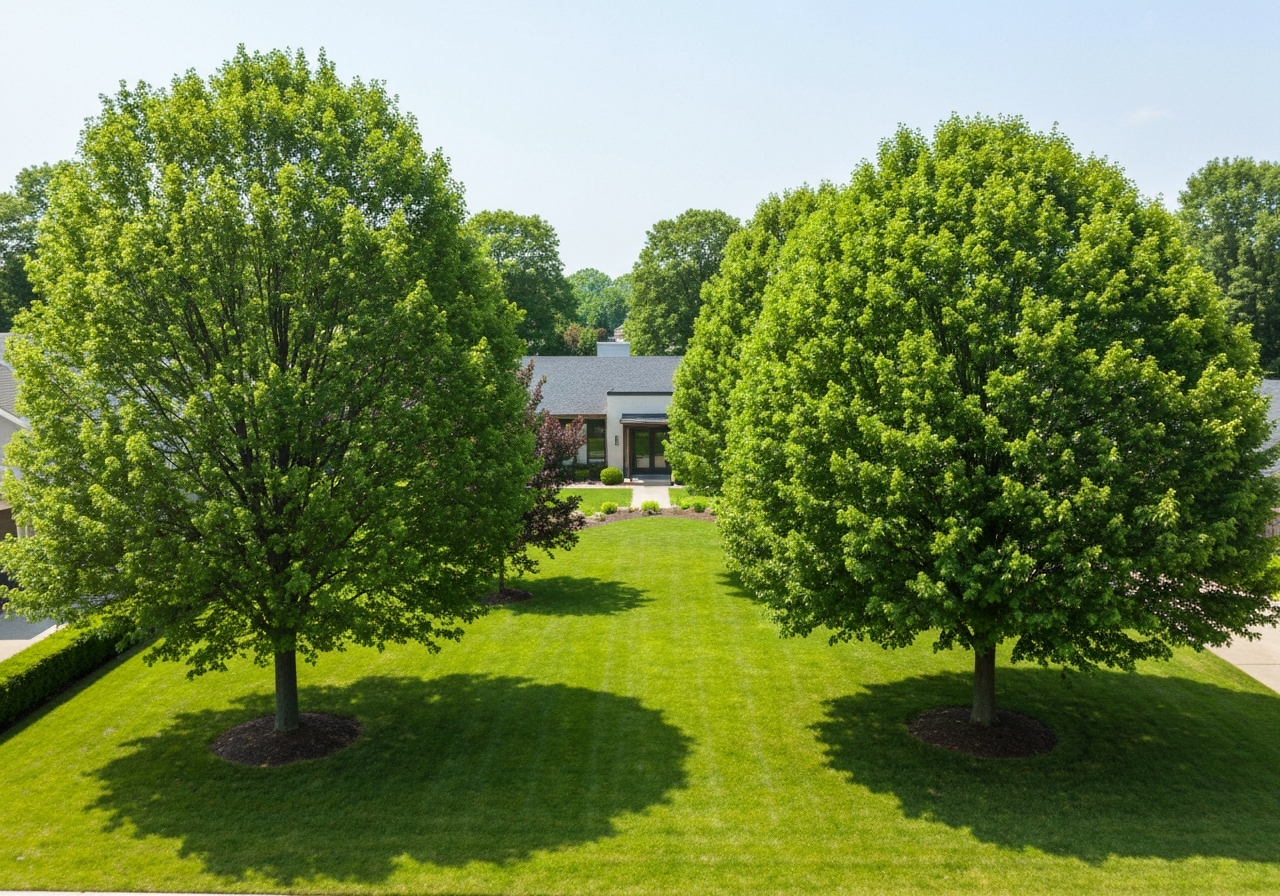
The permanent fix is to not have a tree there at all. Union Power publishes setbacks by mature size on its planting guidelines and clearances page: small trees (under 20 feet at maturity) at least 20 feet from the line, medium trees (under 40 feet) at least 30 feet, large trees at least 50 feet, and everything at least 10 feet from padmount transformers. Species choice matters more than distance alone, because a fast-growing tree planted too close reaches the conductors before the next maintenance cycle and needs heavy clearance pruning for life. Choosing well once is cheaper than fighting the same tree every cycle, and that is ordinary tree trimming and planning work we do across Waxhaw and Union County.
How to Check That a Crew Is Actually Qualified
Line clearance qualification is a documented status, not general competence. A properly trained arborist designated by their employer may work inside the minimum approach distance under strict conditions, but that designation requires OSHA 1910.269 electrical training and demonstrated proficiency, and the employer determines and documents who holds it. An April 2026 bulletin on tree work near electrical hazards summarizes the same tiering and still recommends notifying the power company first even when a qualified crew is available, since the utility may de-energize the line, give guidance, or prohibit the work outright.
Read that as a reason to verify credentials, not as a loophole. Ask any contractor directly: is your crew line clearance qualified, and have you contacted the utility? One who answers by describing how careful they will be has answered no. Duke Energy's position is that only line clearance qualified personnel should do this work.
One detail separates current guidance from stale guidance. The arboricultural safety standard is now ANSI Z133-2026, which superseded the long-cited 2017 edition on 27 May 2026 and is free digitally from the International Society of Arboriculture. Much of the material published earlier this year, including the bulletin above, still cites the 2017 edition. Union Power maintains a crew locations page naming its contracted tree services, worth a look if a crew in your yard claims to be utility contracted.
Quick Answers
Who is responsible for trimming a tree touching a power line?
It depends which line. The primary line along the road or easement is the utility's, cleared at no cost. The service line from the pole to your meter is the owner's for routine pruning, per both Duke Energy and Union Power, though both handle specific hazards such as a dead limb over the drop for free.
Can I cut a tree branch off my own power line?
Not while it is energized, and not by judging the distance yourself. Call your provider and request a free de-energize or wire drop. Once the line is dead the work still needs a competent crew, but the electrical hazard is gone.
How far from a power line can I work?
If you are not line clearance qualified, 10 feet is the federal minimum for lines at 50kV and below, and it increases with voltage. That includes anything conductive you are holding. Since you cannot judge a line's voltage from the ground, treat 10 feet as a stop, not a target.
Who do I call in Union County?
Identify your provider from your bill or meter first, because both Union Power Cooperative and Duke Energy serve parts of the county. Union Power's vegetation management number is (704) 289-3145. Duke takes requests through its tree pruning request page. For a downed line, call the utility and 911 immediately.
Getting the Tree Work Done
Have more questions or want to get in touch? Once your utility has dropped or de-energized the service line, the tree still has to be pruned or removed properly, which is ordinary tree work under safe conditions. We handle pruning, removals and post-storm cleanup across Waxhaw, Weddington, Wesley Chapel, Indian Trail and Monroe, and we will tell you honestly whether it is a utility call, our call, or both. Contact our team to schedule an assessment. We look forward to hearing from you.
Citations
- Duke Energy - "Tree Pruning Requests" (undated maintained program page, verified live 2026-07-20)
- Union Power Cooperative - "Integrated Vegetation Management Program: Service Lines" (2026)
- U.S. Occupational Safety and Health Administration - "1910.333, Selection and use of work practices" (current binding regulation, verified live 2026-07-20)
- U.S. Occupational Safety and Health Administration - "eTool: Line-Clearance Tree Trimming Operations" (undated maintained eTool, verified live 2026-07-20)
- Union Power Cooperative - "Electrical Safety" (undated, verified live 2026-07-20)
- Duke Energy - "Rights of Way Frequently Asked Questions" (undated maintained program page, verified live 2026-07-20)
- Duke Energy - "Distribution Line Vegetation Management" (undated maintained program page, verified live 2026-07-20)
- Union Power Cooperative - "Integrated Vegetation Management Program: Pruning Types & Standards" (2026)
- Union Power Cooperative - "Planting Guidelines & Clearances" (undated, verified live 2026-07-20)
- New Jersey Counties Excess Joint Insurance Fund - "Tree Work Near Electrical Hazards: Best Practices" (2026-04-16)
- International Society of Arboriculture - "Z133-2026 Safety Standard Now Available" (2026-05-27)
- Union Power Cooperative - "Crew Locations" (rotating list, verified live 2026-07-20)