Professional Tree Pruning vs Tree Topping: The Critical Choice for Tree Health & Longevity
Understanding the Critical Choice for Your Trees
For homeowners and property managers, making informed decisions about tree care is paramount to the long-term health and aesthetic appeal of your landscape. A common point of confusion arises when considering major crown modifications: Professional Tree Pruning vs Tree Topping. While both involve reducing a tree's canopy, their methods, impacts, and outcomes are drastically different. Understanding this critical distinction is vital for ensuring the vitality and longevity of your trees.
What is Professional Tree Pruning? Techniques and Benefits
Professional tree pruning is a horticultural practice involving the selective removal of branches or stems from a tree. This isn't random cutting; it's a careful process guided by an understanding of tree biology and growth habits. The primary goal is to improve the tree's health, structural integrity, appearance, and longevity.
Key Techniques in Professional Pruning:
- Thinning: Removing entire branches back to their point of origin or to a lateral branch. This increases light penetration and air circulation within the canopy, promoting healthy interior growth and reducing wind resistance.
- Reduction: Reducing the size of a tree or limb by cutting it back to a lateral branch that is large enough to assume apical dominance (at least one-third the diameter of the removed limb). This helps manage tree size without compromising its natural form.
- Raising: Removing lower branches to provide clearance for pedestrians, vehicles, or structures.
- Cleaning: Removing dead, dying, diseased, weakly attached, or rubbing branches to improve tree health and safety.
Proper pruning techniques foster a strong, well-structured tree that can better withstand storms and resist pests and diseases. It encourages balanced growth and can enhance flowering and fruiting in appropriate species. For more details on effective tree care, visit our tree trimming services.
The Harmful Practice of Tree Topping and Its Long-Term Damage
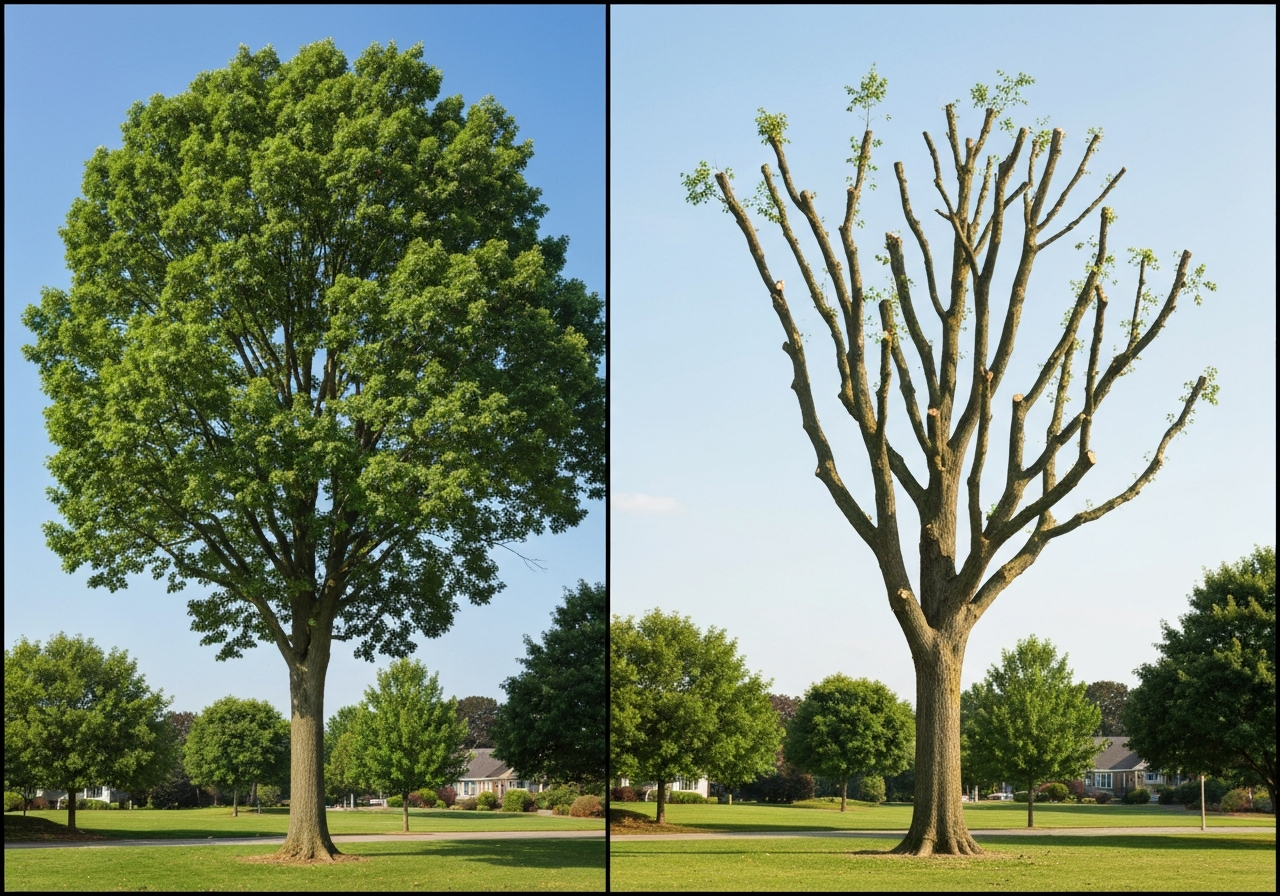
In stark contrast to professional pruning, tree topping is the indiscriminate cutting of tree branches to stubs or to lateral branches that are too small to support the remaining limb. This aggressive and damaging practice, often performed to quickly reduce a tree's height, has severe negative consequences for the tree's health and your property.
As noted by experts, topping is often considered the most serious injury you can inflict on a tree (Maryland Grows, UMD Extension). When a tree is topped, it loses a significant portion of its leaf-bearing crown, which is essential for photosynthesis and energy production. This sudden removal of foliage starves the tree and triggers a survival mechanism, leading to the rapid growth of numerous weak, upright shoots called "water sprouts" or "epicormic shoots" (Arborjet).
Consequences of Tree Topping:
- Starvation and Stress: The drastic reduction of the canopy severely limits the tree's ability to produce food, leading to severe stress and nutrient depletion.
- Weak Branch Development: Water sprouts that emerge are weakly attached to the main stem and are prone to breaking, creating hazardous conditions and structural instability (Coastal Spray). These dense growths often result in a "lion's tail" effect, further weakening the tree's architecture.
- Increased Susceptibility to Pests and Diseases: The large, open wounds left by topping rarely heal properly, making the tree vulnerable to decay fungi, insect infestations, and disease, potentially shortening its lifespan (Washington DNR).
- Unsightly Appearance & Reduced Property Value: Topping disfigures the natural shape of the tree, leaving it with an unnatural, stubby appearance. This can significantly detract from your property's aesthetic appeal and value.
Professional Tree Pruning vs Tree Topping: A Definitive Comparison
The distinction between Professional Tree Pruning vs Tree Topping cannot be overstated. It's the difference between nurturing a tree for lasting beauty and health, and inflicting damage that can lead to its decline and premature death.
| Feature | Professional Tree Pruning | Tree Topping |
|---|---|---|
| Methodology | Selective removal of specific branches, considering tree biology and growth. Cuts are made at appropriate points to encourage healing. | Indiscriminate cutting of large branches, leaving stubs without regard for natural form or tree health. |
| Impact on Tree Health | Promotes strong structure, stimulates healthy growth, and enhances natural resistance to pests and diseases. | Causes severe stress, starves the tree, leads to weak and numerous water sprouts, and invites disease and insect infestation. |
| Aesthetics | Maintains or enhances the tree's natural shape and beauty. | Disfigures the tree, resulting in an unnatural and unattractive appearance. |
| Safety | Reduces risk of branch failure by improving structural integrity. | Increases risk of limb breakage and tree failure due to weak regrowth and decay. |
| Long-Term Cost | Requires less frequent, targeted maintenance, saving money over time. | Often leads to ongoing maintenance needs, tree removal, and replacement, making it more costly in the long run. |
Choosing professional tree pruning means investing in the long-term health and value of your trees, whereas topping is a short-sighted and ultimately detrimental practice (OC Register).
Beyond Topping: Clark's Tree Care's Approach to Responsible Height Reduction
At Clark's Tree Care LLC, we advocate for and practice responsible tree care that prioritizes the tree's health and longevity. When tree height reduction is necessary, we never resort to topping. Instead, we utilize advanced, scientifically-backed pruning techniques designed to achieve desired results without harming your trees.
Our approach includes:
- Crown Reduction: Carefully reducing the overall size of the tree's crown while maintaining its natural shape and structural integrity. This involves making precise cuts to smaller lateral branches, minimizing stress on the tree.
- Structural Pruning: Focusing on developing a strong scaffolding of branches that can support the tree's weight and withstand environmental stressors. This is particularly crucial for younger trees (Texas A&M AgriLife Extension).
- Hazardous Limb Removal: Safely removing limbs that pose a risk to property or people, always with an eye toward preserving the tree's overall health and balance.
We understand that each tree is unique, and our certified arborists tailor their approach to the specific needs of your tree species, its age, and its environment. Our goal is to ensure your trees remain healthy, beautiful, and safe for years to come. Explore our tree services for safe height reduction.
Why Partnering with Certified Arborists Matters for Tree Health
The expertise of a certified arborist is indispensable when it comes to proper tree care. These professionals possess a deep understanding of tree biology, pruning techniques, and disease management, distinguishing them from unqualified tree cutters (Nashville Tree Conservation Corps).
Benefits of choosing a certified arborist:
- Knowledge and Experience: Certified arborists undergo rigorous training and examination by organizations like the International Society of Arboriculture (ISA). They understand how trees grow, react to pruning, and the best practices for maintaining their health.
- Safety: Tree work can be dangerous. Certified arborists are trained in safe climbing and cutting techniques, minimizing risk to themselves, your property, and your trees.
- Long-Term Vision: They don't just address immediate problems; they develop a long-term care plan that promotes the tree's sustained health and growth.
- Property Value Protection: Healthy, well-maintained trees enhance property value. Conversely, poorly treated trees can diminish it.
At Clark's Tree Care LLC, our team includes certified arborists dedicated to providing the highest standard of tree care. We pride ourselves on our knowledge, professionalism, and commitment to preserving the natural beauty of your landscape. You can learn more about our commitment to quality service on our About Us page.
Ensure Your Trees Thrive: Make the Professional Choice Today
When faced with the choice between Professional Tree Pruning vs Tree Topping, the decision is clear: prioritize the health and longevity of your trees. Professional pruning, guided by expert knowledge and proper techniques, ensures that your trees remain strong, beautiful, and valuable assets to your property. Topping, on the other hand, is a destructive practice with lasting negative consequences.
Invest in the future of your landscape by choosing certified arborists who understand and respect the intricate biology of trees. Let true professionals handle your tree care needs, guaranteeing that your trees not only survive but truly thrive.