A Neighbor's Tree Fell on My Property in NC: Who Pays?
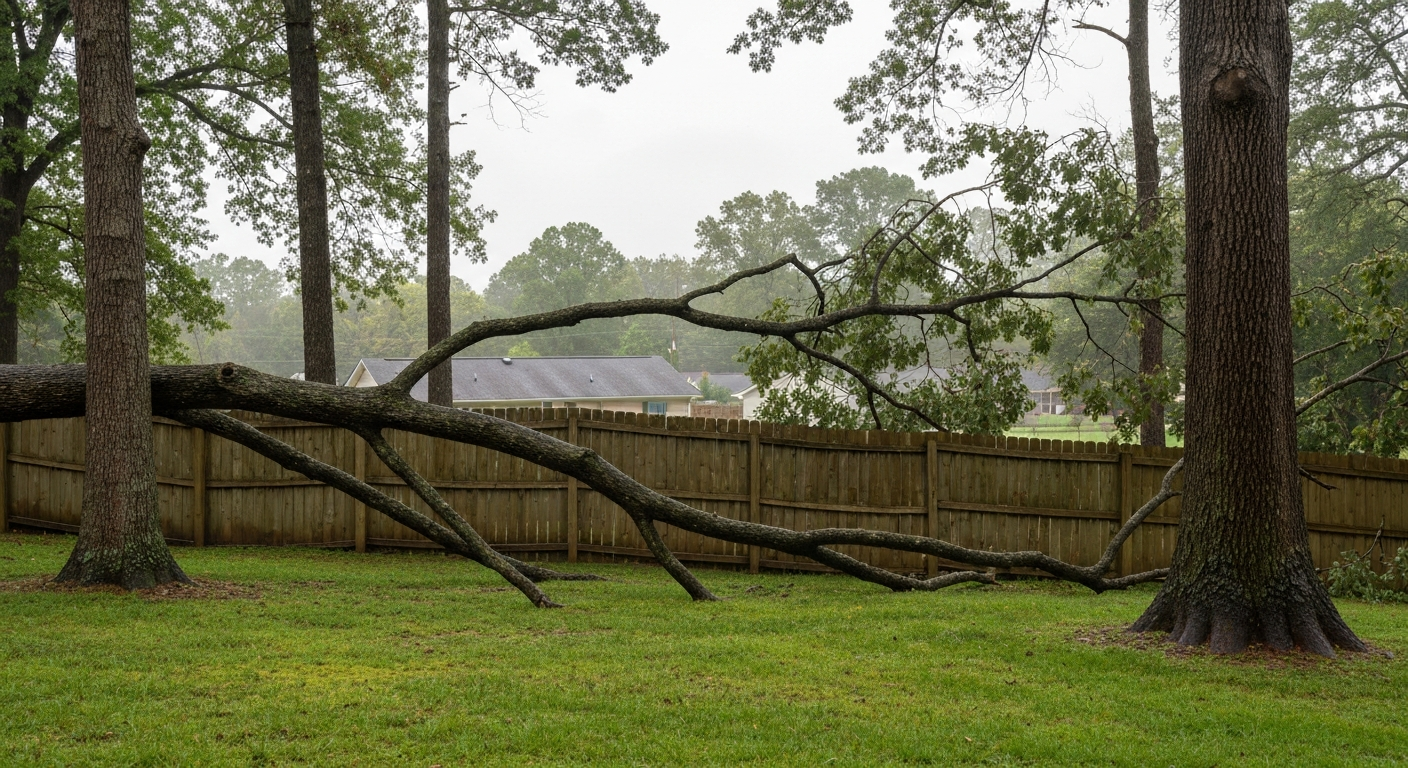
If a neighbor's tree fell on my property in NC, who pays? Most Waxhaw homeowners assume the answer is simple: it was their tree, so it is their bill. North Carolina law does not work that way. Your neighbor is not automatically responsible just because the tree grew on their side of the line. They become responsible when they knew, or reasonably should have known, that the tree was dangerous and left it standing anyway. That single word, notice, decides almost every one of these cases.
There is a second answer that matters more in practice. Whatever the law says about fault, your own homeowners policy is usually what pays, and it pays first. Who is at fault and who writes the check are different questions, and confusing them is why so many neighbors end up in an argument neither of them needed to have.
Why "it was their tree" is not enough in North Carolina
North Carolina applies a common law negligence standard to falling trees, not strict liability. As NC State Extension's agricultural law specialist puts it, the state "does not follow a strict liability standard with an 'it's your tree, you pay' result." The damaged party has to prove the adjoining owner was negligent in letting a dangerous tree remain standing.
That means a healthy tree that comes down in a thunderstorm generally produces no liability for anyone. The NC Disaster Assistance Manual describes this as an act of God, an occurrence due directly and exclusively to natural causes without human intervention. The protection is not absolute, though. That same manual notes that where a defendant's negligence is one of the proximate causes of the damage, the defendant is still responsible even though a natural force also contributed. A storm does not launder away a hazard someone already knew about.
So the real question is never "was there a storm." It is "what did the tree look like before the storm, and who knew."
The case everyone cites, and what it actually held
The controlling North Carolina decision is Rowe v. McGee, 5 N.C. App. 60 (1969), and it is the most misrepresented fact on this subject. Articles cite it as proof that a neighbor has a duty to remove a dangerous tree, and that part is true. In the official reporter text of the opinion, the court held that where landowners knew a tree on their property was decayed and liable to fall on the adjoining property, they had a duty to eliminate the danger and could not place the burden of removing it on their neighbors.
Here is what almost nobody mentions. The homeowners lost. The appeal was brought by the plaintiffs, the people whose house the rotted oak landed on, and the Court of Appeals affirmed the verdict against them in a one word disposition. They recovered nothing.
Contributory negligence is why they lost
The reason is in the record. Eight to twelve months before the tree fell, the plaintiffs had contacted the defendant about the tree's dangerous condition and had received permission to cut it down themselves. They did not do it. By their conduct they led the defendant to believe the tree had already been removed. The jury was allowed to weigh that as contributory negligence, and it did.
North Carolina remains, in the words of the UNC School of Government, "one of a handful of jurisdictions that still follow the contributory negligence rule." Under it, if the plaintiff is even slightly at fault for their damages, they cannot recover from the defendant at all. It is a complete bar, not a reduction. That is why the Rowe outcome is the norm here rather than a fluke.
The practical lesson is not the one most articles draw. It is not "document the hazard so you can sue your neighbor." It is document the hazard and then act on it, because in North Carolina, sitting on a danger you already know about can destroy your own claim.
One note before going further: this article is general information about North Carolina law, not legal advice. These cases turn hard on their specific facts, and if real money is at stake you should talk to a North Carolina attorney about your situation.
Who actually pays when a neighbor's tree falls on your property in NC
Now the question that is actually keeping you up. The North Carolina Department of Insurance answers it directly: generally, if a tree falls on your home or other structure, your own homeowners policy covers the damage. NCDOI adds that a neighbor is not legally liable for an act of nature, and that for the neighbor's insurance to respond, they would have to have known the tree was likely to fall, for example if it was rotten. That is the same notice standard the courts apply, arriving from the insurance side.
So the first call is to your own carrier, not to your neighbor's door.
The removal coverage trap
This is where homeowners get an unpleasant surprise. Damage to the house and removal of the tree are covered differently, and removal coverage is narrow.
| Situation | What the policy typically does |
|---|---|
| Tree damages your house or another structure | Structural damage is covered, subject to your deductible |
| Removing the tree after it hit a structure or blocked the driveway | NCDOI states policies pay reasonable expense up to $500 for any one loss |
| Tree simply falls in your yard, hitting nothing | Removal is generally your cost |
| Removing a hazardous tree before it falls | Not a covered loss, this is maintenance |
The Insurance Information Institute puts the typical industry range at about $500 to $1,000 depending on the insurer and policy type. Either way, anyone who has watched a crew take a mature oak off a roof knows that figure does not cover the job. NCDOI's after-storm claims guidance makes the same point, noting that most companies will pay up to a limit to remove a tree from a damaged structure but will not pay to remove a tree from your yard.
Subrogation, the part that happens without you
If your carrier pays you and believes the neighbor was genuinely negligent, it can pursue the neighbor's insurer to get that money back. The Insurance Information Institute explains this process, called subrogation, and notes that if your insurer succeeds you may be reimbursed for your deductible.
This is not theoretical in North Carolina, and Rowe itself shows it. The homeowners' own carrier appeared in that case as a named co-plaintiff, suing the neighbor as subrogee to recover the $2,900 it had already paid its policyholders. Two insurance companies settling it between themselves is the ordinary path. You usually do not have to run it.
What counts as a warning sign
Because liability turns on what a reasonable owner should have noticed, it helps to know what courts treat as noticeable. NC State Extension lists the facts that point to foreseeability, including but not limited to a tree that is dead or visibly dying, one that leans prominently toward the neighbor, one with limbs extending across the property line or over structures and parked cars, and one that has had a large anchoring root cut.
Those are observable from the ground, which is exactly the point. If you can see them, so can a jury, and so could your neighbor. The same list is what a professional assessment documents in writing, and these are the conditions covered in our guide to hazardous tree removal in Waxhaw.
Rowe also drew a distinction worth knowing in Union County, where subdivision lots sit next to semi rural acreage. The opinion treats the duty to inspect trees growing naturally on rural land as narrower, and it is strongest for a visibly failing tree next to a house in a neighborhood.
Overhanging branches, before anything falls
Most readers arrive at this topic with a live tree, not a fallen one. The accepted rule in North Carolina is that you may trim branches that extend onto your property, at your own expense, but only back to the boundary line. You cannot compel your neighbor to trim, and per the NC Disaster Assistance Manual, the trimming has to be done in a way that will not kill the tree, or your neighbor could pursue you for damages.
Two statutes get quoted loosely on this point, and both are narrower than the blogs suggest. N.C.G.S. § 14-128, the criminal provision, reaches "any person, not being on his own lands," who willfully damages another's trees without consent, a Class 1 misdemeanor. That opening qualifier matters. On the face of the statute, a homeowner standing in their own yard cutting to the line is outside it. The civil statute, N.C.G.S. § 1-539.1, is the one with financial teeth: a person who without permission enters the land of another and injures, cuts or removes valuable wood, timber, shrub or tree is liable for triple the value. Note triple, not double. The multiplier was raised by a 2021 amendment, and plenty of otherwise reliable material has not caught up.
That statute also has an entry element, so like the criminal one it does not cleanly reach cutting done from your own side. The realistic exposure for over pruning and killing a neighbor's tree is ordinary trespass and negligence. Worth knowing too: NC State Extension's analysis of a 2021 Court of Appeals decision involving removed ornamental trees explains that the statutory multiplier is keyed to commercial timber value, and that for trees on personal use property a jury may instead consider replacement and restoration cost, including aesthetic value. A mature specimen tree in a Waxhaw front yard is not a timber case, but replacing one is not cheap either.
If your question is about permits and local rules rather than liability, that is a separate subject, and our guide to the Charlotte tree ordinance covers how removal laws work in the metro.
What to do, in order
- Call your own insurer first. Do not wait for your neighbor to admit anything. Your policy is the one that responds.
- Photograph everything before cleanup, including the failure point on the trunk. Rot, hollowing, and old deadwood are the evidence that establishes what was visible beforehand.
- Budget for removal separately. The $500 sublimit is per loss and only applies if the tree hit a structure or blocked the drive.
- If you are the one who noticed a leaning or dying tree next door, put your notice in writing and date it. A text or email creates a record that the owner knew.
- Then act on your own hazards. If a tree on your side is failing toward someone else, Rowe cuts against you, and delay is the exact fact pattern that sank the homeowners in that case.
- Keep questions about coverage with the regulator. The NC Department of Insurance runs a consumer hotline at 855-408-1212 for claim questions and complaints.
Where we fit in
Clark's Tree Care is a tree service, not a law firm. What we can do is the part that actually changes the outcome: look at the tree and tell you honestly whether it is failing. Nearly every dispute described above traces back to a tree that showed signs long before anyone acted on them.
If you have a tree leaning toward a house, dropping large deadwood, or standing dead on the line between two properties, get eyes on it now rather than after the next storm. We handle tree removal and storm damage cleanup across Waxhaw and Union County. Contact our team for a hazard assessment, or call 980-247-8733 if a tree is already down and you need it cleared.
Citations
- NC State Extension, "Tree Fall Liability: Who Is Responsible for Property Damage?" (April 26, 2022)
- North Carolina Pro Bono Resource Center, "NC Disaster Assistance Manual, Section 3: Falling Trees, Flying Limbs, and Loud Neighbors" (undated, actively maintained)
- North Carolina Court of Appeals, via the Harvard Caselaw Access Project, "Rowe v. McGee, 5 N.C. App. 60, 168 S.E.2d 77" (June 18, 1969)
- UNC School of Government, "Fault Lines: Understanding Negligence Doctrines" (March 21, 2025)
- North Carolina Department of Insurance, "FAQs About Homeowners Insurance" (undated, maintained)
- Insurance Information Institute, "If a tree falls on your house, are you covered?" (undated, maintained)
- North Carolina Department of Insurance, "Claims and Adjuster Information" (undated, maintained)
- North Carolina General Assembly, "G.S. 14-128: Injury to trees, crops, lands, etc., of another" (current code, last amended 1994)
- North Carolina General Assembly, "G.S. 1-539.1: Damages for unlawful cutting, removal or burning of timber" (current code, amended by S.L. 2021-78, s. 5(b))
- NC State Extension, "Utility Easements: Recent Case Considers Aesthetic Value of Removed Trees" (March 2, 2021)