Protecting Trees During Construction: A Guide for Waxhaw and Union County Homeowners
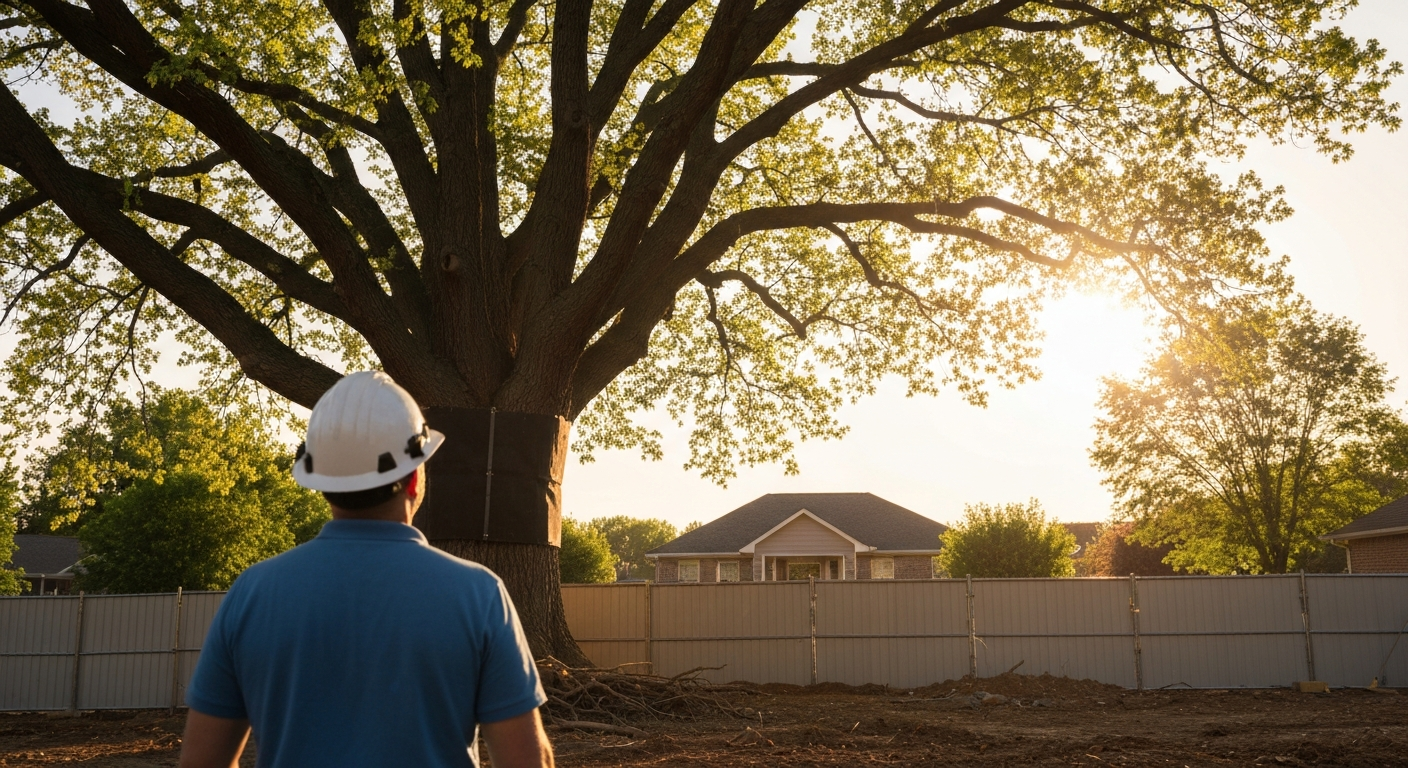
If you are planning a new home, an addition, a driveway, or a pool on a wooded lot in Waxhaw or Union County, protecting trees during construction starts long before the first machine arrives. The single most effective step is to build a fenced tree protection zone around each tree you want to keep, set that fence at or beyond the tree's critical root zone, and keep all digging, traffic, soil storage, and grade changes outside it until the work is finished. Most construction damage to trees is not the obvious hit from a bucket. It comes from crushed and severed roots hidden under the soil, and the decline can take years to show. This guide answers the questions Waxhaw and Union County homeowners and builders ask most about tree preservation, using guidance from arborists, university extension programs, and the national tree-care standards.
The short version
- A tree protection zone is a fenced, off-limits area around a tree that keeps construction activity away from its roots.
- The critical root zone is usually estimated as a circle with a radius of roughly 1 to 1.25 feet for every 1 inch of trunk diameter.
- Install the protective fencing before any clearing, digging, or deliveries begin, and keep it up for the whole project.
- Keep equipment, material and soil storage, foot traffic, trenching, and grade changes out of the zone.
- Construction injury often shows up as delayed decline over several years, so preventing damage matters far more than treating it after the fact.
- There is no single universal radius. A certified arborist can set the right protected area for your specific trees and site.
What is a tree protection zone?
A tree protection zone, sometimes shortened to TPZ, is a defined area around a tree that construction activity is kept out of for the entire project. The recognized United States consensus standard for this work is the ANSI A300 (Part 5) standard, published by the Tree Care Industry Association, which addresses how to establish tree protection zones during site development and how to place protective barriers outside the critical root zone so that equipment, material storage, and traffic stay out of the protected area.
In plain terms, the zone is drawn around the tree's root area, and a physical barrier marks the line. Guidance from the International Society of Arboriculture calls for strong fencing installed around the critical root zone. NC State Extension recommends erecting tall, bright, temporary fencing with "keep out" signs on all sides before clearing, deliveries, and other construction activities begin. The fence is not decorative. It is the physical line that keeps trucks, materials, and foot traffic off the roots for the length of the job.
What is the critical root zone of a tree?
The critical root zone (CRZ) is the area of soil and roots a tree needs to stay healthy. The International Society of Arboriculture defines it as a circle whose radius equals 1 foot for every 1 inch of trunk diameter, measured at 4.5 feet above the ground (a measurement arborists call diameter at breast height, or DBH). The same ISA guidance notes that a common rule of thumb is to compare that circle with the tree's dripline and use whichever gives the larger area.
Authorities do not all use the same number, and that is important. NC State Extension recommends a slightly larger protected area of at least 1.25 feet of radius for each inch of trunk diameter, so a 12-inch-diameter tree needs a protected circle of about a 15-foot radius. The table below shows how the two common formulas compare.
| Trunk diameter (DBH) | ISA baseline (1.0 ft radius per inch) | NC State (1.25 ft radius per inch) |
|---|---|---|
| 6 inches | 6 feet | 7.5 feet |
| 12 inches | 12 feet | 15 feet |
| 18 inches | 18 feet | 22.5 feet |
| 24 inches | 24 feet | 30 feet |
| 36 inches | 36 feet | 45 feet |
Because the figures differ and every tree is different, treat these numbers as a floor, not a guarantee. Larger, older, and less tolerant trees need more room, and a certified arborist can measure your trees and mark the real zone for your site.
How close can you build or dig near a tree?
As a starting point, keep construction outside the protected root area described above, meaning at least 1.25 feet of radius for each inch of trunk diameter per NC State Extension. Digging is especially risky because it severs roots you cannot see. According to the Minnesota Department of Natural Resources, more than 90 percent of a tree's roots sit in the top three feet of soil, and roots commonly extend two to three times the tree's height beyond the trunk. In other words, the roots reach far past where most people expect, so a trench that looks "well clear" of the trunk can still cut through vital roots.
NC State Extension advises never trenching within 3 times the trunk diameter, and preferably never within 5 times the trunk diameter. Grade changes matter just as much as digging. The Minnesota DNR notes that lowering the grade by more than 2 inches over the root zone damages roots, and NC State warns that both cutting and filling soil around roots will weaken and eventually kill valuable trees. If a utility line, driveway, or foundation must pass near a tree you want to keep, route it around the protected zone where you can, and ask an arborist whether boring or tunneling under the roots is an option rather than open trenching.
How do I protect my trees during construction?
The Arbor Day Foundation identifies three of the most common causes of tree damage or death during construction: cutting into roots, compacting the soil over roots, and changing the ground level around the tree. A good protection plan is really a plan to prevent those three things. Here is a practical sequence for a Waxhaw home or addition:
- Decide which trees to keep before the design is final. It is far easier to shift a driveway, a utility run, or the corner of an addition on paper than to save a tree after the footprint is set.
- Bring in an ISA Certified Arborist early. A certified or consulting arborist can assess each tree's health and species tolerance and mark the correct protection zone for your specific site.
- Fence the critical root zone before any ground is disturbed. NC State Extension recommends tall, brightly colored temporary fencing with keep-out signs, installed before clearing and deliveries, and the Arbor Day Foundation likewise recommends brightly colored or flagged fencing so crews can clearly see the zones to stay out of.
- Keep everything out of the fence. The ANSI A300 tree protection zone concept means no equipment operation, no material or soil storage, no vehicle parking, no concrete washout, and no foot traffic inside the barrier for the length of the project.
- Avoid trenching and grade changes inside the zone. Route utilities around it, and do not cut or fill soil over the roots.
- Reduce compaction where access is unavoidable. Soil compaction is one of the most common construction injuries, so if a path across a root area truly cannot be avoided, arborists often recommend spreading the load with a thick mulch layer or ground protection mats to limit the pressure on the soil.
The theme across all six steps is the same. The roots are the vulnerable part, they extend well past the trunk, and once the soil over them is compacted or cut, there is no easy fix. Prevention is the whole game.
Can construction damage kill a tree?
It can, but usually not right away, and not as a certainty. This is the part homeowners most often miss. According to the University of Georgia Extension, tree decline from soil compaction may take three to seven years to appear, and construction-damaged trees commonly die within five to seven years, often several years after the building contractor is long gone. The Minnesota DNR similarly reports that damage symptoms are more likely to take years than weeks to show, and that a tree can die about five years after the original damage. Because that gap is so long, people rarely connect a struggling tree back to the construction that caused it.
At the same time, construction near a tree is not an automatic death sentence. The Minnesota DNR notes that a tree can lose roughly 20 percent of its root system before it shows signs of injury, while losing about 40 percent will probably kill it. Survival depends on the species, the tree's age and health, and how much of the root zone is actually disturbed. The honest framing is that the risk of decline rises with the extent of root and soil disturbance, rather than being all or nothing. That is exactly why a protection plan is worth the effort, and why prevention is far more reliable than trying to rescue a tree that is already declining.
A homeowner's checklist for protecting trees during construction in Waxhaw and Union County
Union County and Waxhaw are among the fastest-growing parts of North Carolina, and new construction beside established trees is a common sight. If keeping mature trees is a priority, protecting trees during construction comes down to a few local steps on top of the fencing and root-zone rules above.
North Carolina law gives local governments a role here. According to NC State Extension's guide for North Carolina municipalities and counties, counties and municipalities in the state may require tree protection plans that preserve trees before, during, and for two years after construction, may require those plans to diagram the critical root zones of protected trees, and may deny site plans or building permits for up to three years where protected trees are improperly removed. Before you build, it is worth checking with Union County Planning and Development about any local tree-protection requirements for your parcel, and having a certified arborist prepare or certify the tree protection plan.
If you are weighing your options for tree care in Waxhaw and the surrounding Union County area, an arborist assessment before construction is the highest-value visit you can schedule. And if a tree is already too damaged or unstable to save, professional tree removal is safer than leaving a declining tree standing near your home.
Talk to a local arborist before you build
Have questions about a specific tree on your property or want a protection plan before your project starts? Every tree and site is different, and a site-specific look from a certified arborist is the best way to know how close is too close. Prefer to speak with a member of our team? Give us a call at 980-247-8733. Contact Clark's Tree Care to set up a consultation for your Waxhaw or Union County property. We look forward to hearing from you.
Citations
- Tree Care Industry Association. "ANSI A300 (Part 5)-2019: Management of Trees During Site Planning, Site Development, and Construction" (2019 edition, maintained consensus standard)
- International Society of Arboriculture (Rocky Mountain Chapter). "Protecting Trees From Damage" (accessed 2026)
- NC State Extension. "Construction and Tree Protection" (updated May 28, 2024)
- Minnesota Department of Natural Resources. "Construction damage: causes and remedies" (maintained state reference, accessed 2026)
- Arbor Day Foundation. "Saving Trees During Construction" (maintained reference, accessed 2026)
- University of Georgia Extension. "Construction Damage to Trees" (March 4, 2024)
- NC State Extension. "Protecting and Retaining Trees: A Guide for Municipalities and Counties in North Carolina" (updated May 28, 2024)