sapsucker holes on a tree trunk, not bark beetles
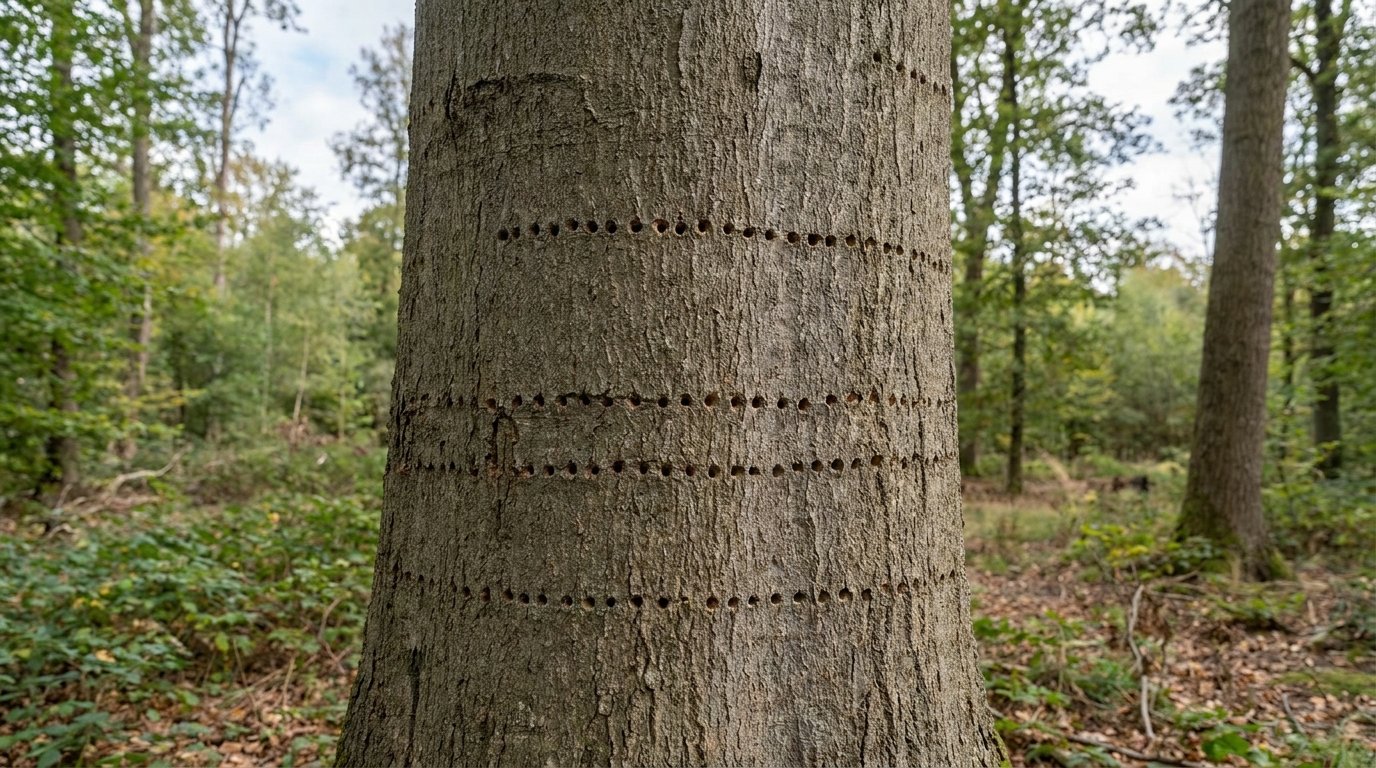
Those straight rows of small holes are sapsucker holes on a tree trunk, made by a yellow-bellied sapsucker, not by a bark beetle. The bird drills sap wells, drinks from them, and usually sets the holes in even horizontal rows, often in several parallel bands [1]. One round hole can look like a wood-borer's exit. A line of evenly spaced holes is the bird [1]. Ips engravers and southern pine beetles leave pitch tubes, boring dust, and galleries under pine bark. Emerald ash borer leaves small D-shaped exits on ash, not a tidy grid on the nearest trunk [5][6]. Most trees live with light feeding. Rows that ring the trunk, or a crown that is dying rather than just dropping fall leaves, are the cases to look at harder [1][3].
The rows are sap wells, not beetle holes
Look at the spacing before you name an insect. Holes about a quarter-inch across, set close together in neat lines, are sapsucker feeding [2][8]. A North Carolina Cooperative Extension note calls the yellow-bellied sapsucker the woodpecker that pecks horizontal quarter-inch holes, tight and uniform, along limbs and trunks [2]. University of Maryland Extension describes numerous rows about one-quarter to three-eighths of an inch, including on trees that are still healthy [3]. A Pacific Northwest Extension handbook by a Washington State University Extension forester notes that this species is the sapsucker native to the eastern United States, and that the holes run in horizontal and vertical rows [8].
The bird is after sap, not a larva under the bark [1][8]. Mississippi State University Extension calls the holes sap wells. The sapsucker returns and laps the sap with a brush-tipped tongue, and it may also take trapped insects, inner bark, and cambium [1][2]. Deeper, rounder wells tap sugars moving up through the wood, while shallower, often square wells tap sugars moving down the inner bark, and the bird keeps those open so the tree does not seal them [1][4].
Insect exits are scattered. Sapsucker holes are organized [4][8]. Bark-beetle and borer holes are typically fewer, smaller, and random, and they may show boring dust, called frass, in the hole or on the ground. Sapsucker holes do not [8]. The one look-alike is a single well about the width of a pencil, much like a wood-borer's emergence hole. Evenly spaced holes in a line are still the sapsucker [1].
The rows get blamed on whatever pest is in the news because the bird uses so many trees. A 2021 North Carolina Cooperative Extension note reports that sapsuckers may attack more than 250 species of woody plants, including maple, pine, elm, apple, and dogwood [2]. Ohio State, in a bulletin published on May 2, 2026, says the scientific literature puts sap wells on more than 250 trees, shrubs, and vines, both deciduous and evergreen [4].
Why they show up as the canopy thins in fall
Around Waxhaw and the rest of the Union County Piedmont, fall is when the holes seem to appear overnight. Leaves drop, bark is easy to see from the driveway, and this bird is a cold-season visitor here, not one that nests in the yard maple. Ohio State calls it the only woodpecker in the eastern United States that is completely migratory. It nests across Canada and the New England states, and it winters from the southern and south-central United States south through Central America and the West Indies [4]. Mississippi State, writing about the South, says the birds do not breed there. They come south for the winter, numbers peak in spring and fall, and sap is an important food in winter and spring [1]. From Waxhaw toward Indian Land and Fort Mill, some rows are fresh wells. Some are old scars that only look new because the foliage is gone.
A thinner crown in fall is not proof the holes are killing the tree. Hardwoods are supposed to look open once the leaves drop, and most trees tolerate repeated feeding with little long-term loss of growth or vigor [1]. On a walk-through we check whether the twigs are alive, and whether the bark shows only clean holes or also sawdust, popcorn-like pitch, or pale flecks of missing bark. Fresh wells may still weep, and older rows are dry scars. Birds add holes near older work, so both can show on the same stem [1][4].
Ips and southern pine beetle are a different picture
Ips engravers and the southern pine beetle feed in the inner bark of southern pines. They do not leave a ruler-straight grid of open wells. NC State Extension groups the common pine attackers as the southern pine beetle, three Ips engravers, and the black turpentine beetle [5].
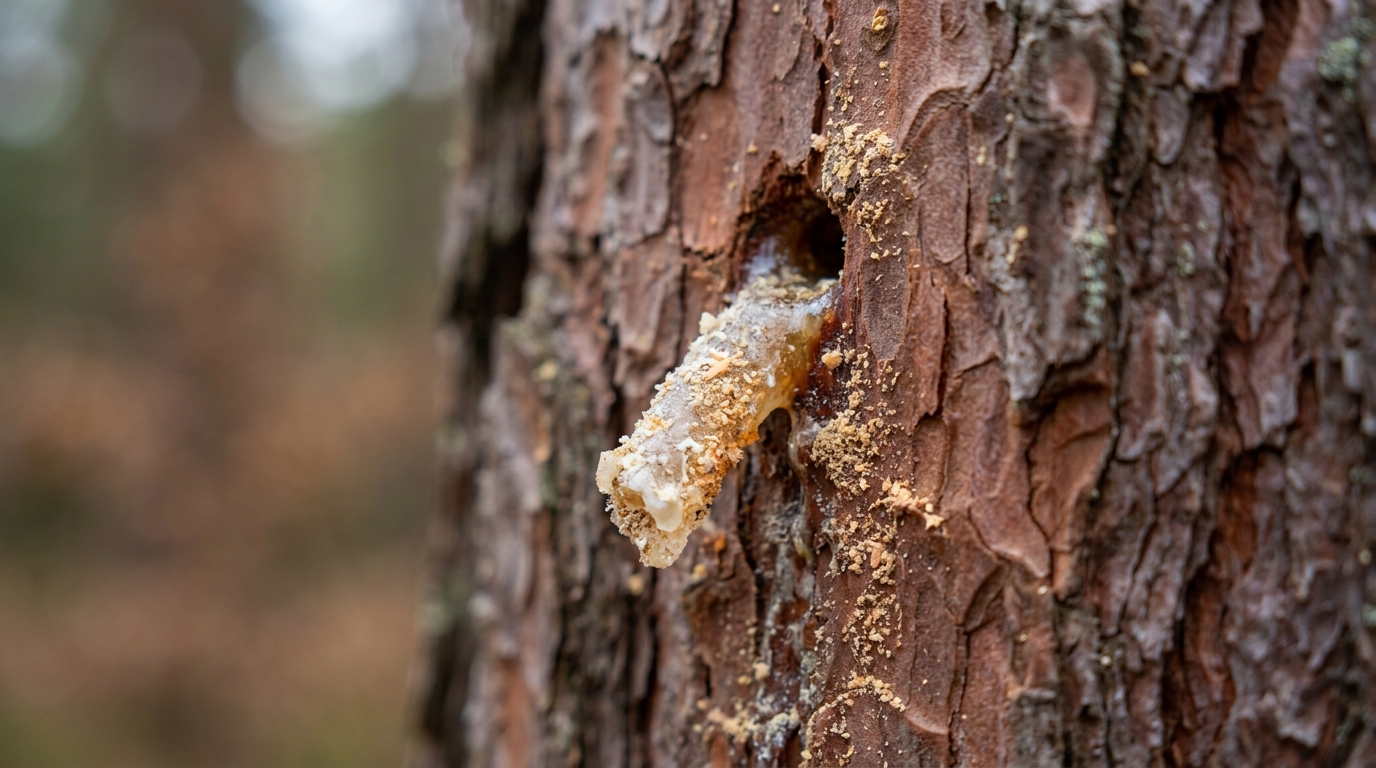
When a pine can still fight, beetles often produce a pitch tube, dried resin with a popcorn look where the beetle bores in [5]. A badly stressed pine may not make pitch tubes, so a clean trunk is not a full all-clear, but those tubes are not open wells in parallel lines [5]. The galleries that name the beetle show up only under loose or cut bark. Southern pine beetle galleries wander in an S shape. Ips galleries run with the grain in shapes like an I, a Y, an X, or an H [5]. Needles on a beetle-killed pine fade from green to yellow to red, which is a dying crown, not normal fall color on a hardwood [5]. Ips mostly hits pines that are already stressed, often as scattered trees, and it can work in the top [5]. Southern pine beetle is the one that, in outbreak years, kills adjacent pines in a spot [5]. A pine with only clean rows, green needles, and no pitch or boring dust is not a bark-beetle attack [5][8].
Emerald ash borer is a different picture too
Emerald ash borer is an ash insect. Neat rows on a maple, oak, elm, dogwood, pine, or any non-ash are not that beetle [6]. NC State Extension limits the main hosts to North American ash, including green, white, Carolina, and pumpkin ash in this state. White fringetree is a less common secondary host. Mountain-ash is not a true ash and is not susceptible [6].
On a true ash, the signs still do not match sap wells. Adults leave D-shaped exit holes about one-eighth of an inch across, not round or square wells in parallel lines [6]. Larvae make serpentine galleries under the bark, the bark may split vertically, and attacks often start high, so eye-level holes can be missing for years [6]. Woodpeckers on an infested ash usually fleck the bark, chipping pale patches to reach larvae, which is hunting a borer rather than keeping a sap well open [6]. Canopy thinning, branch dieback, and sprouts on the trunk are the decline NC State ties to this insect. Once those symptoms show, the tree has often already been infested for a year or two, and death typically comes within five years of the initial infestation [6].
When the tree can live with the damage
Most of the time, it can. Mississippi State says most trees tolerate repeated feeding with little long-term harm to growth or vigor [1]. A 2021 North Carolina Cooperative Extension note says trees usually recover from minor damage [2]. Limited damage is not proof of an insect infestation, and the birds do drill rows in healthy trees, including ornamentals and fruit trees, to reach sap and trapped insects [3][8].
There is a limit. Unusually heavy, repeated feeding can cut vigor and can kill a tree [1]. Continued pecking can enlarge wounds, strip bark, and occasionally girdle a limb or the trunk [3]. Excessive holes also let in insects and decay fungi, and that secondary damage can make recovery unlikely [2][8]. Sap running down the bark can feed sooty mold and blacken the trunk. That stain is mostly unsightly, and on sugar maple it is tied to sap leaking from the wells, not to the wood already being dead [1][4].
Heavy feeding often hits one tree and skips the same species beside it. Ohio State reports that research points to stressed trees, and to sap high in sugar, as what the birds choose [4]. A study published in 1974 linked heavy feeding to crown dieback, but later research found the birds selecting trees that were already stressed or damaged, so the sapsucker is not always the first injury [4].
A few bands on one side, with a crown thin only because the leaves fell, can stay [1][2]. Rows that meet around the trunk or a main limb, or a lattice on a young maple, dogwood, or fruit tree, are the girdling cases to inspect before the next season [2][3]. Thin-barked trees such as birch are easier targets than an older pine with thick ridged bark [8].
What to do while the birds are here
Do not shoot them, trap them, or poison the holes. U.S. Fish and Wildlife Service guidance published in 2022 states that the Migratory Bird Treaty Act, in place since 1918, protects woodpeckers, and that sapsuckers drill small holes for sap [7]. Lethal control is not allowed without a special permit [1]. A permit comes only after nonlethal methods have failed, and the Service describes that path for cases such as structural damage, not for holes in yard bark [7].
Loose burlap, bird netting, plastic mesh, or quarter-inch hardware cloth over the drilled area can stop new holes [1][3][7]. A study published in 2007 showed that wrapping sugar maple stems with burlap prevented damage, though Ohio State notes this fix is impractical on a large tree [4]. Keep the material loose, and take it off once feeding passes. A wrap left up too long can hurt the tree more than the bird did [1][2].
Skip sticky gels. The Fish and Wildlife Service warns that tactile deterrents can impair flight and make it harder for a bird to stay warm [7]. Shiny tape and owl decoys are sometimes hung as deterrents [2]. They can move the feeding onto more trees, so one tree that is taking the hits can stay as a feeding spot [3][8].
Water a tree that gets worked every year, especially in a dry stretch. Keeping it properly watered and fertilized helps recovery [1]. If the fresh holes are above arm's reach, leave them. Call us when deadwood hangs over a roof, a drive, or a walkway, or when the rows have ringed the stem and the crown is failing.
Practical takeaways
- Even rows of small holes are sapsucker sap wells. Random holes, pitch tubes, boring dust, and galleries under the bark point to insects [1][5][8].
- In the Piedmont the bird is a migrant and winter visitor, so bare fall trunks from Waxhaw across Union County show both new wells and old scars [1][4].
- Most trees live with light or moderate rows. Look harder when holes ring a trunk or limb, the crown is truly dying back, or insects and decay are using the wounds [1][2][3].
- Pine bark beetles and emerald ash borer do not make this pattern. Fading pines with pitch tubes, or an ash with D-shaped exits and flecked bark, are separate problems [5][6].
- The birds are federally protected. A temporary loose wrap can shield a valuable trunk if you remove it promptly, and sticky repellents are a bad idea [1][7].
How we can help
Have more questions or want to get in touch? If a trunk is ringed with fresh holes, or you are not sure whether you are looking at a sapsucker, a fading pine, or an ash in trouble, our team can walk the tree and say which one it is. We will tell you when the right move is to leave a lightly tapped tree alone, and we handle the deadwood or the removal when the tree itself is the hazard. Reach us through our contact page and we will set a time to look.
Citations
- Mississippi State University Extension, "Yellow-bellied Sapsuckers, Vol. 10, No. 05" (2024)
- N.C. Cooperative Extension, Surry County Center, "Yellow-Bellied Sapsucker Damage" (2021-04-09)
- University of Maryland Extension, "Woodpecker and Sapsucker Damage on Trees" (2023-12-13)
- Ohio State University Extension, BYGL, "Rows of Holes in Tree Bark" (2026-05-02)
- NC State Extension, "Pine Bark Beetles" (2022-08-04)
- NC State Extension, "Emerald Ash Borer" (reviewed 2025-10-30)
- U.S. Fish and Wildlife Service, "Woodpeckers and your home" (2022-03-22)
- Pacific Northwest Plant Disease Management Handbook, "Recognizing Sapsucker Damage on your Trees" (revised 2023-03)