English ivy on tree trunks: Cut It at the Base
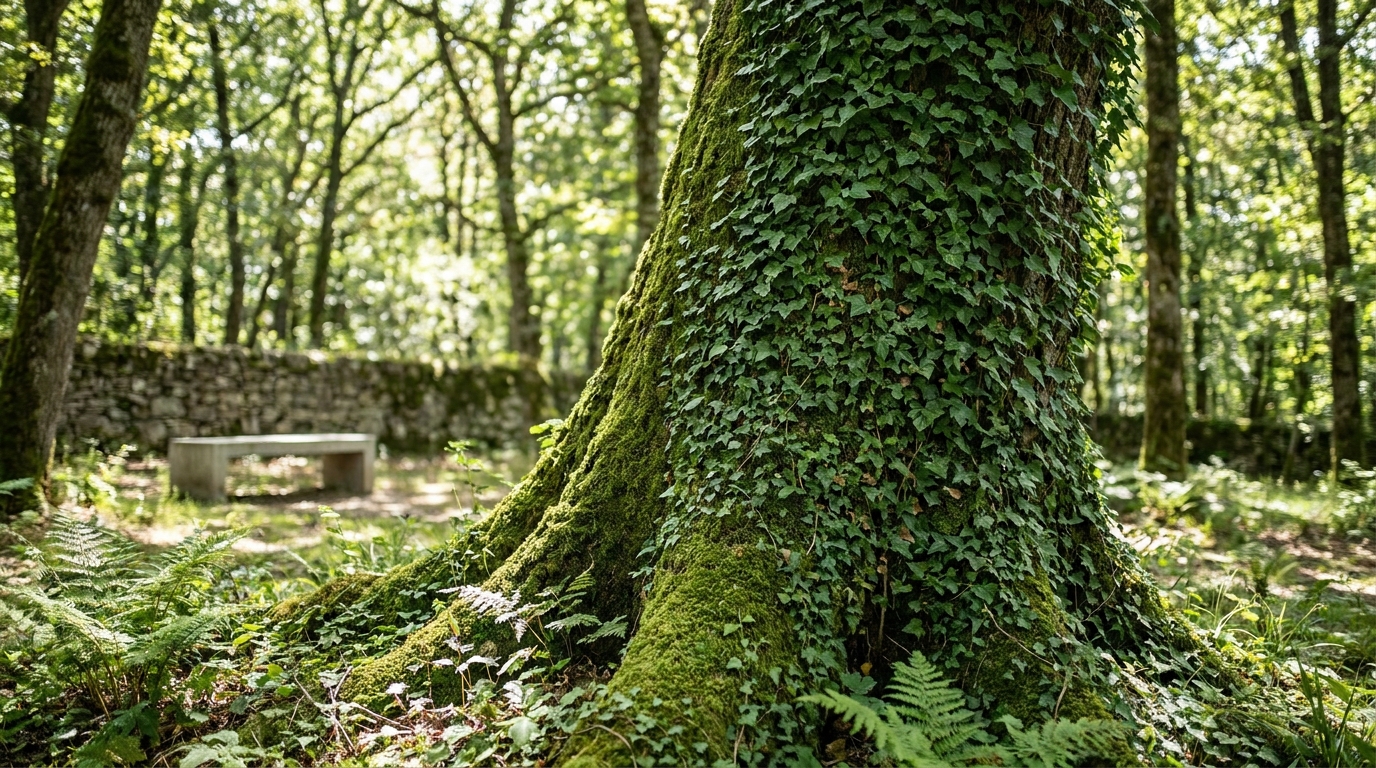
Cut English ivy on tree trunks at the base, and leave the vines above the cut to die on the bark. Do not rip them off. The N.C. Cooperative Extension office in Union County says a vine that reaches the canopy shades the tree's own leaves, adds weight that breaks limbs in wind, and hides structural defects you cannot see [1]. The upper growth dies once it is separated from the soil, and the useful time to inspect the trunk is after that cover loosens [1][5].
Why it shows up on hardwoods around Waxhaw
Winter is when most of us notice it. The hardwoods are bare, and the evergreen vine is easy to see on the trunks [1]. That vine is English ivy, Hedera helix, a shade-tolerant woody perennial planted as a groundcover that, left unchecked, climbs into trees [2]. It sticks to bark with root-like holdfasts rather than twining around the trunk [3].
Young stems creep and climb. Mature stems change. University of Maryland Extension, on a page updated in July 2026, says older growth branches outward, looks bushy on a trunk, and only then flowers and sets fruit [3]. Birds eat the berries and move the seed [3][4]. The same page notes growth of several feet per year, and climbing stems that can easily reach 60 feet or more on a tall tree [3]. That is enough to carry a shaded bed of ivy into the crown of a Waxhaw hardwood.
The Union County Center said it plainly in February 2023: get English ivy off your trees before it is too late [1].
What a heavy vine does to the tree
English ivy hurts a tree in three ways that stack. It shades the foliage, it keeps the bark wet and hidden, and it hangs extra weight where the wind can use it [1][3].
When the vine reaches the canopy, it grows along the branches and shades the tree's own leaves, and the Union County Center says that shading can kill entire large limbs [1]. Penn State Extension, on a page updated in September 2025, says unchecked ivy covers the foliage and kills the branches [4].
The trunk takes a different hit. A thick sleeve of evergreen growth smothers the bark and shades that surface all year [3]. University of Maryland Extension says climbing vines cause damage and death by loosening the bark and holding moisture against the trunk, which sets up fungal disease and decay [3]. Piedmont Master Gardeners, in a February 2025 article on ivy in trees, say the vines trap moisture close to the bark and cause the bark to rot [5].
You also cannot see the defects. In its February 2023 note, the Union County Center says ivy obscures the trunk and the branches, so a structural defect stays hidden until it is too late [1]. Penn State Extension says ivy grown against trunks gives voles and mice a hiding place where they feed on bark undisturbed [4]. An Ask Extension answer from November 2024 adds that clinging ivy can damage bark by itself, and that the leaves reduce the light reaching the tree's foliage [6].
The wind problem is weight plus a leafy surface. The vine adds a significant amount of extra weight, and the Union County Center says limbs break more often in wind because of it [1]. University of Maryland Extension says that weight leaves trees more likely to fall or break under wind, snow, and ice, and Penn State Extension ties the same load to limb breakage or complete failure [3][4]. English ivy is evergreen, so the leaves stay on when the hardwood is bare [3]. That winter surface is extra sail, and ice and snow collect on those leaves [3]. Piedmont Master Gardeners call the tree top-heavy and likely to break, and they point to one that snapped in an ice storm [5].
The Union County Center said in 2023 that English ivy in a large tree close to a home greatly increases the risk to that home [1]. Stopping the vine does not undo rot that is already in the wood.
Do not rip the vine off the bark
Pulling is the wrong move on a living trunk. The holdfasts are stuck to the bark, and a hard yank can peel bark off with the vine [3][5]. Piedmont Master Gardeners say it is not necessary, and not desirable, to pull the vines down, because ripping them can damage the bark and can bring branches down on the person below [5].
A saw can do the same harm. NC State Extension's fact sheet, revised in April 2024, shows ivy stems cut along with the tree's bark, and the caption says the upper vines will die but the tree must not be damaged [2]. If the blade will not fit without cutting wood, move the cut [5].
The Union County Center was just as direct in February 2023: if you try to rip the vines down, you will probably snap limbs, and even after they dry and turn brittle it may be best to leave them [1]. Ask Extension's November 2024 answer says the same thing: cut the stems at the base, remove what you can reach, and do not pull ivy out of the branches [6]. The ivy higher up dies, dries, and falls out over time [6].
How to sever it at the base
Work from the ground, only as high as you can safely reach, and do not climb into the crown to kill the vine [1][5].
Find every stem. Ivy hides in bark furrows, and one missed stem keeps the top alive [5]. If a vine sits so deep that cutting it would cut the tree, follow it down and cut where the blade stays on the vine [5].
Make two cuts on each vine, one about 1 or 2 feet up and one close to the base, so the ends cannot grow back together [5]. Remove only the short piece between the cuts, and only if it comes free without tearing bark [5]. Do not leave that piece on bare soil. English ivy can root from cut vines or stems [4].
NC State Extension, in a fact sheet revised in April 2024, says ivy on a tree can be killed by cutting the stems at the ground and taking off only what you can easily reach, then leaving the rest to die and fall [2]. If the piece between your cuts is glued on hard, the base cut is enough. Forcing it off peels living bark [5]. Use hand pruners on small stems and a handsaw on thick ones, and keep the teeth on the vine [5][2].
Leave everything above the upper cut. Those stems cannot resprout roots or reattach once they are separated from the soil [1]. English ivy is not an epiphyte, so it cannot live on the tree without that ground connection [5]. In its February 2023 note, the Union County Center says the leaves brown and drop within a couple of months, the woody vines dry and lose weight in that same stretch, and the brittle stems drop over a couple of years [1]. Piedmont Master Gardeners say the vines can brown in a few weeks and fall in a year or two, slowed by a waxy leaf coating [5]. If the top stays green, you missed a stem [5]. Cut it. Do not pull.
Wear long pants, a long-sleeve shirt, gloves, and eye protection. English ivy sap can cause a rash even if poison ivy does not bother you, and poison ivy sometimes grows in the same mat [5].
If you use a herbicide, keep it on the root-side stump, not on the trunk. Piedmont Master Gardeners describe a labeled dab on the fresh cut still attached to the roots, put on right away and kept off the tree [5].
After the cover dies, look at the trunk
Dead ivy is not a finished job. The stems still hide the bark until they drop, which can take a year or two [1][5]. The weight comes off sooner. In the February 2023 Union County note, drying vines lose weight within a couple of months, which eases the limbs [1]. Lift only what releases without a fight. If it still holds, leave it, because pulling dry vine off a high limb is how branches come down [1][5].
Once you can see bark, look for the structural defect the ivy was hiding [1]. A crack, a cavity, loose bark, or a dead limb is reason enough to have someone stand at the trunk with you. Branches the vine killed by covering the foliage stay a separate problem, and a dead limb over a roof, a drive, or a walk should not wait on the last strand to fall [1][4].
If the tree is leaning, split, or already dropping large wood, cutting ivy is not the emergency step. Deal with the failing tree first. Our crew takes emergency calls around the clock when a tree is on a structure or a limb is hanging where it can hit something. The ivy cut is the slower ground job, so the next wind has less sail, less weight, and less hidden decay to work with [1][3].
Keep the carpet from climbing back
Cutting the climbers does not kill the mat on the ground. There, English ivy crowds out other plants and competes with the tree's roots for moisture and nutrients [1]. It spreads by runners and by seed, and it flowers and makes that seed when it grows vertically, so cutting the upright stems slows the next berry crop [3][5].
Regrowth is expected. NC State Extension says this woody perennial returns from small stem pieces and from seed, so you have to come back and pull new plants [2]. Penn State Extension says hand-pulling or mowing is the start, and that young regrowth is easier to manage than old waxy leaves [4]. Mowing only helps if it is frequent, like a lawn, and if it covers the whole patch [2].
Clear a ring a few feet out from the trunk so a new shoot is not already on the bark [5]. The roots are shallow and come up more easily from moist ground [5]. Keep pulled stems off the soil so a cut piece cannot root against the flare [4][5]. University of Maryland Extension says not to plant English ivy, and to replace what you have when you can [3].
Practical takeaways
- Cut English ivy on tree trunks at the ground, and make a second cut about 1 or 2 feet up so the ends cannot rejoin [5].
- Remove only the short piece between those cuts, and only if the bark stays intact [2][5].
- Do not rip vines out of the crown. They die without soil, brown out over a few weeks to a couple of months, and drop over a year or two [1][5][6].
- The vine shades limbs, holds moisture on the bark, hides defects, and adds evergreen weight that breaks branches in wind, snow, and ice [1][3][4][5].
- Clear a few feet of ground ivy around the trunk, keep cut stems from rooting, and come back for resprouts [2][4][5].
- After the cover loosens, have the trunk and any dead limbs looked at before the next storm [1].
How we can help
Have more questions or want to get in touch? If a hardwood on your Waxhaw or Union County property is sleeved in English ivy, we can look at the trunk once the vine is cut, or sooner if the tree is already cracking, leaning, or dropping limbs. Dead wood over a house is a tree job. Our team handles trimming, removal, and around-the-clock emergency calls when a tree is failing. Start with our contact page.
Citations
- N.C. Cooperative Extension, Union County Center, "English Ivy" (2023-02-14)
- NC State Extension Publications, "Controlling English Ivy in Urban Landscapes" (reviewed 2024-04-04)
- University of Maryland Extension, "English Ivy" (updated 2026-07-15)
- Penn State Extension, "English Ivy in the Landscape" (updated 2025-09-11)
- Piedmont Master Gardeners, "How to remove English ivy from trees" (2025-02)
- Ask Extension, "Tree with Ivy" (2024-11-21)