Bagworms on Leyland Cypress: October Bags Hold Eggs
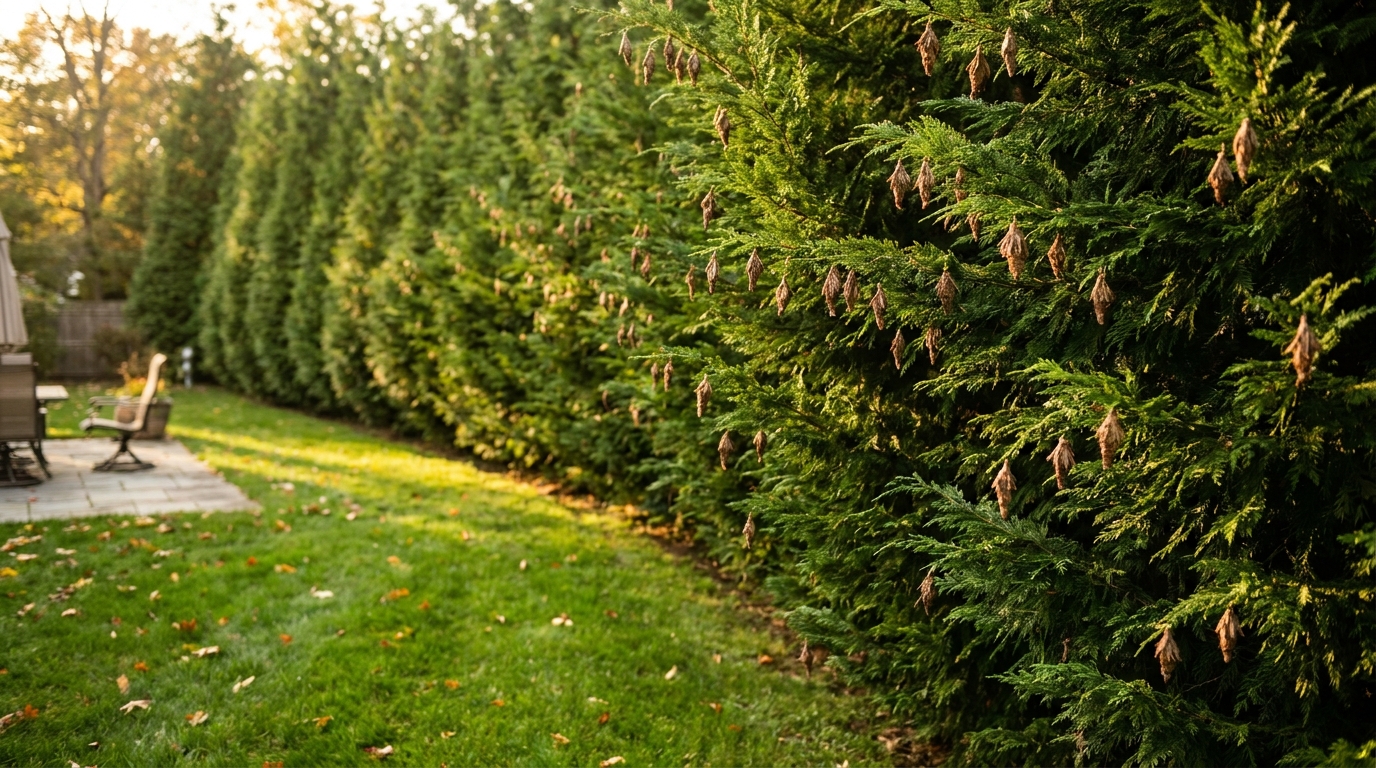
Those brown, pinecone-shaped bags on a Leyland cypress in October are bagworms, not seed cones and not the silky nests of fall webworm. By the time the bags are easy to see, the caterpillars have usually finished feeding, and the cases are holding the eggs that will hatch next spring. [1][2] An October spray mostly hits silk and eggs. It misses the chewing stage. If you are dealing with bagworms on Leyland cypress right now, the useful work is to cut the bags off and to decide which branches still have live green growth.
What those brown bags are
The insect is the evergreen bagworm, Thyridopteryx ephemeraeformis. It is common across North Carolina, and it favors the plants people use for a screen: Leyland cypress, arborvitae, cedar, juniper, and pine. [1] Clemson's 2026 Leyland cypress pest sheet lists the same insect as a defoliator of Leyland cypress in South Carolina, and it notes that people often mistake the bags for cones. [3] We see that mix on hedges around Waxhaw and the rest of Union County. A row that looked solid in June can look spotted and brown once the bags hang down in fall.
The bag is a camouflage case the caterpillar builds while it eats. NC State describes the size range as about 1/4 inch when the worm is young to more than 2 inches when it is full grown, with bits of the host plant stuck to the silk. [1] The caterpillar stays inside. You may only see the head poke out while it feeds. [6]
There is one generation a year. [8] Females never grow wings and never leave the bag. Males are small brown moths. They leave their own bags, find the females, and mate through an opening in the case. The female then lays her eggs inside the pupal skin in her bag and dies. [1] NC State and Clemson both put that clutch at 500 to 1,000 eggs. [1][3] A 2026 University of Georgia circular gives a slightly wider range, about 300 to 1,000. [8] The eggs stay in the bag through winter. In North Carolina, NC State puts hatch in May and June. [1] Clemson, writing for South Carolina, says larvae hatch in May. [3] These notes do not give Union County its own hatch date. Think late spring, not October, and let the plants tell you when the tiny new bags appear.
Young larvae do not all stay where they hatched. Many spin a silk thread and ride the wind to a new host. Extension writers call that ballooning. [1][8] That is how a clean arborvitae down the row picks up bagworms even though the adult female cannot fly. Damage is often clumped. NC State gives the example of only four or five trees infested in a hedge of 50. [1] Eggs left on the plants all winter are what fuel that spread the next spring.
Feeding is the only stage that hurts the foliage. Young larvae scrape needle surfaces. Older larvae eat whole needles, and they eat much more as they grow, which is why a hedge can look fine in early summer and ragged by August. [1][2] Kentucky extension notes that feeding often starts at the top and that heavy feeding can bronze an evergreen. [6] Caterpillars mature and pupate in August, tied to a twig with a silk band. Adults emerge during August and September. [1][3] A 2021 Clemson garden note puts a finer point on the edge of the season: feeding is finished by late August, and the moth stage shows up in early October. [11] October in the Piedmont is egg-bag season. A male moth may still be flying early in the month. The brown bag on the twig is not a caterpillar chewing needles anymore.
Why an October spray usually misses
The damage is obvious in fall. The insect you would spray for is already done eating.
NC State's residential guidance, revised in July 2026, says that if you first notice bagworms in late summer, it is too late to do anything but physically remove the bags. By then they have mated, and the females have laid next year's eggs. [1] Franklin County's February 2026 note says it is too late to spray in the fall once the bags are formed, and that the insecticide window is late May and June. [4] Wayne County wrote in August 2025 that sprays need to go on in June or early July, while the worms are small, or they will not get through the bag. [5]
Two problems stack up in October.
First, the insect is no longer a feeding caterpillar. Bt (Bacillus thuringiensis subsp. kurstaki) has to be eaten to work. [2][7] Kansas State said in June 2025 to apply Bt or spinosad when bagworms are 1/4 inch long or less, and to repeat sprays while hatch is staggered. [7] Clemson's 2026 Leyland sheet says Bt works best on young larvae, usually in May, and that control falls off once bags reach about 3/4 inch. [3] A finished bag is often around 2 inches. [1]
Second, the bag blocks contact sprays. NC State notes that contact insecticides may fail because the caterpillar lives inside a waterproof bag. [1] Clemson's 2026 pest management sheet says egg cases are hard to penetrate, and that a useful spray, if you make one, goes on before bags are tied off and while larvae are eating. On that seasonal table, Bt belongs in late spring. Fall and winter are for hand removal. [2]
A November 2023 revision of NC State's Leyland cypress pest calendar marks bagworm sprays from May through September and leaves October blank. The dates are approximate. [9] That chart does not mean a late spray on full-sized bags works like a May spray on tiny larvae. The July 2026 insect note is the clearer match for what we find on hedges: once you notice the bags in late summer, pick them off. [1]
We do not sell a pesticide program, and this is not a spray recipe. If you treat next spring, the label sets the rate and the plant list, and your county Cooperative Extension office can help match a product. The spray window was late spring. What is hanging on the Leyland now is next year's infestation, still in the bag.
How this differs from fall webworm
The names get mixed because both show up in late summer and both involve caterpillars and silk. Wayne County Extension separated them in August 2025. Fall webworms are the gauzy webs at the ends of branches, full of many small hairy caterpillars, most often on pecan, sourwood, persimmon, and many other hardwoods. Bagworms are separate silk bags, one caterpillar each, camouflaged with pieces of the host, and they are the ones on arborvitae, Leyland cypress, and juniper. [5]
Fall webworm (Hyphantria cunea) feeds inside a shared web at the branch tips. Bagworms do not build that tent. Each worm carries its own case. [1][5] We already covered the hardwood nests, and when they are mostly an eyesore: Fall Webworm Nests in Waxhaw NC: When to Worry. On a needled screen, bagworms are the more serious of the two. Kentucky extension says bronzed sections on evergreens will likely never recover. [6]
Eastern tent caterpillar is the third name that gets swapped in. Those tents show up in spring, in branch crotches, not as October bags on a Leyland. [5] A single hanging case tied to a twig is a bagworm.
When you can prune, and when the wood is already dead
Needled evergreens do not releaf the way a maple does. A 2021 Clemson note says these plants cannot grow new foliage on branches that have been stripped, and a fully defoliated plant can die. [11] Franklin County wrote in 2026 that once conifers are damaged, they do not produce new foliage. [4] Kansas State wrote in 2025 that evergreens usually do not push another flush after bagworms defoliate them, and that the insects can kill plants, especially small or newly planted ones. [7] NC State adds that repeated defoliation can leave sparse plants, and that large sections of evergreens may be killed outright. [1] Clemson's April 2026 Leyland sheet lists the same end point: thinner growth, branch dieback, and, in a heavy case, plant death. [3]
Twigs can also die after the worm is gone. The bagworm wraps a silk band around the twig before it pupates. Yanking the bag can shear needles, and a band left in place can girdle the twig. Cut the silk instead of pulling. [1] If you cannot make that cut safely from the ground, stop.
Green growth is the test, not a perfect outline. A September 2023 reply from University of Maryland Extension, on distressed Leyland cypress, draws the line we use. Most conifers, including Leyland cypress, cannot replace lost foliage. Browned needles shed and do not grow back. Tips that still have live growth can fill over time, because new buds can form there, and that growth may slowly hide a bare interior. Do not cut back a branch that is mostly brown but still has green tips unless you mean to remove that branch for good. [10]
Some interior browning is normal. A November 2023 Beaufort County note, updated in February 2024, describes fall shading on arborvitae and Leyland cypress: older interior foliage browns as the inside of the plant gets less light. Excessive browning can be something else, including Passalora needle blight, which moves from the inside out and from the bottom up. [13] Bags plus chewed outer growth, often starting high in the plant, point to bagworms. [6] Do not clear a hedge for interior color alone, and do not call it bagworms if you cannot find bags.
The Royal Horticultural Society's Leyland pruning page says not to cut into older leafless growth, because new shoots will not come from bare wood. A healthy plant will usually tolerate taking up to one-third off the height, best in early April, but more than that can leave a bare flat top and can kill an older or weaker plant. Their trimming season runs from April through the end of August. [12] October is outside that window. Shearing a brown face now will not fill the hole.
Here is how we sort a screen on site.
If the plant still has a green framework, prune only the fully dead twigs back to live growth. Leave every shoot that still carries green needles, even if the inside of that branch is bare. Those tips are the part that can fill. [10][12]
If a whole limb is brown, with no green needles, that limb is dead wood. Cutting it out improves the look and removes egg sites. The gap stays. Green shoots nearby will not reclothe a bare stub. [4][11][12]
If most of the plant is bare sticks, or several plants are brown with only a tuft of green at the tip, pruning will not rebuild the screen. Large sections may already be dead. [1] Removal is the honest job: tree removal. Where bagworms keep returning, NC State suggests choosing less susceptible plants before the next row goes in. [1]
What to do on a Waxhaw screen this month
October through early spring is hand-removal season. Clemson's 2026 fact sheet calls picking bags one of the most effective steps on a light infestation, because the eggs sit in the bags all fall and winter. [2] Georgia's 2026 circular says to pick from fall through early spring, before hatch, and drown the bags in soapy water. [8] Kentucky says to snip the silk loop and not to drop a bag on the ground, where a live larva can crawl back. [6]
Cut the silk instead of ripping the bag down the twig. [1] A sealed trash bag or a soak in soapy water kills the eggs. [2][6][8] If you would rather let parasitic wasps fly back out, NC State suggests holding picked bags in an open, dry paper bag. [1] Clemson describes a deep container that wasps can leave and bagworms cannot. [3] If the only goal is to stop the hatch on your hedge, drowning or the trash is more certain.
Check arborvitae and juniper on the same property, not only the worst Leyland. Females do not fly, so the heaviest plants are often clustered, but spring ballooning moves hatchlings to whatever is nearby. [1][4][8] Plan another look in late May. Tiny new bags, which NC State compares to upside-down ice cream cones, are the stage a spray could actually hit, and plants that carried bags this year will have them again if eggs were missed. [1] On a small shrub, hand picking may be the whole job. On a tall screen you will miss some bags, and partial removal still cuts the egg load. [2] What you cannot reach is a reason to plan deadwood pruning, not a reason to fog the hedge in October. Shaping a Leyland belongs in the growing season, and only into green growth. [12]
Practical takeaways
- October bags on Leyland cypress and arborvitae are egg cases of evergreen bagworm, usually after the caterpillars have stopped feeding. Spraying them now usually misses. [1][4][11]
- Cut the bags off from now through early spring. Cut the silk band instead of yanking, and destroy the bags so the eggs do not hatch on the ground. [1][2][6]
- Bt and other sprays, if you use them at all, belong on tiny larvae in late May and June, while the insects are still eating. A 2-inch bag is past that window. Follow the label. [3][7]
- Green tips can stay and may fill in. Bare, defoliated wood will not sprout new needles. Do not cut a Leyland or arborvitae back into old brown wood and expect a screen. [4][10][11][12]
- If most of the plant is dead sticks, removal is the honest fix. Fall webworm is a different insect, usually in webs at the tips of hardwoods. [5][6]
How we can help
Have more questions or want to get in touch?
If the bags are out of reach, or you want a second look at which Leylands and arborvitae still have live wood, our team can prune the dead growth or remove plants that will not fill back in. See our tree trimming and pruning service, or call (980) 247-TREE. We do not run a spray route. In October the useful work is the bags and the dead wood, not a pesticide pass on cases that are already full of eggs.
Citations
- NC State Extension Publications, "Bagworms in Ornamental Landscapes" (reviewed/revised July 10, 2026)
- Clemson Cooperative Extension, Home & Garden Information Center, "Integrated Pest Management for Evergreen Bagworms" (updated June 26, 2026)
- Clemson Cooperative Extension, Home & Garden Information Center, "Leyland Cypress Diseases and Insect Pests in South Carolina" (updated April 24, 2026)
- N.C. Cooperative Extension, Franklin County, "What are those bags hanging on my evergreen trees?" (February 10, 2026; updated March 5, 2026)
- N.C. Cooperative Extension, Wayne County, "Webworms or Bagworms?" (August 14, 2025)
- University of Kentucky Extension Entomology, "Dealing with Bagworms on Landscape Plants" (ENTFACT-440, revised March 2026)
- Kansas State University Extension Entomology, "Bagworms" (June 5, 2025)
- University of Georgia Cooperative Extension, "Bagworms in Urban Landscapes" (published August 19, 2026)
- NC State Extension Publications, "Leyland Cypress Pest Management Calendar" (reviewed/revised November 9, 2023)
- University of Maryland Extension via Ask Extension, "Leland Cypress in distress" (answered September 21, 2023)
- Clemson Cooperative Extension, Home & Garden Information Center, "Bagworms" (May 6, 2021)
- Royal Horticultural Society, "Leyland Cypress: Pruning" (2026)
- N.C. Cooperative Extension, Beaufort County, "My Trees Are Turning Brown" (November 15, 2023; updated February 8, 2024)