Fall Webworm Nests in Waxhaw NC: When to Worry
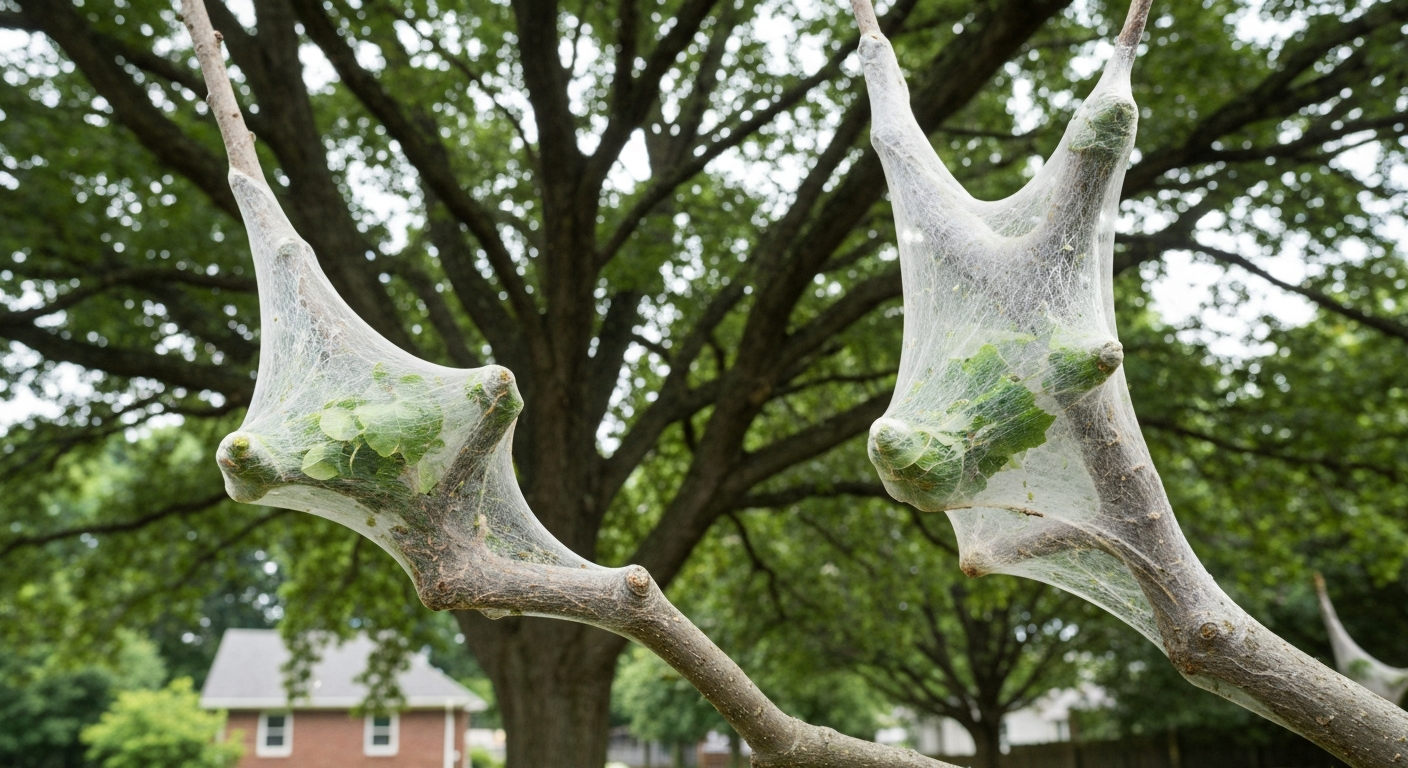
Short answer: If big, gauzy webs have appeared at the tips of your tree branches in late summer, you are almost certainly looking at fall webworm, a native caterpillar that shows up every year around Waxhaw and the rest of Union County. It looks alarming, but on a healthy, established tree the damage is cosmetic. The tree keeps next year's buds and leafs out fine in the spring, so for most homeowners the honest answer is that no treatment is needed. The exceptions worth knowing about are young or newly planted trees, trees that are already stressed, and the rare severe or repeat infestation.
Key takeaways
- Fall webworm builds silky webs at the ends and tips of branches in late summer into fall, and the caterpillars feed inside the web.
- Its spring look-alike, the eastern tent caterpillar, builds webs in the forks and crotches near the trunk and leaves the web to feed.
- On a healthy, established tree the feeding is cosmetic. It rarely causes lasting harm, because it happens after the tree has already set next year's buds.
- It is not "never harmful." Newly planted or already stressed trees, and severe or multi-year infestations, are the real exceptions.
- Most nests need no treatment. If you want to act, pruning out or tearing open the reachable webs is the lowest-risk option. Skip the insecticide on a healthy tree, and never use fire.
What are those webs in my tree branches in late summer?
The webs are the nests of the fall webworm (Hyphantria cunea), the caterpillar of a small white moth. It is native to the region, not an invader, and NC State Extension notes it has at least two generations a year and is active throughout the summer here in North Carolina. The webs start small at the end of a branch and, as Clemson's Home and Garden Information Center describes, grow to cover the entire terminal branch, with the caterpillars feeding on the leaves trapped inside. You will usually start noticing them from July into the fall.
Fall webworm is not fussy about which tree it moves into. Estimates of its host range vary by source, from NC State's "hundreds of plant species" to Clemson's "over 300 hardwood tree and shrub species" to the University of Georgia Extension figure of "more than 600 species of plants." The exact number is less important than the takeaway: it uses a very wide range of hosts. Around the Piedmont you are most likely to see the nests on crape myrtle, pecan, hickory, walnut, persimmon, maple, sweetgum, sourwood, cherry, and redbud.
Fall webworm vs. tent caterpillar: how to tell them apart
The mix-up is understandable, because both insects make webs in trees. The two reliable tells are the timing and where the nest sits. Fall webworm appears in late summer and fall and builds at the ends of the branches, wrapping the leaves inside the web. The eastern tent caterpillar is a spring insect. According to NC Cooperative Extension in Macon County, "tent caterpillars are generally active until early June and fall webworms are active in July through September," and the tent caterpillar builds its nest in the fork of branches and does not enclose the leaves the way fall webworm does. As NC Cooperative Extension in Burke County puts it, tent caterpillars nest in the spring in the crotch of the tree, while fall webworms nest in late summer out at the ends of the limbs. And unlike fall webworm, the eastern tent caterpillar leaves its web to go feed, a point University of Illinois Extension makes as well.
| Feature | Fall webworm | Eastern tent caterpillar |
|---|---|---|
| When you see it | Late summer into fall (roughly July through September) | Spring (active until about early June) |
| Where the nest sits | At the ends and tips of the branches | In the forks and crotches, near the trunk |
| What it does with the leaves | Encloses the leaves inside the web | Does not enclose the leaves |
| Where the caterpillars feed | Inside the web | Leaves the web to feed |
A quick memory aid: spring and near the trunk means tent caterpillar, late summer and out at the branch tips means fall webworm.
Do fall webworms kill trees?
For a healthy, established tree, almost never. NC State Extension puts it plainly: fall webworms "upset people because they are ugly not because they damage trees that much." The reason is timing. The caterpillars feed late in the season, after the tree has already stored its energy and set the buds for next spring. As University of Illinois Extension explains, they leave next year's buds alone, so the tree should leaf out just fine the following year. Extension offices across the region land in the same place: the nests are "unlikely to cause long-term damage" (Clemson), they "usually do not harm the tree's overall health" (NC Cooperative Extension in Wayne County), and they "rarely cause any real damage" (NC Cooperative Extension in Lee County).
Honesty matters here, though, and "rarely harms a healthy tree" is not the same as "never harms any tree." There are real exceptions worth naming. University of Illinois Extension points out that newly planted or young trees "could be at risk of harm if there is enough feeding." A tree that is already stressed, for example by a hot, dry Waxhaw summer, has less in reserve to spare. And while a single season of webbing is cosmetic, the University of Georgia notes that a "severe infestation can cause considerable damage to trees." Those cases are the exception, not the rule, but they are the reason we will not tell every caller that fall webworm is completely harmless.
Should I remove or spray fall webworm nests?
Most of the time, you do not need to do anything. University of Illinois Extension says management "isn't usually warranted" for established trees, and Wayne County Extension notes that if the webs are not within reach, "do not worry." If the nests are low and you would simply rather not look at them, the lowest-risk approach is physical, not chemical:
- Prune or open the reachable webs. Prune out the affected branch tips, or tear or poke the web open. NC State suggests you can "prune out the nest or just poke it with a stick so parasitoids and birds can get in to kill the larvae." Opening the web lets birds and parasitoid wasps finish the job for you, which Lee County Extension describes as tearing open the webs to expose the caterpillars to predators.
- Bt for small caterpillars. Bacillus thuringiensis (Bt) is a targeted, low-impact biological option while the larvae are still small.
- Broad insecticides are rarely worth it. On a healthy tree they are usually unnecessary, and the webbing itself makes good spray coverage difficult. The University of Georgia advises that synthetic insecticides "should only be attempted by trained professionals."
One thing to avoid completely: do not try to burn the webs out of the tree. Wayne County Extension warns that using fire on fall webworm or tent caterpillar nests "can set up an extremely dangerous situation," where the fire "may get out of hand and destroy the tree, endanger the person, and nearby properties." A torch in a tree is a far bigger risk than the caterpillars ever were.
The honest bottom line for Waxhaw homeowners
Fall webworm is one of several tree pests we see around Waxhaw and Union County, alongside issues like the emerald ash borer moving through the area. Unlike some of those, fall webworm rarely calls for anything more than patience. If your tree is healthy and established, the webs are a seasonal eyesore that the tree will shrug off. Where a professional genuinely helps is with the harder cases: nests high in a large tree, a young or already stressed tree you want to protect, or anything close to power lines, which is never a do-it-yourself job. We would rather tell you to leave a harmless nest alone than sell you a spray you do not need.
If you are unsure what you are looking at, or a nest is somewhere you cannot safely reach, reach out to the Clark's Tree Care team for a free, no-pressure assessment. We will give you a straight answer about whether it needs anything at all.
Citations
- NC State Extension (Department of Entomology & Plant Pathology), "Fall Webworms" (Aug 2, 2018)
- Clemson Cooperative Extension, Home & Garden Information Center, "Fall Webworm" (Sept 1, 2022)
- University of Georgia Cooperative Extension, "Fall Webworms: Biology and Management" (Circular 1197, reviewed Aug 1, 2025)
- NC Cooperative Extension, Macon County Center, "Eastern Tent Caterpillars" (updated Nov 23, 2023)
- NC Cooperative Extension, Burke County Center, "Fall Webworms" (Mar 10, 2021)
- NC Cooperative Extension, Wayne County Center, "Bagworms or Fall Webworms?" (Aug 14, 2025)
- NC Cooperative Extension, Lee County Center, "Fall Webworms Are Back" (updated Jul 31, 2025)
- University of Illinois Extension (Good Growing), "Webs in trees: The life and impact of fall webworms" (Sept 12, 2025)