Emerald Ash Borer in Waxhaw and Union County, NC: Signs, Treatment, and When Removal Is the Safe Choice
Short answer: The emerald ash borer in North Carolina is no longer a threat on the horizon. It is here, statewide, and that includes Waxhaw and the rest of Union County, which regulators now officially consider infested. If you own an ash tree, the question is no longer whether the borer will arrive, but whether to treat the tree, keep watching it, or have it removed. A healthy ash can often be protected with insecticide. An ash that has lost more than about half its canopy is usually past saving, and a dead ash turns brittle and dangerous quickly, which is when professional removal becomes the safe choice.
Key takeaways
- The emerald ash borer is established across all of North Carolina, so the entire state, including Waxhaw and Union County, is officially considered infested.
- Both the federal quarantine (lifted in 2021) and North Carolina's own statewide quarantine (repealed in 2026) are gone, because the pest is now everywhere and a quarantine no longer slows it.
- Warning signs include 1/8 inch D-shaped exit holes, a thinning canopy and dead upper branches, new sprouts on the trunk, splitting bark, and heavy woodpecker activity.
- Untreated ash usually die within about five years, sometimes in as little as two to three.
- Treat healthy, high-value ash and remove dead or heavily declining ones. Once a tree passes roughly 30 to 50 percent canopy loss, an on-site certified arborist should make the call.
- A dead ash can drop large limbs on a calm day, so removing it while the wood is still sound is safer and less expensive.
What the emerald ash borer is, and why Union County homeowners should care
The emerald ash borer (Agrilus planipennis) is a small, metallic green beetle from Asia whose larvae tunnel just beneath the bark of ash trees. Those tunnels cut off the tree's ability to move water and nutrients, which is what kills it. The insect attacks our native ash species (Fraxinus) and makes no distinction between a forest tree and the shade ash in your front yard. In Waxhaw and across Union County, ash are a common landscape and street tree, which is why this pest matters locally. An infested ash rarely recovers on its own, and once it dies it becomes a hazard rather than standing quietly. That combination, a tree that is hard to save and dangerous to ignore, is what makes early identification so valuable.
Is the emerald ash borer in North Carolina and near Waxhaw?
Yes. The emerald ash borer in North Carolina is now established statewide. The North Carolina Department of Agriculture and Consumer Services reports that the statewide EAB quarantine has been officially repealed and that the entire state is now considered infested. The borer was first detected in North Carolina in 2013, according to NC State Extension, and as of May 2024 the N.C. Forest Service reported it in 76 counties, more than three quarters of the state, including all of Western North Carolina and most of the Piedmont.
Closer to home, the beetle was found in Charlotte and Mecklenburg County, which borders Union County, back in May 2017, per the local TreesCharlotte "Save Your Ash" campaign. No agency publishes a Waxhaw specific detection date, and we will not invent one. The honest picture is simple: the pest reached the Charlotte metro years ago and is now considered present across the whole state, so Waxhaw, Weddington, Marvin, Wesley Chapel, Monroe, Indian Trail, and the rest of Union County sit squarely inside the infested area.
You may have read that North Carolina is still "under an EAB quarantine." That framing is out of date. The federal quarantine was lifted on January 14, 2021 (NC State Extension), and North Carolina repealed its own statewide quarantine in 2026, as confirmed in the state's EAB quarantine and compliance FAQ. Those rules ended not because the danger passed, but for the opposite reason: the beetle is so widespread that a quarantine no longer slows it. In practical terms, moving ash wood within the state is no longer restricted by law, though sensible firewood habits still matter, as we cover below.
Do you have an ash tree? How to identify ash on your property
Before you worry about the borer, confirm you actually have an ash. According to Michigan State University Extension, three features together identify an ash tree:
- Opposite branching. Branches, buds, and leaves grow directly across from each other, not staggered along the twig.
- Compound leaves with 5 to 11 leaflets arranged along a central stem.
- Diamond patterned bark. Mature ash bark forms a distinct pattern of diamond shaped ridges.
Ash also produce dry, oar shaped seeds called samaras. The common look alike, boxelder, is also oppositely branched and compound, but it has only 3 to 5 leaflets and paired samaras. If you are not certain, a certified arborist can identify the tree in seconds.
Signs of emerald ash borer on your tree
The signs of emerald ash borer can be subtle at first, because infestations usually start high in the canopy, so the tell tale exit holes may not be visible at eye level for a few years. NC State Extension lists this cluster of symptoms to watch for:
- D-shaped exit holes about 1/8 inch wide, left where adult beetles chew their way out.
- Canopy thinning and dead branches, usually beginning at the top of the tree.
- Epicormic sprouts, new shoots growing straight out of the trunk or base.
- Vertical splits in the bark, often running over the tunnels beneath.
- Serpentine galleries, winding, sawdust packed tunnels just under the bark.
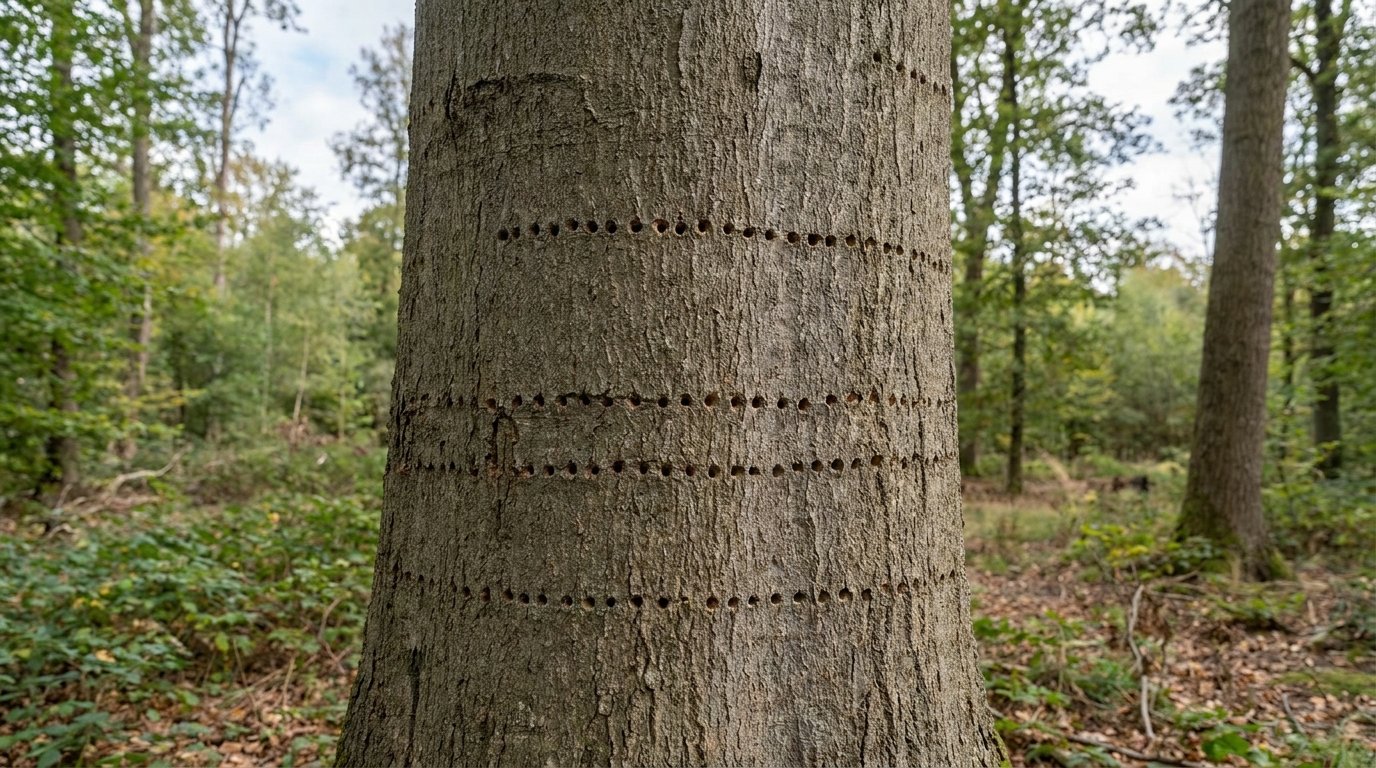
- Increased woodpecker activity, as birds strip patches of bark to reach the larvae.
Any one of these can have another cause, but several together on an ash tree are a strong signal to have it inspected.
Treat or remove? Making the safe call
Not every ash with the borer needs to come down, and not every ash can be saved. The deciding factor is how much of the canopy is still alive.
Healthy, high-value ash can often be protected. The most effective emerald ash borer treatment is a stem injection of emamectin benzoate, repeated every two to three years, according to NC State Extension. Soil applied neonicotinoids such as imidacloprid and dinotefuran are labeled alternatives, but they generally need annual reapplication and are less effective. Because treatment must be repeated for the life of the tree, it makes the most sense for structurally sound, well placed ash you genuinely want to keep.
Removal becomes the safer call once a tree is too far gone. If an ash has lost more than about half its canopy, treatment is unlikely to save it and removal is recommended (NC State Extension, University of Minnesota Extension). Purdue Extension is more conservative, advising that once a tree passes about 30 percent canopy loss you should plan to remove it, because waiting only lets the wood grow more brittle and more dangerous. Because the experts land in a range, the honest guidance is this: once an ash has lost roughly 30 to 50 percent of its canopy, stop guessing and have an ISA certified arborist assess it on site. A percentage eyeballed from the ground is not a safe basis for a decision.
| Canopy condition | What the research suggests | Typical next step |
|---|---|---|
| Healthy, full canopy | No reason to remove a healthy ash preemptively; protective treatment can preserve high-value trees. | Monitor, or treat if the tree is worth the long-term cost. |
| Early infestation, under about 30 percent canopy loss | Treatment is most effective while most of the canopy is still alive. | Treat, for trees worth keeping. |
| Roughly 30 to 50 percent canopy loss | Sources split: Purdue says plan to remove past 30 percent; NC State, UMN, and Wisconsin treat up to about 50 percent. | Get an ISA certified arborist assessment. |
| More than about 50 percent canopy loss, or dead | Too late to save; treatment is not recommended and the tree is a growing hazard. | Remove promptly, while the wood is still sound. |
Why a dead ash tree becomes a safety hazard fast
This is the part homeowners most often underestimate. An ash killed by the borer does not decay slowly and predictably. It becomes brittle, and it does so fast. Purdue Extension warns that dead ash break easily, dropping branches in a snowstorm, in a light breeze, or on a calm, clear day, and that it is not uncommon for sizable limbs to snap 30 feet off the ground with no wind at all. University of Minnesota Extension adds that the borer carries decay fungi that rot the branches from the inside, making a dead ash both hazardous to people, pets, and property and genuinely dangerous to cut down.
Timing is the whole point. Untreated, an infested ash typically dies within about five years, and most of the crown can die within two years of the first symptoms, sometimes killing the tree in as little as two to three years, according to the N.C. Forest Service (University of Minnesota Extension reports a similar four year window). That short runway is why a leaning or declining ash near a house, driveway, or power line should not wait. Removing it while it is still structurally sound is safer for the crew and less expensive than handling a brittle, half collapsed tree later, a point University of Wisconsin Extension makes directly.
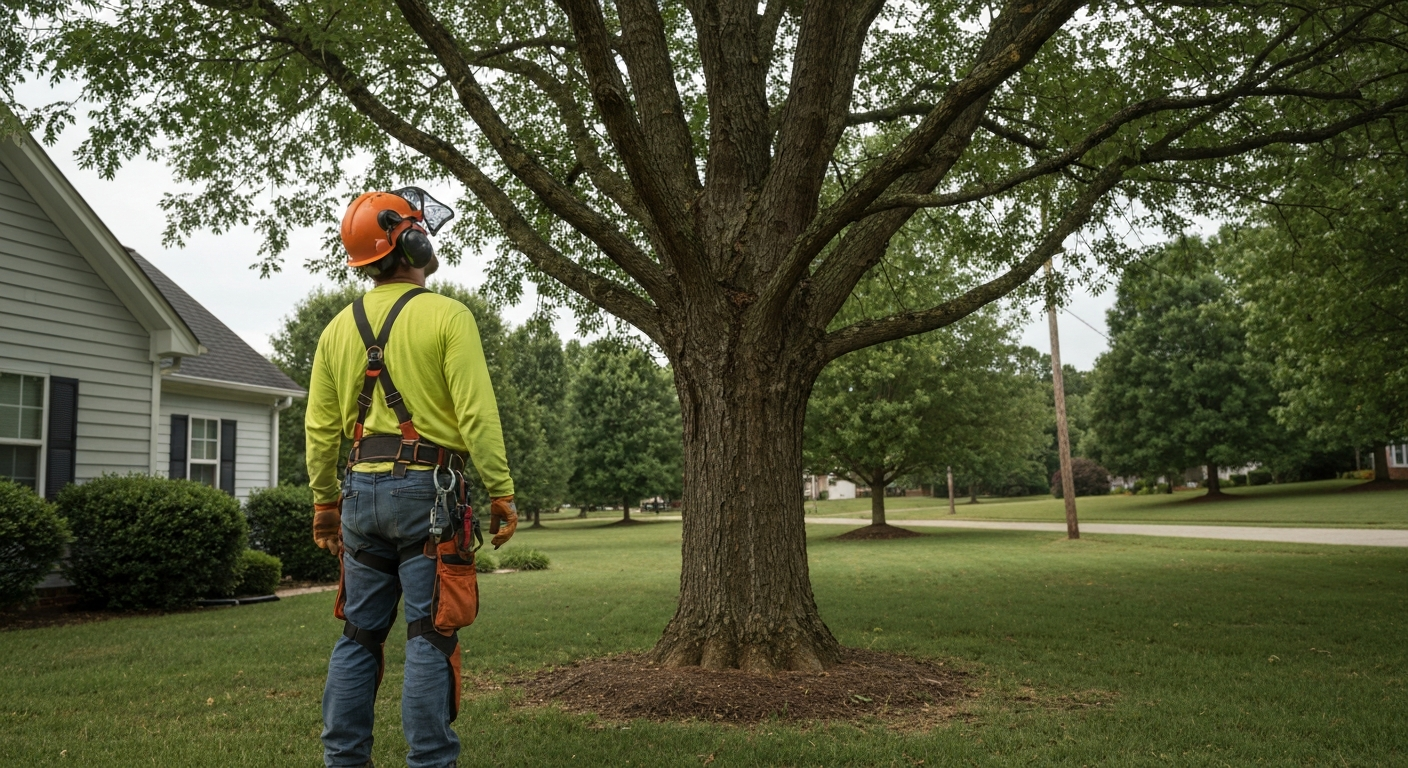
This is where our work at Clark's Tree Care comes in. Our crews handle the hazardous removal of dead and dying ash trees across Waxhaw and Union County, and for a large ash looming over a home or power line we bring in crane assisted removal so the tree comes down under full control.
What to do next in Waxhaw and Union County
If you have an ash tree you are unsure about, here is a sensible order of operations:
- Get a professional assessment. An ISA certified arborist can confirm the tree is an ash, gauge how much canopy is truly gone, and tell you honestly whether treatment or removal is the right move.
- Treat what is worth saving. A healthy, well placed ash can be protected with a proper treatment program.
- Remove what is dead or declining, promptly. The longer a dead ash stands, the more brittle and dangerous it becomes.
- Be thoughtful with firewood. With the quarantine repealed, moving ash wood within North Carolina is no longer against the law, but the N.C. Forest Service still recommends burning firewood within about 50 miles of where it was cut, since firewood is a major way the borer spreads.
We serve Waxhaw and the surrounding Union County communities, including Weddington, Marvin, Wesley Chapel, Monroe, and Indian Trail. When a dead ash is the problem, dead ash tree removal in Union County NC is core to what we do every week.
Have more questions or want to get in touch? If you have an ash tree in Waxhaw or anywhere in Union County that has you concerned, contact the Clark's Tree Care team for a straightforward, safety first assessment. We look forward to hearing from you.
Frequently asked questions
Is the emerald ash borer in North Carolina?
Yes. North Carolina is officially considered infested statewide, and the pest has been confirmed in the large majority of counties, including neighboring Mecklenburg County, where it was detected as early as May 2017.
How do I know if my ash tree has emerald ash borer?
Look for 1/8 inch D-shaped exit holes, a thinning canopy and dead upper branches, new sprouts on the trunk, splitting bark, S-shaped tunnels under the bark, and unusual woodpecker activity. Several of these signs together on an ash tree are a strong warning.
Can you save a tree with emerald ash borer?
Often, yes, if you catch it early. Insecticide treatment, most effectively a stem injection of emamectin benzoate every two to three years, can protect an ash that still has most of its canopy. Once a tree has lost more than about half its canopy, treatment is unlikely to work and removal is recommended.
How long before an ash tree dies from emerald ash borer?
Untreated, an infested ash usually dies within about five years, and sometimes in as little as two to three. Most of the crown can die within two years of the first visible symptoms.
Should I remove a dead ash tree?
Generally yes, and sooner rather than later. Dead ash become brittle fast and can drop large limbs even on a calm day, so they are a real hazard near homes, driveways, and power lines. Removing one while the wood is still sound is safer and less costly than waiting.
Citations
- N.C. Department of Agriculture and Consumer Services, Plant Industry, "Emerald Ash Borer" (maintained 2026 reference; accessed July 2026).
- N.C. Department of Agriculture and Consumer Services, Plant Industry, "EAB Quarantine and Compliance Agreements FAQ" (maintained 2026 reference; accessed July 2026).
- NC State Extension, "Emerald Ash Borer" (updated October 30, 2025).
- N.C. Forest Service, "Emerald Ash Borer Frequently Asked Questions" (updated June 24, 2026).
- N.C. Forest Service, "N.C. Forest Service detects emerald ash borer in five new counties" (May 22, 2024).
- Purdue University FNR Extension, "Avoid Deadly Risk of Dying Ash Trees with Timely Tree Removal" (updated June 5, 2026).
- University of Minnesota Extension, "Emerald ash borer" (reviewed 2026).
- University of Wisconsin-Madison Division of Extension, "Is my ash tree worth treating for emerald ash borer?" (January 29, 2026).
- Michigan State University Extension, "Ash Tree Identification (Bulletin E2942)" (2016; used for ash identification, which does not change over time).
- TreesCharlotte, "Save Your Ash" campaign (June 11, 2018; used only for the May 2017 Mecklenburg County detection).