Summer Heat and Drought Stress: How to Protect Your Trees in Waxhaw, NC
When it comes to summer tree care in Waxhaw, NC this year, the single most helpful thing you can do is water your trees the right way: deeply and infrequently. During the 2026 drought that has gripped Union County and most of North Carolina, that means a slow, deep soak of roughly 10 gallons of water per inch of trunk diameter every one to two weeks, rather than a little water every day. Keep a 2 to 3 inch ring of mulch around the base (never piled against the trunk), skip the fertilizer and heavy pruning until conditions improve, and give newly planted trees the most attention. Below is why the heat is so hard on local trees right now, how to spot a tree in trouble, and how to help it through the summer without overdoing it.
Why summer 2026 is so hard on Waxhaw trees
This is not an ordinary summer. As of early July 2026, nearly every county in North Carolina was in some stage of drought. The state's July 9 update from the N.C. Department of Environmental Quality counted 46 counties in extreme drought, 31 in severe drought, and 14 in moderate drought, with the most severe (exceptional) category centered on the Triangle and eastern part of the state. Here in the Charlotte metro, Union County sits in the severe to extreme band, and conditions have been worsening rather than easing. Independent reporting from WUNC (North Carolina Public Radio) likewise noted that the majority of the state remained in extreme to severe drought with little relief in sight.
Closer to home, the Union County Center of N.C. Cooperative Extension warned in late June that the county was experiencing severe drought conditions with extreme heat, and that even mature, well-established trees can be stressed enough to warrant supplemental watering. When trees lose more water through their leaves than their roots can pull from dry ground, the strain shows up as the symptoms below.
Signs of heat stress in trees
Catching drought stress early gives you the best chance to help a tree recover. According to NC State Extension Forestry, the clearest visible signs are yellowing or browning leaves and early leaf fall, often noticed here in June or July before autumn would normally arrive. Other commonly recognized signs of heat stress in trees include:
- Leaf scorch, where the edges and tips of leaves turn brown while the center stays green
- Daytime wilting or curling that does not bounce back overnight
- Undersized, sparse, or off-color leaves
- A thinning canopy or dead twigs in the upper branches
One important point keeps homeowners from over-reacting: newly planted trees show stress first because their root systems are not yet developed, while NC State Extension Forestry notes that established trees older than about a year typically withstand moderate to severe drought without the addition of other stressors. In other words, the young tree you planted last spring needs your attention far more than the oak that has shaded your yard for decades.
Watering trees in summer the right way
The guidance from local and state experts is consistent: water deeply and infrequently. A deep soak reaches the roots and encourages them to grow deeper, while frequent light sprinkling only wets the surface. Union County Extension recommends about 10 gallons of water per inch of trunk diameter during extended dry periods, noting that a deep soaking every one to two weeks beats frequent, shallow watering. NC State Extension's Dealing With Drought guidance agrees, advising you to water deeply and then let the soil dry between waterings, and the Lee County Center of N.C. Cooperative Extension adds that a slow soaking every few weeks can make a real difference in an established tree's survival. Check soil moisture by feel before you water.
Newly planted trees are the priority and need water more often. The following are general starting points; adjust them to your soil and the weather.
| Tree type | How much water | How often |
|---|---|---|
| Newly planted (within about 2 years) | About 5 gallons per inch of trunk diameter | About twice a week |
| Established or mature | About 10 gallons per inch of trunk diameter, as a slow deep soak | Every 1 to 2 weeks |
The young-tree numbers follow the formula published by UF/IFAS Extension for trees planted within the last two years. In every case, apply water at or just inside the dripline (the outer edge of the branches), where the feeder roots are, using a hose at a trickle, a soaker hose, or a bucket with small holes rather than a fast blast that runs off.
There is a local catch worth knowing. Much of Union County sits on heavy Piedmont clay, which drains slowly and can actually hold too much water even in a drought. As Utah State University Extension explains in its guidance on overwatering, waterlogged soil starves roots of oxygen and can cause root rot, and the resulting yellowing and wilting can look almost identical to drought stress. The practical rule: water slowly, stop if water begins to pool or run off, and let the soil dry out between soaks. Deep and slow is right for clay, but deep and constant is not.
Mulch the right way: a ring, not a volcano
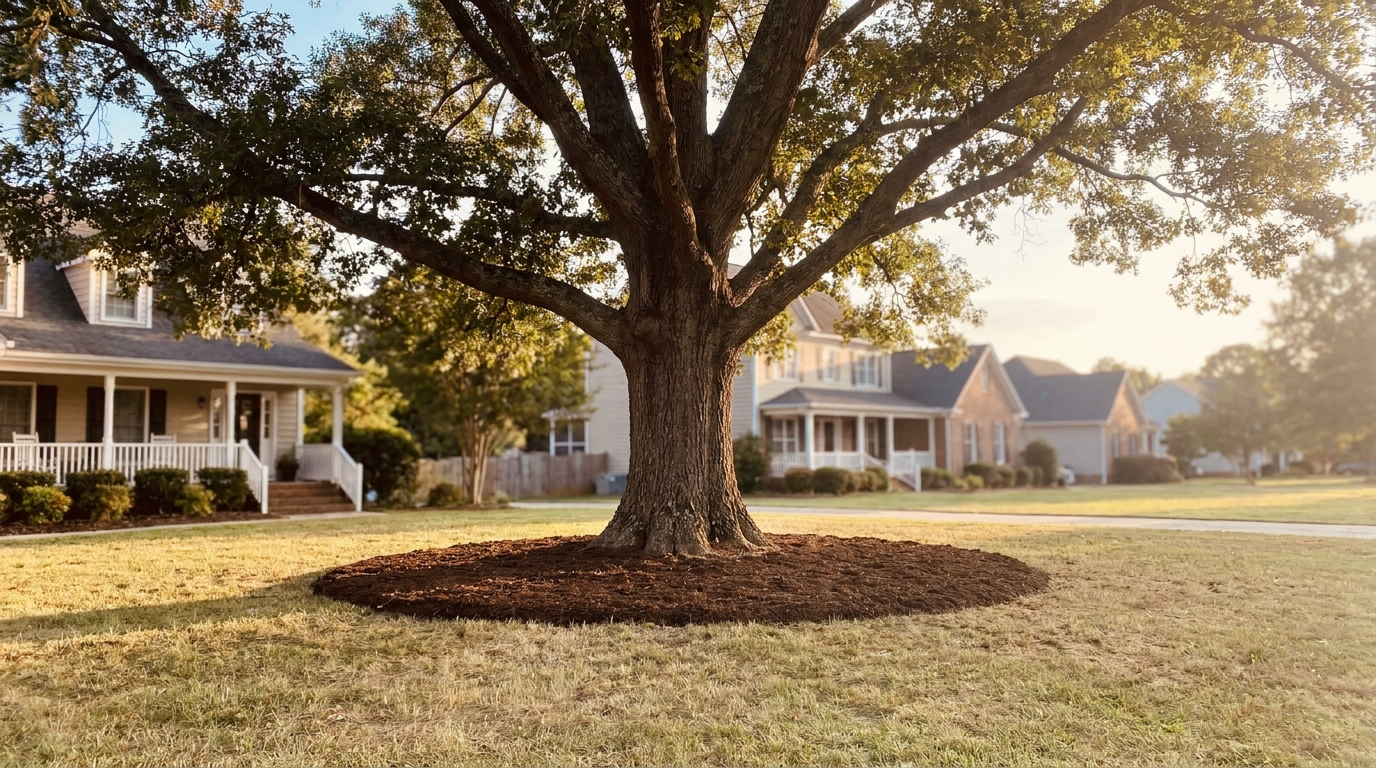
A good layer of mulch is one of the simplest ways to help a tree hold moisture through the summer. The Durham County Center of N.C. Cooperative Extension notes that 2 to 4 inches of organic mulch can lower soil temperatures by 5 to 15 degrees compared with bare ground, which reduces both heat and moisture stress on the roots. Aim for a 2 to 3 inch layer of hardwood mulch spread in a wide ring out toward the dripline.
The mistake to avoid is the mulch volcano: mulch piled high and mounded against the trunk. Keep mulch a few inches away from the bark so the base of the trunk can breathe. NC State Extension also cautions that piling mulch too deep encourages roots to grow upward into the mulch, which actually makes a tree more vulnerable when the mulch dries out. A flat, wide, shallow ring is what you want.
What not to do to a stressed tree this summer
When a tree looks stressed, the instinct is often to feed it or tidy it up. During a drought, both can do more harm than good. NC State Extension's Dealing With Drought guidance is direct: during drought, add no new plants, no fertilizer, and no pruning except to remove dead or dying branches. The reason is that fertilizer and pruning both push a tree to produce tender new growth, and new growth is exactly what a water-starved tree cannot support. UF/IFAS makes the same point, explaining that fertilizing pulls water from the roots and forces the tree to spend energy processing it, while pruning forces the tree to spend energy healing wounds. Durham County Extension similarly advises pausing fertilizer applications while trees are drought stressed.
The one exception is safety. Removing genuinely dead or dying branches is still appropriate, since dead wood serves no purpose and can become a hazard. That kind of work is different from routine shaping and is best handled carefully; our tree trimming and pruning team can take out dead limbs without stressing the rest of the tree.
When drought stress becomes a safety concern
Most trees that get a little help will pull through. But prolonged drought does weaken trees over time, and a weakened tree becomes more susceptible to pests, disease, and structural decline. Union County Extension frames the stakes plainly, noting that a small investment in supplemental watering may prevent the loss of a tree that took generations to grow and could cost thousands of dollars to remove. If you notice large dead limbs, significant canopy dieback, leaning, or a tree that has been declining for more than one season, it is worth having it looked at before a storm or a hot spell finishes the job. In some cases the safest path is professional tree removal, but many stressed trees can be saved with the right care.
Your summer tree care checklist for Waxhaw, NC
- Water deep, not often. About 10 gallons per inch of trunk diameter as a slow soak every 1 to 2 weeks for established trees; about 5 gallons per inch twice weekly for trees under 2 years old.
- Prioritize young and newly planted trees. Established trees are more drought tolerant than most homeowners fear.
- Mulch in a wide 2 to 3 inch ring, never a mound against the trunk.
- Hold off on fertilizer and heavy pruning until the drought breaks; remove only dead or dying branches.
- Mind the clay. Water slowly and stop if it pools or runs off, then let the soil dry between soaks.
- Watch for warning signs like leaf scorch, early leaf drop, and canopy thinning, and get a professional opinion if a tree keeps declining.
Talk to a local tree care team
Have more questions or want to get in touch? If you are not sure whether a tree on your property is simply thirsty or genuinely in decline, we are happy to help. Schedule a professional tree health assessment through our contact page and we will take a look. As a local, family-run company here in Waxhaw, we believe in honest assessments and no pressure sales. Prefer to speak with a member of our team? Give us a call at (980) 247-8733. We look forward to hearing from you.
Citations
- N.C. Cooperative Extension, Union County Center. "Severe Drought can Stress Even Mature Trees: Consider Supplemental Watering" (June 25, 2026)
- NC State Extension. "Dealing With Drought" (updated July 9, 2026)
- NC State Extension Forestry. "Managing Trees Under Drought Conditions" (June 11, 2026)
- N.C. Department of Environmental Quality. "Nine N.C. Counties in Exceptional Drought as Statewide Drought Continues" (July 9, 2026)
- N.C. Cooperative Extension, Durham County Center. "Essential Gardening Tips for Drought Conditions" (May 19, 2026)
- N.C. Cooperative Extension, Lee County Center. "Combating Drought in Your Garden" (September 19, 2025)
- UF/IFAS Extension. "Tree Care During Drought" (undated, maintained reference)
- Utah State University Extension. "Overwatering" (undated, maintained reference)
- WUNC (North Carolina Public Radio). "N.C. drought update: Despite storms, many counties remain in extreme drought" (updated July 9, 2026)