Bradford pear removal Union County: when trunks split
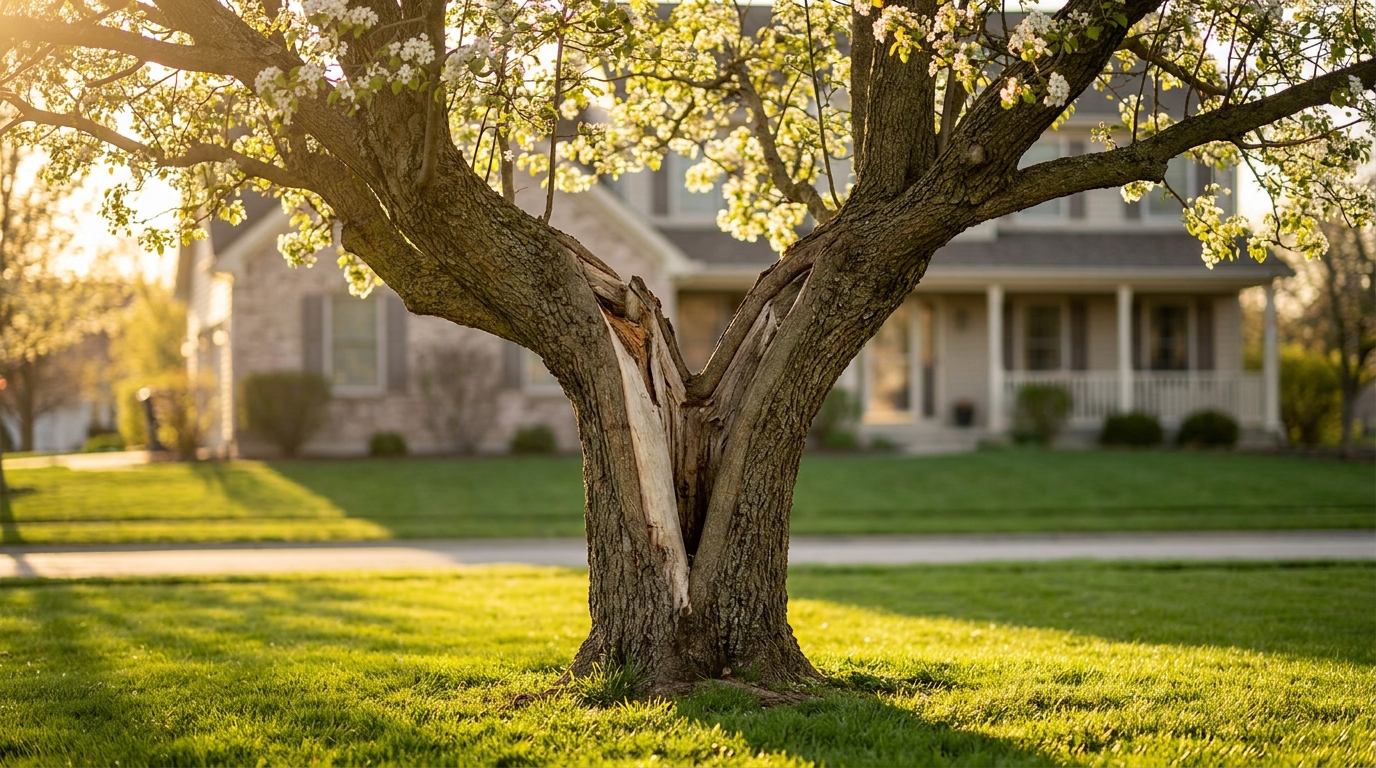
A Bradford pear usually fails at the trunk, not out at the twig tips. The cultivar stacks upright limbs on a short trunk, and those tight crotches hold bark instead of a solid wood joint, so a mild or moderate storm is enough to tear a main stem.[1] Clemson Extension's 2020 factsheet put the worst splitting on trees about 15 years and older, and a federal invasive-species summary, drawing on reviews from 2017 and 2019, notes that Bradford pears can also split under their own weight after 15 to 20 years.[3][5] If yours already shows a crack over a roof, driveway, or play area, Bradford pear removal Union County homeowners ask us about is usually the safer call before the next wind, not another light pruning.
Why the crotch fails in ordinary Carolina wind
Callery pear, Pyrus calleryana, is an Asian species. 'Bradford' was the first widely planted ornamental variety, bred in the 1950s for white spring flowers, red fall color, and a neat oval crown that would tolerate poor soil.[1] The shape people liked is the shape that fails.
Bradford limbs grow strongly upright and close together. NC State Extension's plant profile says the cultivar develops tight crotches that are likely to split in half in heavy wind and rain, and it lists 'Bradford' as a selection that tends to split with age. Mature size there is about 30 to 50 feet tall and 20 to 35 feet wide.[2] A November 2025 note from the Madison County center describes the same habit in North Carolina: branches at steep upright angles that break with age or in heavy wind and ice.[9] University of Florida's 2019 profile names the tissue in the joint. 'Bradford' carries many vertical limbs with embedded bark packed closely on the trunk, a dense crown, and long branches that do not taper well, so the tree is susceptible to wind, ice, and other breakage.[4]
Embedded bark is what arborists call included bark. A 2025 Florida Urban Forestry Council article, about codominant stems in general rather than pears alone, describes the joint. Two stems of similar diameter rise from one point and make a sharp V, not the wide U of a strong branch collar. Each stem keeps its own bark, pressed between them, so overlapping wood never ties the sides together. The bark can disappear from view as the stems thicken. The union stays weak under wind, ice, wet leaves, or the weight of the crown, and a storm can start a separation that finishes later.[6]
NC State's July 2025 publication puts that weakness in ordinary weather. Acute branching and fast growth lead to weak unions. The tree can break under its own weight. Mild or moderate storms cause excessive branch and main-stem breakage, and debris can hit structures, vehicles, or people.[1] That is what we see on Waxhaw lots and across Union County.
Clemson's factsheet, revised January 9, 2020, adds the clock. It called Bradford a rapid grower, with 12 to 15 feet of height gain over an 8- to 10-year period, a spread of 20 to 30 feet, and a life span of 15 to 25 years. Severe branch splitting shows up especially at 15 years and older, because narrow angles let the tree split in half in ice and storms.[3] The crown gets heavy while the joints stay narrow.
Some older profiles describe other Callery cultivars, such as 'Chanticleer' or 'Cleveland Select,' as having somewhat better branch angles. That is not a reason to plant a substitute pear. NC State's 2025 publication groups those names with Bradford. All of them can set seed, and it recommends removal and a native replacement, not a swap inside the same species.[1]
How to spot a splitter before it opens
You can see this defect from the ground. Look when the leaves are off, or up through the crown in early spring before the white flowers hide the limbs.
A sound shade tree usually has one dominant stem and side branches that leave it at a wider angle, with a raised bark ridge on the union. A Bradford set up to split has several upright stems of similar thickness leaving a short trunk in one cluster. The Florida Urban Forestry Council says to look for forked stems nearly the same diameter, a sharp V rather than a U, and no interlocking wood at the attachment. Included bark in that fork is often hidden once the stems thicken, so do not wait to see a wide open seam.[6]
Then look for movement. Check the crotch for a crack, splintered fibers, or decay where the stems meet.[6] A fresh crack in calm weather means the two sides are pulling apart. A tear scar, a hanging slab of wood, or a leader that already dropped means the structure has failed once. That wound opens the wood to decay.[6]
Age is a clue, not a verdict by itself. The National Invasive Species Information Center states that narrow crotch angles make Bradford extremely susceptible to storm damage, and that these trees will also split under their own weight after 15 to 20 years, citing reviews from 2017 and 2019.[5] A young tree with one tight fork can still be trained. A mature pear with several tight forks over a roof or driveway is a different problem.
White flowers that many people compare to rotting fish confirm a Callery pear. They do not mean the joint is sound.[1] Birds take the small, hard fruit.[1][3] Long thorns on a pear along the fence mean escaped offspring. Clemson described the planted Bradford itself as thornless.[3]
Why pruning rarely fixes the structure
Pruning can build a better tree when you start early. It rarely rebuilds a mature Bradford.
University of Florida's 2019 profile says the problem is too many upright branches growing too close together on the trunk, and that the useful work is early: space laterals along one central trunk. A skilled crew is needed. Even then the tree often looks misshapen. The authors wrote that this tree probably was not meant to be pruned, but that without pruning it has a short life, and that as 'Bradford' and some other cultivars approach 20 years old they fall apart in ice and snow because of tight branch structure.[4]
On a mature tree the included bark is already inside the fork. You cannot saw that seam out and leave both stems. The 2025 council article says removing or reducing a codominant stem late can cause tear-out and other harm. Shortening a long limb to ease the pull is, in that article, a temporary option for stems that cannot easily be pruned. Cabling or bracing may reinforce a large mature codominant stem.[6] That hardware does not replace the wood the union never grew.
Pruning still makes sense when the tree is young, the competing shoots are small, and there is no crack. Subordinating one stem so a single leader takes over is the council's prescription for young trees.[6] Once the forks are large and people or buildings are in the fall zone, pruning manages risk. It does not repair the joint. We would rather say that in the yard than leave a weak crotch over the driveway and call the job finished.
The seed problem does not stay in the yard
Structure is the safety reason to remove a Bradford. Seed is the reason a healthy-looking one still matters to the fields and woods around Union County.
When Bradford was the only Callery cultivar nearby, it was sterile, because that lone variety could not pollinate itself. After Chanticleer, Cleveland Select, Autumn Blaze, Aristocrat, and other varieties were planted, they could cross-pollinate. Sprouts off the rootstock can pollinate flowers on the grafted top, and common European pear can pollinate Callery pear as well. All of the varieties can produce viable seed. Birds and other animals eat the fruit and drop it along roads, field edges, lots, wetlands, and forest borders. The escapes show up in early spring as lines of white bloom.[1]
Clemson's 2020 factsheet says Bradford was bred sterile and thornless, then cross-pollinated and produced fruit that birds carried into thorny thickets, with thorns from a quarter inch to over 2 inches.[3] NC State's July 2025 publication, the newer figure, says wild thorns can grow up to 4 inches and can puncture tractor tires.[1] The lengths do not match. Both say the offspring are thorny and hard on equipment. The yard tree is usually the thornless parent.
The thickets leaf out early, shade native plants, and can leave little understory.[1] NC State cites a 2022 paper finding that caterpillars prefer Callery pear less than native trees, which limits food for birds.[1] The North Carolina Forest Service lists Callery pear among invasive trees and urges people to plant natives and remove exotic invasives.[7] The plant toolbox marks the species invasive in North Carolina and points people toward eastern redbud, flowering dogwood, serviceberry, or American plum instead of another pear.[2]
Several states stopped the sale. NC State reported in July 2025 that from 2021 to 2024, Ohio, South Carolina, Pennsylvania, and Kansas enacted bans or restrictions. North Carolina is not on that list.[1] Clemson announced on July 14, 2021, that South Carolina's nursery-sale ban, covering Bradford and other pears on Pyrus calleryana rootstock, would begin October 1, 2024.[10] That matters in Union County if a replacement would come from a nursery across the state line. The announcement did not order owners to cut trees already growing.
North Carolina's answer so far is a bounty, not a retail ban. NC State Extension, the North Carolina Urban Forest Council, the North Carolina Wildlife Federation, and the North Carolina Forest Service launched the NC Bradford Pear Bounty in 2022, trading proof of removal for up to five native trees at events that move around the state.[1] An April 22, 2026 NC State article said those efforts had reached 18 events and more than 3,000 trees removed and replaced. The program does not pay for the removal.[8] Coordinator Kelly Oten said every tree removed is one less seed source and is replaced with something ecologically beneficial.[8] Check that an event is actually on the calendar before you count on a free sapling.
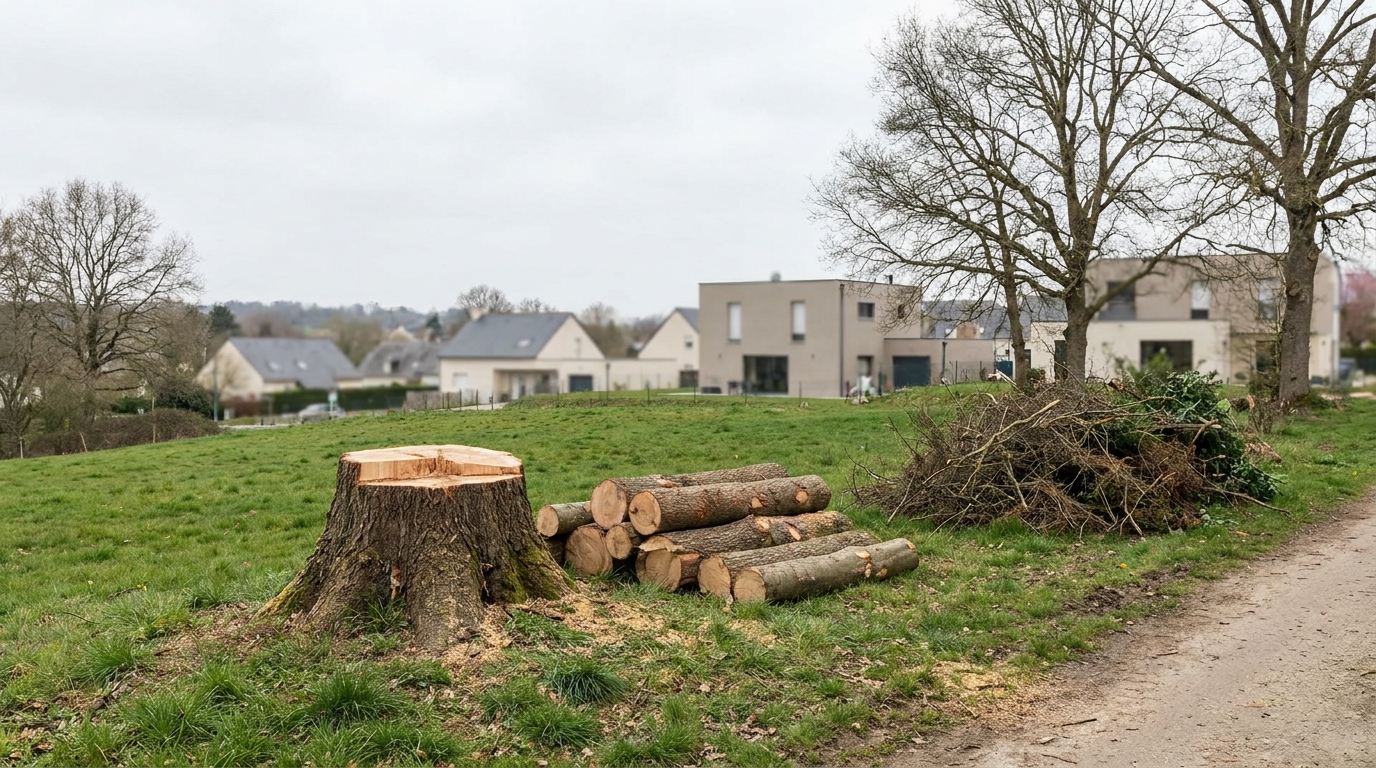
Plan on resprouts. NC State says Callery pear sends new growth from the base and the roots, so a yard removal usually means cutting the tree and grinding the stump. Where the goal is to kill the plant, extension says a herbicide on the fresh cut may fail if it is not applied within 5 to 10 minutes, and the product label is legally binding.[1] We cut and grind. We do not hand out pesticide recipes. If sprouts are the worry, say so when you call, and see our stump grinding service. Shoots that come back still need a follow-up.
When removal is the safer call
We do not tell every owner to cut a pear the week it is identified. We do say when waiting is the larger risk.
Remove it before the next storm if you can see a crack, an opening seam, or a split that has already dropped one side. Cabling may reinforce a large codominant pair.[6] It does not erase included bark over a bedroom, a driveway, or a parking row.
Remove it if the tree is mature, the forks are tight and numerous, and a target sits underneath. A crown about 30 to 50 feet tall over a roof, sidewalk, or play set is that kind of target.[2] Use Clemson's 2020 note on splitting after 15 years, and the 15- to 20-year self-weight window from the 2017 and 2019 reviews, as a reason to look closely. They are not a switch that flips on a birthday.[3][5]
Remove a same-age row if one tree has already split. Subdivision and parking-lot pears often share the architecture. One failure is a preview. Property managers usually have cars and walkways in the fall zone and little reason to leave a torn trunk until it leafs out.
Remove it if you want to stop the seed. NC State encourages owners to take Callery pears out and replace them with natives such as flowering dogwood, eastern redbud, serviceberry, black cherry, or Chickasaw plum.[1] What you plant next is a separate choice.
A young tree with small shoots, no crack, and nothing under it can still be structurally pruned.[4][6] If the stems are large and people are under the crown, we would rather take the tree down on purpose than meet it on the roof after a weeknight storm. Do not replant another Callery cultivar. The 2025 NC State publication applies the seed problem to the whole species, not only to the name Bradford.[1]
Practical takeaways
- Bradford pears split because upright stems of similar size form tight V crotches with included bark, so mild or moderate storms, and even the tree's own weight, can open the trunk.[1][4][5]
- Look for clustered upright limbs, bark turning into the fork, and any crack or old tear. Clemson's 2020 factsheet tied severe splitting to trees 15 years and older, inside a 15- to 25-year life span.[3][6]
- Early training on a small tree can help.[4] On a mature tree, cutting off one huge stem can tear the trunk, and a cable only reinforces the weak union.[6]
- Bradford cross-pollinates with other Callery cultivars. Birds spread the seed, and the wild trees are thorny. NC State in 2025 reported thorns up to 4 inches. Clemson in 2020 reported a quarter inch to over 2 inches.[1][3]
- North Carolina lists Callery pear as an invasive tree. A bounty program, which an April 2026 NC State report credited with replacing more than 3,000 trees at 18 events since 2022, does not pay for the removal, and events move around the state.[7][8]
- Removal is the safer call when the fork is cracking, the crown stands over a target, the tree is in that older age band, or you want to stop the seed. Deal with the stump, because these pears resprout.[1]
How we can help
Have more questions or want to get in touch?
Our team looks at the unions, what sits under the crown, and whether the pear should come down before the next wind. We remove the tree and can grind the stump so you are not left with a sprouting knob. You can see how we handle takedowns on our tree removal page, or call (980) 247-TREE and we will set a time to look at the tree.
Citations
- NC State Extension Publications, "Callery Pear: Bradford Pear, Other Varieties, and Their Invasive Offspring" (2025-07-10)
- NC State Extension Gardener Plant Toolbox, "Bradford Pear - Pyrus calleryana" (accessed 2026-09-28)
- Clemson Cooperative Extension, Home & Garden Information Center, "Bradford Pear" (revised 2020-01-09)
- University of Florida IFAS Extension, "Pyrus calleryana: 'Bradford' Callery Pear" (2019-04-25)
- USDA National Invasive Species Information Center, "Callery Pear" (summarizes Culley 2017 and McMillen et al. 2019; accessed 2026-09-28)
- Florida Urban Forestry Council, "Stump the Forester: What Are Codominant Stems?" (2025)
- North Carolina Forest Service, "N.C. Forest Service - Invasive Plants" (accessed 2026-09-28)
- NC State College of Natural Resources, "Bradford Pear Bounty Program Replaces Invasive Trees With Native Species" (2026-04-22)
- N.C. Cooperative Extension, Madison County Center, "On the Lookout for Non-Native Invasive Plant Species: Callery Pear" (2025-11-24)
- Clemson University News, "Invasive Bradford Pear, 3 Other Species to be Banned for Sale in South Carolina" (2021-07-14)