Tree Roots and House Foundations Rarely Crack Sound Slabs
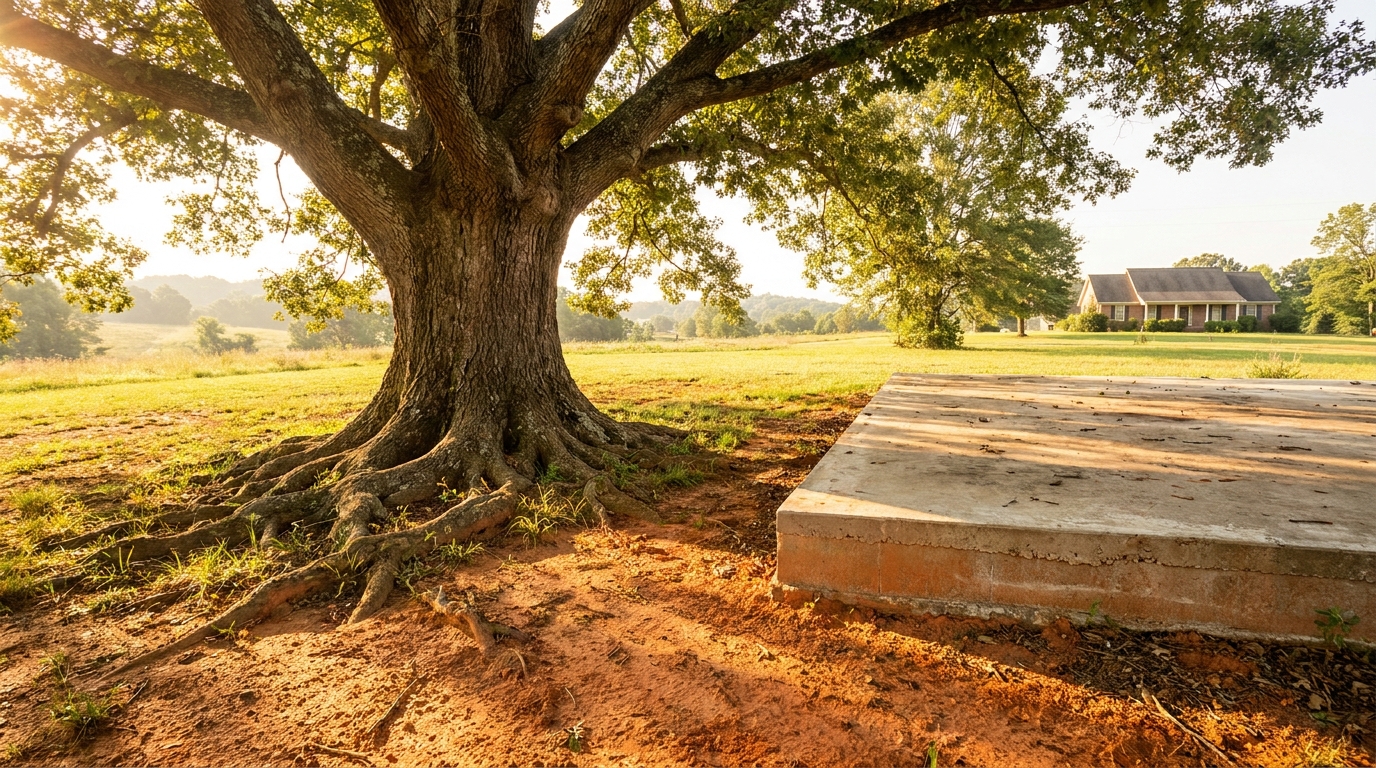
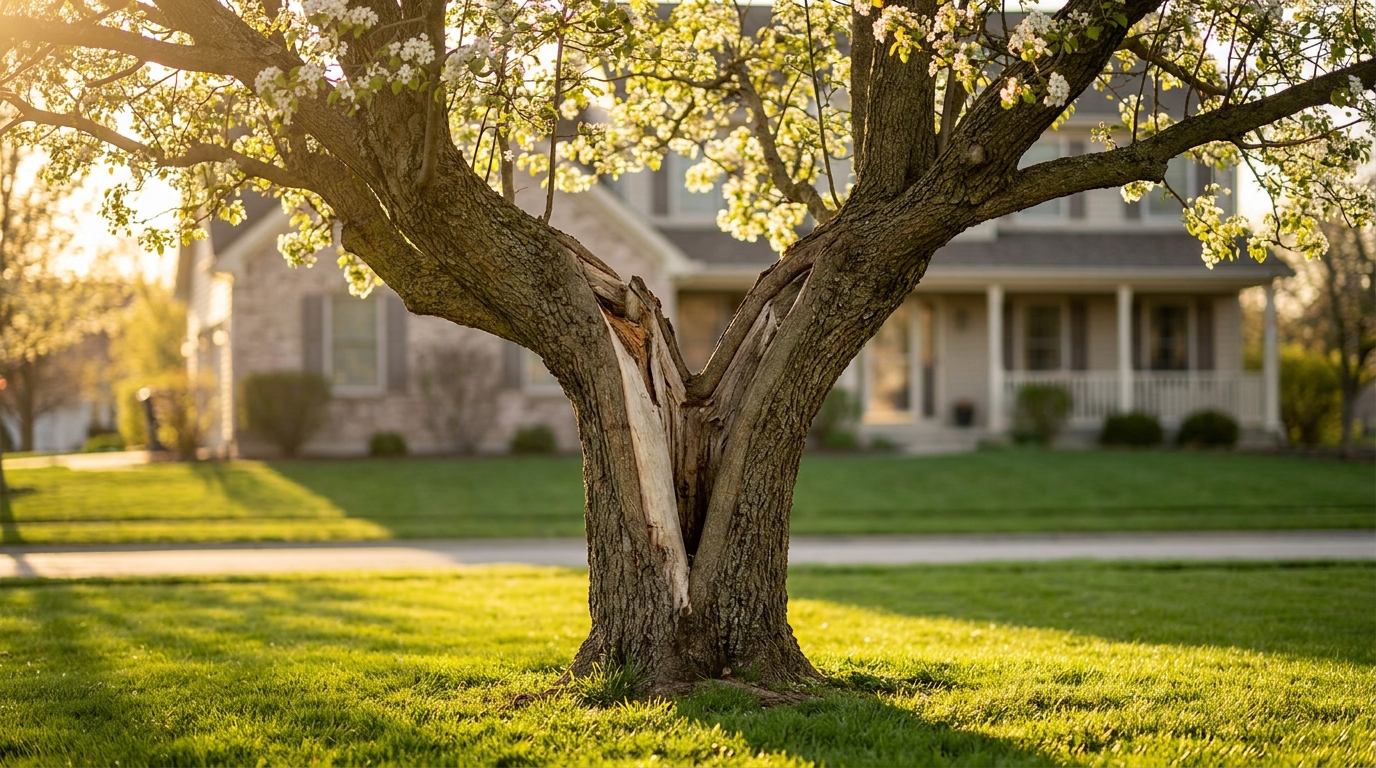
Usually, no. Tree roots and house foundations get blamed together after a slab crack or a sewer backup, and the order of events is often backwards. Roots grow where moisture and loose soil make it easy. When they meet solid concrete, a sound pipe, or a foundation wall, they tend to turn aside. They exploit a crack, a gap, or loose backfill that is already there [1]. A September 2024 extension reply said roots do not generally keep pressing on a solid surface. The responder had seen roots physically move a foundation, but only from trees allowed to grow within a few feet of the house, and even then the root was most likely using a weakness already in the wall [2]. Around Waxhaw, Union County, and Charlotte, the clay is not one soil. The Cecil series, mapped in the North Carolina Piedmont, is rated low for shrink-swell. Enon, also a North Carolina Piedmont series, is rated high. The Mecklenburg series, established in Mecklenburg County, is rated moderate [3][4][5]. Sawing off a large root beside the house to "save the slab" can be the step that makes the tree unsafe [9].
Roots follow water. They do not jackhammer sound concrete.
Purdue Extension answered this in October 2020, after a homeowner asked about a large oak close to a walkout basement. Roots can damage a foundation when they are invited to. They grow in loose soil and mulch. Solid surfaces such as pipes, sidewalks, curbs, and foundations usually send the root sideways, or up and over. If a breach or a crack is nearby, the root will use that void while it hunts for moisture [1].
That is not a root acting like a jack under a sound slab. Most roots grow horizontally, and not very far below the surface. The exception Purdue described is the loose soil builders put back against a foundation. A root running sideways can turn down in that softer backfill. The way to see whether one is actually against the wall is a careful dig, a foot or two down, within a few feet of the foundation. Purdue's note about cutting a suspect root belongs to that case: a root already found in the backfill, on a wall that may need repair anyway, ideally with a barrier so it does not grow back [1]. It was not advice to chainsaw a buttress root off a mature oak.
The 2024 reply adds a distance test. A root may worsen a crack that is already there, but an oak twenty feet off the corner is a poor first explanation for a new crack in the middle of a slab [2].
Charlotte clay is not one soil
Homeowners here hear one story on repeat: red clay swells and shrinks, and the oak or maple cracked the house. That is not true of every yard from Waxhaw to Charlotte. The color on a shovel is not a rating.
USDA describes soils series by series. Cecil soils are very deep, well drained Piedmont upland soils formed from felsic igneous and high-grade metamorphic rock, mapped in North Carolina. USDA classifies them as fine, kaolinitic, thermic Typic Kanhapludults and rates shrink-swell potential as low, in a series description revised in November 2025 [3]. A slab crack on that kind of ground is a weak candidate for "the clay heaved and the tree did it." Not every lot is Cecil. Soil packed against a foundation is often fill, not the native series. Red Piedmont clay is still not automatically expansive clay.
Enon soils are the contrast. They are Piedmont upland soils in North Carolina, formed from mafic or intermediate rock such as diorite, gabbro, diabase, or hornblende gneiss or schist. The official description, revised in June 2026, rates shrink-swell potential as high [4]. The Mecklenburg series sits between them. It formed from intermediate and mafic crystalline rock, it is mapped in North Carolina, and it was established in Mecklenburg County in 1910. USDA rates its shrink-swell potential as moderate, in a description revised in November 2025 [5].
Where shrink-swell is real, moisture moves the house. The ASCE Geo-Institute, in a 2022 guide from its Shallow Foundations Committee, says these soils create damaging up-and-down movement because moisture changes. Keeping moisture even beside and under the foundation is the most useful maintenance step. Drying outside can pull moisture out from under the house, the soil loses volume, and the foundation can move down. The tree line is specific: roots next to or under the foundation can dry soils and cause non-uniform downward movement. On those soils the guide says to plant trees farther away than their mature height. If the tree is already closer and movement tracks drought, the steps it discusses (a moisture barrier, less canopy demand, watering on the far side of the tree) are moisture management, not proof a root lifted a sound slab on low shrink-swell Cecil clay [6]. A barrier or a pier is foundation work.
The same 2022 guide lists other lookalikes: roof water dumped at one corner, poor drainage, drought, and a leaking water or sewer line, which it treats as a plumber's leak check [6]. Stair-step brick cracks, sticking doors, sloping floors, and floor cracks about 1/16 inch across or wider are on its sign list, especially when they change with the seasons [6]. None of that names the tree.
Sewer backups: the pipe usually leaks first
The other call is the sewer. A bathroom backs up, a camera shows roots, and the oak is sentenced. Union County Cooperative Extension wrote about this on March 7, 2023. Roots search for nutrients and moisture. If the pipe is vulnerable, they find it. A tiny root enters a crack, thickens, and widens that crack. Then the line blocks, and the tree gets the blame [7].
Roots cannot create the crack. They can only use a crack or gap that is already there. They do not wrap a sound pipe and squeeze it open. If roots are inside the line, the line was already leaking. Old clay tile and cast iron break down. The article says modern PVC should not break down for 100 years or longer, then notes joints that were never sealed and a cap left sitting loose. Harsh drain chemicals can also damage older pipe. The mechanical fix it points to is a plumber with a snake or pressurized water [7].
The North Carolina Extension Gardener Handbook, published February 1, 2022, agrees. Roots are often incorrectly blamed for pipes that failed from settling, age, and wear. Leaks invite roots in, and thickening roots widen the breaks [8]. Clearing the roots does not seal the joint. Removing the tree does not seal it either.
Distance is why "it is only a few feet from the line" is weak comfort. The Union County article says roots can grow two to three times as wide as the tree is tall, so shifting a planting five feet will not decide whether roots can reach a leak [7]. The 2022 handbook puts the absorbing root zone beyond the drip line, out to about two to three times the distance from the trunk to the edge of the canopy [8]. Those are 2022 and 2023 extension rules of thumb, not a tape measure of one Indian Trail oak.
Do not plant on top of the line for a different reason. The Union County article says you do not want to cut the tree down when the line needs work, and you do not want decades of trunk weight on the pipe. That weight is not the same thing as a root in a crack [7]. The handbook also says not to plant willow, maple, or elm near a septic field [8]. We do not repair sewers or septic systems.
Sidewalks heave. Foundation walls usually do not.
People generalize from the driveway. The 2022 handbook says that as roots increase in diameter, they crack or lift sidewalks, driveways, and other paved surfaces [8]. Purdue's point still holds. The root did not drill through the concrete. It was turned by a hard surface, then got thicker under a shallow slab [1]. A sidewalk and a house foundation are not the same structure. A footing goes deeper, and intact concrete gives the root a reason to go around [1][2]. A popped paver is not evidence the same tree cracked the slab. Severe root pruning, the handbook says, leads to major decline or death of the tree [8].
Cutting a big root next to the house can make the tree dangerous
This is the part a tree crew is for.
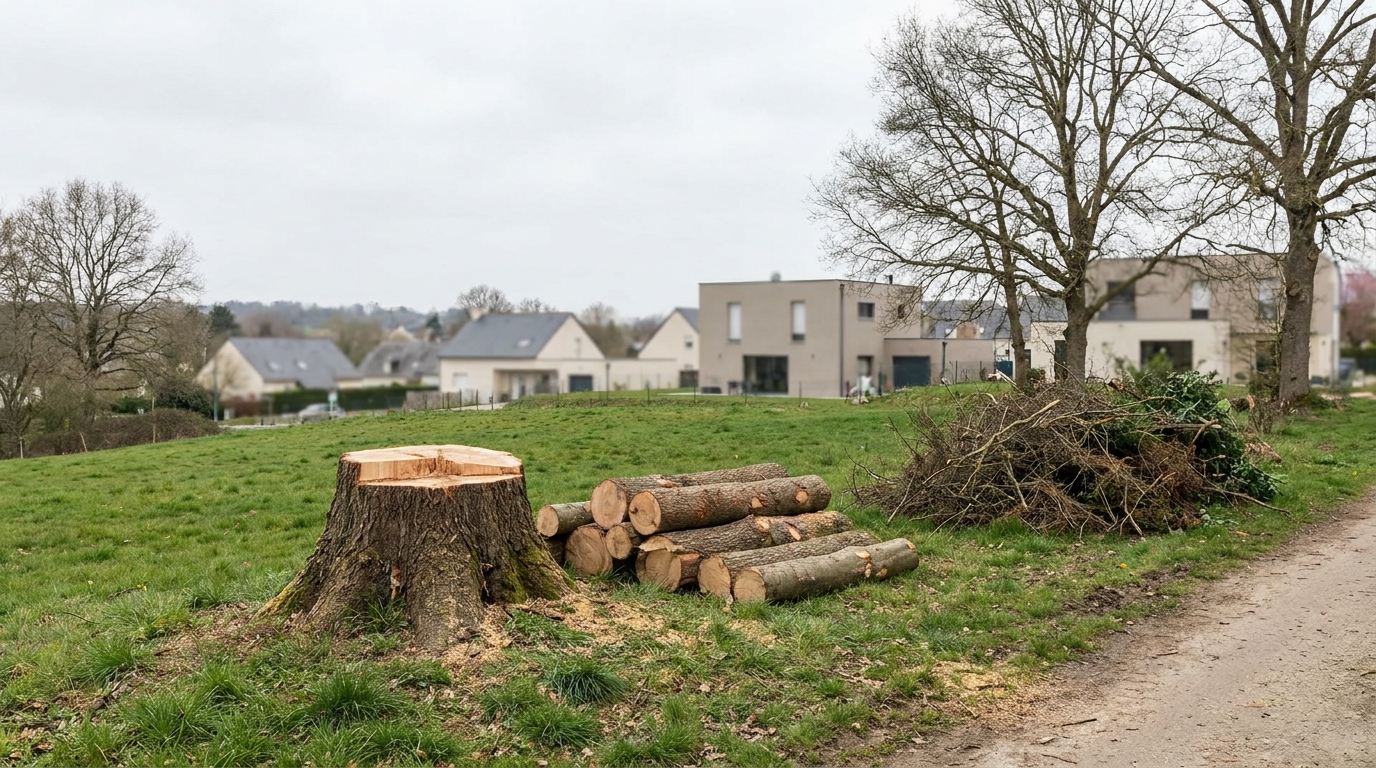
Oregon State University Extension, in a construction guide first published in 2009 and reviewed in 2023, says cutting or disturbing a large share of the roots raises the chance the tree fails or dies. Most roots over 4 inches in diameter are likely structural. Cutting them may affect stability and can lead to catastrophic failure, meaning the tree falls. Cuts that have to happen should be clean, with sharp tools, not torn by a backhoe, because a ragged tear spreads decay. If the damage is already severe, removal belongs in the conversation [9].
That guide prints a critical-root-zone rule it attributes to the International Society of Arboriculture: 1 foot of radius for each inch of trunk diameter at 4.5 feet up. A 20-inch trunk has a 20-foot zone on that rule [9]. North Carolina State's construction and tree protection publication, reviewed May 28, 2024, uses at least 1.25 feet of radius per inch of diameter, and its table lists 25 feet as good protection for a 20-inch tree. It also says never trench within 3 times the trunk diameter, and preferably never within 5 times that diameter [10]. Diameter means trunk thickness, not tree height. Three times a 20-inch trunk is 5 feet. Five times is a little over 8 feet. The wider zone is about water and health. The close zone is about the roots that hold the trunk up. A cut at the foundation, on a tree only a few feet off the wall, is inside the zone NC State says not to trench [10].
The crown can stay green after the cut. Failure shows up in wind, or in saturated ground, when the remaining roots cannot hold the crown. If a trench has already torn roots on the house side of a large oak, the question is whether the tree is still safe over the house. We would rather take it down cleanly, with a crane when it stands over the roof, than leave it compromised because someone hoped the slab would stop moving.
Keep the scale straight. A small root in loose backfill, cut cleanly, is the case Purdue described [1]. A root over 4 inches, or digging inside a few times the trunk diameter of a tree that could hit the house, is the case these guides warn about [9][10]. If saving the wall means taking the structural roots, removal is often the safer tree decision. The slab still needs its own contractor. We do not lift foundations or predict an insurance payout.
Who to call, and in what order
Call a plumber when drains slow, toilets gurgle, or a camera shows roots in the lateral. The leak came first, and cleaning the pipe is plumbing work [7]. Ask whether it is clay, cast iron, or PVC, and whether the joints were sealed. If the dig will pass near a tree you want to keep, call us before the excavator. NC State says not to trench inside a few times the trunk diameter [10].
Call a foundation contractor, or a structural or geotechnical engineer, when the house is moving: widening cracks, stair-step brick, doors that stick in dry weather, a sloping floor. On moderate or high shrink-swell soils, uneven moisture, including drying by nearby trees, is a real mechanism, and so are plumbing leaks and bad drainage [4][5][6]. On low shrink-swell ground such as Cecil, do not skip that inspection because an oak is nearby [3]. We can talk about the tree. We cannot tell you the footing is sound.
Call us when the decision is the tree. A large root someone wants cut beside the foundation, a trench that already severed one side, a lean toward the house from a tree only a few feet off the wall, or a mature oak that should come out rather than lose its anchors [2][9]. Removal, trimming that leaves those roots, stump grinding after the tree is down, and a crane when the crown is over the roof are the work we do. Canopy reduction is sometimes mentioned, on shrink-swell sites, as a temporary way to lower water use [6]. It does not repair a pipe or a slab.
For a new tree, keep it off the sewer line itself so the pipe can be dug up later without a trunk sitting on it [7]. Skip willow, maple, and elm near a septic field [8]. If a soils report has already called the ground shrink-swell, the 2022 ASCE distance is greater than the tree's mature height [6].
Practical takeaways
- A sound foundation is a hard surface roots usually go around. They widen cracks and enter pipes that already leak. They rarely break intact concrete from a distance [1][2][7].
- Red clay in Union County and Charlotte is not one rating. Cecil is low for shrink-swell, the Mecklenburg series is moderate, and Enon is high. Shoe-staining red dirt does not tell you which series is under the house [3][4][5].
- On soils that do shrink and swell, a nearby tree can dry the ground unevenly. So can drought, bad drainage, and a leaking pipe. A foundation professional has to sort that out [6].
- Roots in a sewer mean the pipe had a crack, a bad joint, or a bad seal first. Cleaning the line is plumbing. Removing the tree does not close the hole [7][8].
- Sidewalks and thin driveways lift as roots thicken. That is not the same evidence as a cracked footing [8].
- Roots over about 4 inches across are likely structural. Cutting them, or trenching within a few times the trunk thickness, can leave a green tree ready to fall [9][10].
How we can help
Have more questions or want to get in touch?
If a tree near the house is the question, our team can look at whether it should come down, whether a crane is the safe way to take it, or whether trimming can happen without cutting the roots that hold it up. We do not repair foundations, clear sewer lines, or promise what a claim will pay. Start with our tree removal service or the contact page. You can also call (980) 247-TREE.
Citations
- Purdue University Extension, Forestry and Natural Resources, "Question: Can tree roots cause damage to a home's foundation?" (2020-10-27)
- Ask Extension, "Oak Tree Root" (2024-09-09)
- USDA Natural Resources Conservation Service, "Official Series Description - CECIL Series" (2025-11)
- USDA Natural Resources Conservation Service, "Official Series Description - ENON Series" (2026-06)
- USDA Natural Resources Conservation Service, "Official Series Description - MECKLENBURG Series" (2025-11)
- ASCE Geo-Institute, Shallow Foundations Committee, "Living With Shrink/Swell Soils: A Homeowners' Guide to Maintenance of Shallow Foundations" (2022)
- N.C. Cooperative Extension, Union County Center, "Tree Roots & Sewers" (2023-03-07)
- NC State Extension, "11. Woody Ornamentals" (2022-02-01)
- Oregon State University Extension Service, "Protecting trees on construction and development sites" (reviewed 2023; first published 2009)
- NC State Extension, "Construction and Tree Protection" (reviewed 2024-05-28; first published 2019-06-13)