Crape Myrtle Winter Pruning: Cut to a Lateral
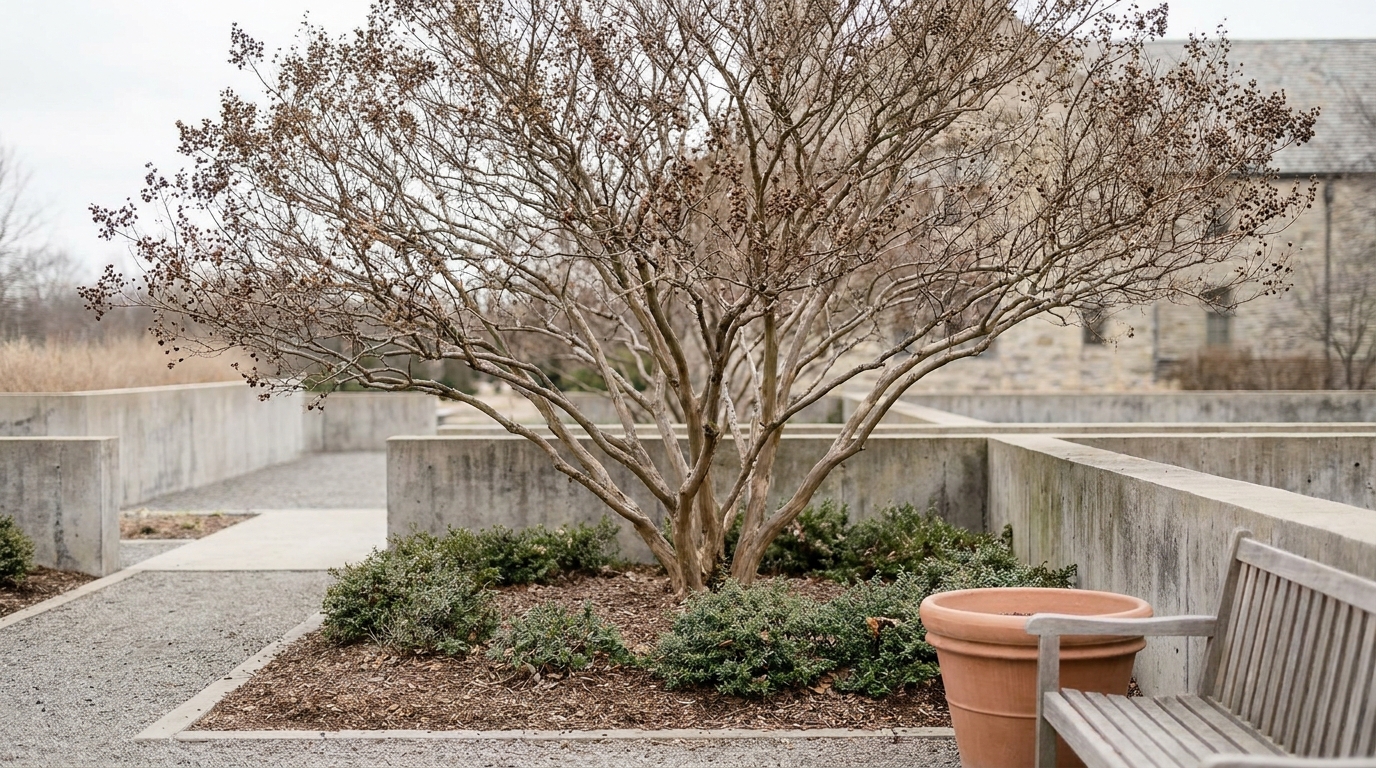
A fat stub on a crape myrtle is not a proper reduction, and it is not good crape myrtle winter pruning. In late fall, a lot of yards around Waxhaw get those cuts anyway: main limbs sawed off in open wood until the top looks like a row of knuckles. Next summer the wood that comes back is crowded and weakly attached, and it breaks more easily than a branch the tree grew in place [1][4]. When height has to come down, we cut back to a lateral branch. We do not leave fist-sized stubs on a crape myrtle.
What a knuckle cut actually is
The practice has a plain name: topping. A few university pages also use the nickname "crape murder" for the worst of it [1]. After this we will stick to knuckle cuts, stub cuts, and topping.
Topping is a heading cut. NC State Extension's pruning guide, revised in 2025, describes cutting main branches back to stubs at random spots, ignoring the branch collar [5]. Sprouts push from latent buds under the wound and are held on by the newest growth ring, not a real branch union [5]. The wound is hard to close, and decay is likely, so those fast shoots sit on wood that is already breaking down [5].
Union County Extension, which covers Waxhaw, defines topping as cutting the crown back to stubs, or to side branches too small to take over the end of the limb, the way a shrub gets sheared [7]. Brunswick County Extension says crape myrtles are multi-trunk trees, and a stub in the middle of a branch is not a reduction [2].
A reduction cut shortens a stem back to a lateral large enough to take over, at least one-third to one-half the diameter of the branch you remove [5]. Brunswick County says the same thing plainly: take the tall branch back to the lateral you want, instead of cutting it in the middle [2]. Pender County Extension calls that reduction pruning, made where the tall or wide limb joins another branch, and prefers it to topping [6]. A fist in empty wood has no side branch. It is only a wound.
What those stubs do next summer
Flower buds form on new growth, so a winter cut finished before growth starts does not erase the coming bloom [1][3]. That is why a knuckled tree can look fine in July. The flush is real. The wood under it is not.
New shoots come out a few inches below the cut [1]. A large stub sends up a crowd of them, and the crown looks like pom-poms on stalks rather than a crape myrtle [1]. Those shoots are poorly attached, so wind and ice tear them, and they sag under the flowers because they cannot hold the load [1].
UF/IFAS Extension calls that summer shape a witch's broom: out of proportion, with profuse growth at the cuts, basal sprouts, and a shell too dense for air and light inside [4]. Blooms may be larger, on thinner wood that droops after rain and may break [4]. Repeat the stubs and large knobs build where the saw keeps landing [4]. Brunswick County ties the knuckle to the tree trying to compartmentalize around the wound [2]. Henderson County Extension, writing in 2024, says repeated cuts on large stems leave unsightly knuckles, and that the idea they should be cut back to the main stem every year is untrue [8].
Severe stub pruning can also mean a shorter bloom, delayed flowering, weaker branching, and more insect and disease trouble [2]. Topping may shorten the life of the tree [4]. It does not mean a dead plant by spring. Clemson's factsheet, revised in 2015 and still the Cooperative Extension page on this practice, states that severe pruning will not kill or injure a healthy crape myrtle [3]. The same page says a hard prune is not what makes the flowers better [3]. The tree flowers well with no pruning, and light pruning is what can enlarge the bloom [3].
Why the saw comes out so early
Once the shape is set, Wayne County calls these trees low-maintenance, and Clemson says only light pruning, if any, is typical [1][3]. The saw still comes out because a neighbor was topped, because someone said the flowers depend on it, or because the plant outgrew the bed [3].
Union County's urban forestry page describes a pattern we also see on newer Waxhaw streets. Trees go in close to a new house, then get topped years later because they feel too tall, when the worry is siding and gutters [7]. Clearance off a wall does not need a knuckle on every trunk. Clemson says to raise limbs that block people or cars, prune above the roofline when they cover a one-story window or door, and remove a trunk tight to a building [3]. Topping to force the fit is the last resort [3].
If size control means a hard prune every year or every few years, the plant is in the wrong place [5]. Cultivars run from about 3 or 4 feet to well over 25 feet [5]. In a 2022 Pender County note, Natchez, Muskogee, and Tuskegee were described as reaching 25 feet or taller, with a similar spread, while Tonto, Sioux, and Catawba were described as 15 feet or less [6].
What a cut back to a lateral looks like
Crape myrtle winter pruning has a season because the flowers ride on new wood [1]. Prune in winter, before spring growth. Many people prune from late February into early March [1]. Dormant late winter is the better window, because the frame shows once the leaves are down, while dead, damaged, diseased, and crossing wood can come off any time [2]. UF/IFAS puts the main pruning in late winter, and Clemson puts structural cuts in the dormant season, winter or early spring [3][4]. If leaves are still on in late November, wait until you can see the laterals, and finish before the buds push.
Start with dead, dying, and diseased wood [1]. Remove branches that cross or rub before they open a wound, and remove shoots growing inward or down so the crown heads up and out [1]. Pull basal sprouts while they are soft, and take water sprouts as they show [1][3]. In a crowded spot, take a whole limb back to another limb so air can move. Wayne County notes that this can lower the chance of powdery mildew [1].
If only last summer's shoots overshot, remove that growth and stop. A tree that is already short enough only needs old flower heads and seed pods [8]. Henderson County, writing in 2024, calls the outer work pencil pruning: pencil-sized twigs in the third degree of the crown, with the ground stem as the first degree, the next split as the second, and the split after that as the third [8].
When a longer limb must come back, find a side branch headed up and out that is at least one-third to one-half the diameter of the piece you remove, so it can keep feeding what remains [5]. Cut just beyond it. Pender County describes that same joint, and Clemson says twiggy growth should go back to lower side branches rather than a chopped top [3][6]. Do not leave a bare peg in empty wood.
A limb removed entirely is cut just outside the branch collar [3][7]. Pender County notes that a correct collar stands out a centimeter or two [6]. On a young thicket, keep three to five strong trunks, take the extras off at the ground, and lift lower side branches over the first few years [1][3]. That is training, not topping. Seed heads are optional: cut just above a lateral bud if you can reach them, let them drop on a tall tree, and know that tipping pencil-thin wood may enlarge flower clusters without being required for health [3][6].
Do not remove more than 25% of the live growth in the dormant season, or 10% while the tree is in leaf [7]. NC State discourages reduction on older crowns because of decay and stress, reserves it for young trees when it is truly needed, and points that judgment to a certified arborist [5].
If the knuckles are already there
Plenty of crape myrtles around Union County already wear last year's fists. Cutting the knuckle flat only opens the same wound.
UF/IFAS says, while the tree is dormant, keep the strongest two or three sprouts on each stub and remove the rest so the keepers thicken and the crown opens [4]. Follow that for a couple of seasons [4]. The harder reset on that page, for a ruined plant, is a dormant cut to within 1 to 2 inches of the ground, then after two to three weeks keeping three to five new shoots per trunk. A natural look after that takes three to five years [4]. Clemson offers a similar last resort, stems cut to about 6 inches above the ground each year, or replacement with a smaller cultivar, when a large plant is stuck in a small spot [3]. We do not use a ground cut as ordinary winter work. Where a frame remains, select sprouts and cut to a sound lateral. Do not refresh the knob.
Practical takeaways
- A knuckle or fist-sized stub is topping. A level row does not turn it into a reduction.
- Next summer, expect crowded shoots a few inches under each stub, weak attachment, and limbs that sag or break under flowers, wind, ice, or rain [1][4]. Repeat cuts build the knobs [2][4].
- A healthy crape myrtle often survives a bad cut [3]. Bloom can still be shorter, later, and carried on weaker wood [2], and topping may shorten the life of the tree [4].
- Do structural crape myrtle winter pruning while the tree is dormant and the wood is visible, before spring growth. Late February into early March is the stretch many North Carolina agents name [1][2].
- If only last summer's shoots overshot, remove that growth and stop, out at pencil-sized twigs [8]. Otherwise shorten a limb only to a lateral about one-third to one-half its diameter [5][6].
- Treat 25% of live dormant growth as a ceiling, and 10% once the tree is leafed out [7]. If the tree only fits when you pass that every year, it is the wrong plant for the spot [5].
- Trees that already have knuckles need sprout selection, not another flat cut across the fist [4].
How we can help
Clark's Tree Care is based in Waxhaw. For crape myrtle winter pruning on a home or managed property, our team brings height down by cutting back to a lateral branch. We do not leave fist-sized stubs on a crape myrtle. The point is a crown the tree can hold, not a shorter outline that lasts until the next flush.
You can read how we handle tree trimming and pruning on that service page. If a row was headed hard in a past winter, we can sort what to thin, what to cut to a lateral, and what to leave until the frame recovers.
Have more questions or want to get in touch? Use our contact page and tell us what the trees are doing.
Citations
- NC State Extension, Wayne County, "Pruning Crape Myrtles the Correct Way" (2025).
- NC State Extension, Brunswick County, "Crape Myrtle Pruning" (2025).
- Clemson Cooperative Extension Home and Garden Information Center, "Crape Myrtle Pruning" (2015).
- University of Florida IFAS Extension, "Crape Myrtle Pruning" (2025).
- NC State Extension, "Before the Cut" (2025).
- NC State Extension, Pender County, "How Do I Prune Crape Myrtle?" (2022).
- NC State Extension, Union County, "Crepe Myrtles" (2026).
- NC State Extension, Henderson County, "Pruning Crapemyrtles Properly" (2024).