Hanging Broken Tree Limb: Not a Late-Winter Job
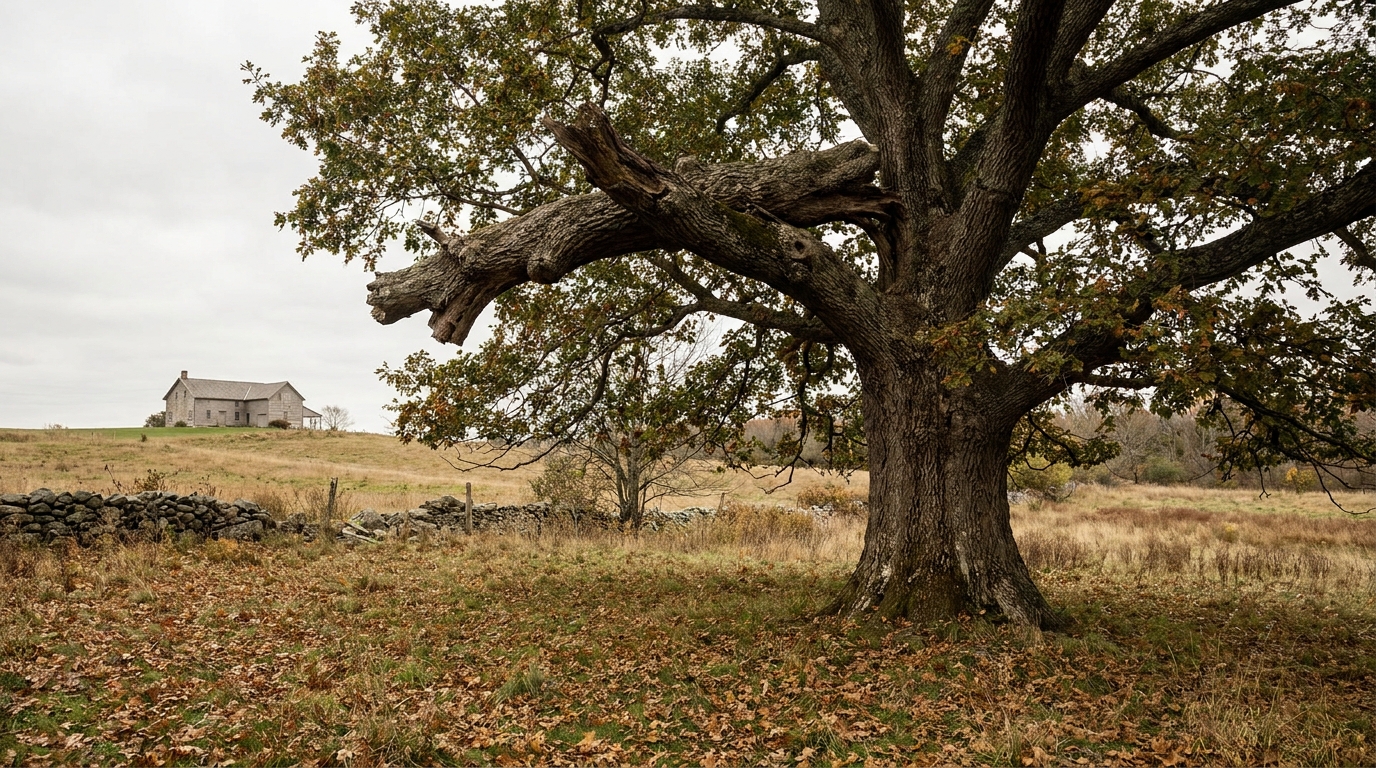
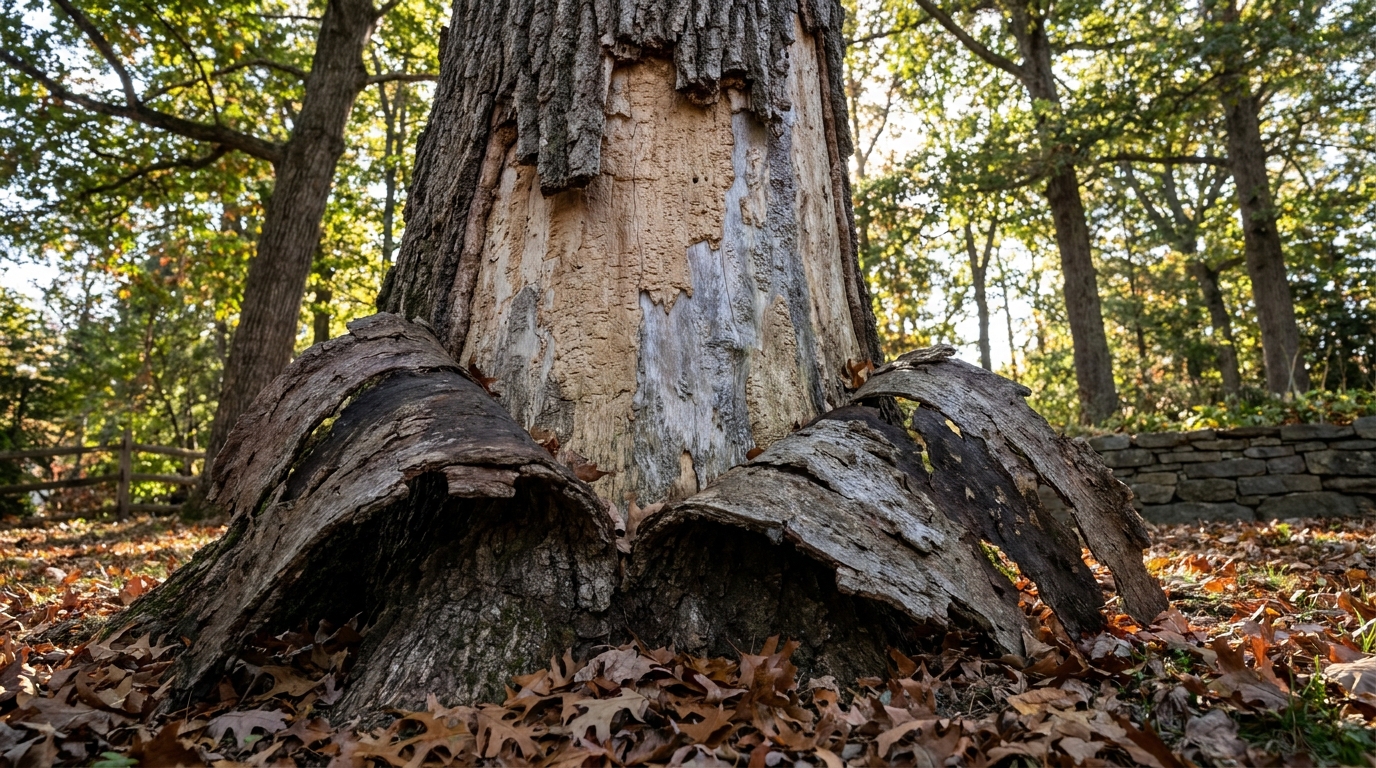
A hanging broken tree limb after a fall wind is not a pruning appointment you save for late winter. Tree workers call that piece a hanger. Older woods slang calls it a widow-maker: wood that has already broken and is only caught in the crown. It can look wedged and quiet. A 2012 University of Kentucky Forestry Extension guide says these limbs can fall without warning on a calm day or a windy one, and that they can stay in the crown for years [1]. Keep people, pets, and cars out from under it. Do not set a ladder under it, and do not pull on it.
What you are looking at
After a windy night in Union County, the yard can look fine from the driveway. The problem is overhead. Kentucky Extension calls broken branches still high in the crown widow-makers: broken or dead hanging branches. [1] That 2012 guide says they follow all kinds of storms, show up more often after ice or snow, and can still be 40 feet up four years later [1]. The broken piece has already failed. It is only caught overhead.
On the Francis Marion and Sumter National Forests in South Carolina, the Forest Service says to look up for broken limbs or tops and not to stand under leaning trees. [2] Ice can crack large branches that stay in the tree. Those cracks can threaten people and property after the ice melts. Limbs may fall at any time, and trees can fall without warning. [2] We see that from Waxhaw to Rock Hill. A clear sky does not make the caught piece safe.
A hanger is not a whole tree lodged in another tree, but both should keep you out. OSHA's logging standard defines a lodged tree (a hung tree) as a tree leaning on another tree or object so it cannot reach the ground, and a danger tree as a standing tree hazardous because of damage to the roots, trunk, stem, or limbs, or because of its lean. [3]
Late winter is the wrong calendar
Clemson Extension says December through mid-March is the best time to prune here, because trees are dormant, bleed less, and are less likely to draw insects or disease. [4] The same note says a larger limb can break partway from the trunk and dangle, waiting to drop, and that dead, broken, and damaged limbs should be pruned out. [4] That winter window is for planned cuts.
NC State Extension says broken, dead, weak, or heavily shaded branches can come off at any time of year. It calls the dormant season the time for general pruning, and the best time to direct growth on young plants if those cuts stay light [5]. It is not a holding pen for wood that has already cracked loose.
Iowa State University Extension says the preferred pruning season may not match the storm, so repair once it is safe to work. Look first at large broken branches, or split trunk wood, still partly attached and hanging over a house, sidewalk, driveway, or garage. [6] NC State's storm page says to check the canopy for large broken limbs that could fall, and for bent or twisted limbs under tension that may spring back. [7] Do not prune other than to remove the damaged wood. Cosmetic cuts wait until the tree recovers and can use its remaining leaves [7].
A hanger is not ordinary deadwood
Ordinary deadwood is still seated. It has not cracked through, it is not hanging free, and it is not lodged overhead. Penn State Extension treats structural pruning and deadwood removal as routine work that keeps weak or dead limbs from failing later. [8] In our area, Clemson's December-to-mid-March window is the time for that planned pass. [4]
A hanger is past that. Kentucky Extension says if widow-makers are overhead, stay out, including a piece in a nearby tree that a shake could drop. Moving brush on the ground can rub a standing tree and bring one down, so the space above you has to be clear. [1] Penn State says to notice broken limbs hanging in trees and to stay away from trees that have failed and are off balance [8]. Patience fits only when the tree is not an immediate hazard, so there is time to hire someone to judge the risk and repair the damage [8]. It does not mean the broken limb waits until March. Dead wood that is already hanging counts as a widow-maker in the Kentucky guide, not as ordinary deadwood. [1]
A limb that is only bent is different. NC State says not to knock ice or snow off branches, because the shock can break them, and not to prop sagging limbs. Wait until the ice or snow melts before cleanup. [9] University of Missouri Extension, in guidance reviewed in 2025, says twisted and bent wood is often under strain you cannot see, and that bent trees and branches larger than 6 inches in diameter are not a job for a weekend woodcutter [10]. Leave a bent, still-whole limb alone, and do not stand under it. A cracked limb in the crown is not that wait.
What to do before anyone climbs
Move cars and pets, and keep people out. University of Minnesota Extension said in June 2026 that hanging limbs can fall without warning. If the area is not safe, rope it off and wait for a certified arborist. [11] Missouri Extension says to look up and down for hanging branches that look ready to fall. [10]
Do not climb, and do not pull, shake, or pole the limb. Bent or twisted limbs under tension may spring back [7]. NC State says to hire a certified arborist if a ladder or chainsaw would be required, if property could be damaged, or if wood under pressure could kick back. [7] Iowa State says to call a professional when the work needs climbing or a chainsaw, a large branch has to come off, or the branch is leaning on another tree or a structure. Minor breakage low on a smaller tree is the exception it leaves to the owner. A limb in the crown is not that exception. [6] Minnesota Extension says not to climb a ladder with a chainsaw. [11]
Sticks already on the ground are different. NC State says to attempt only minor debris yourself. Chainsaw work on storm-damaged trees is dangerous, and historically more people are hurt by chainsaws than by the storm. Do not leave broken or torn parts on the tree. Hire someone who does storm restoration pruning. [9]
If the limb is on a wire
If the limb is on a wire, or a wire is down, stop. Do not pull it free and do not set a ladder nearby. NC State says not to touch limbs that may be on power lines, and not to attempt the tree work if wires are involved. Call the utility and let them deal with the wires. [9] Penn State says to avoid power lines even if the power looks off, and to call the utility and wait if a branch is affecting a line. [8] Iowa State says the utility should handle broken limbs or tree damage around power lines. [6] OSHA's logging rule tells crews the same thing: if a felled tree hits a power line, notify the power company and stay clear until it says the electrical hazard is gone. [3] For a limb on a wire, that is the whole list. Stay away, and call the utility.
After the piece is on the ground
Off the wire, a hanger is still not a ladder job. We keep people out of the fall path and sort out whether the piece is only wedged or still held by a strip of wood. Twisted and bent wood can also be under strain you cannot see [10]. We also look for a second dead branch in a nearby crown, because Kentucky flags that as the same hazard. [1] This is not a cutting lesson. Large or high wood belongs with a trained crew. [6] The call looks the same in Waxhaw, Charlotte, Lancaster, Indian Land, Fort Mill, Tega Cay, and Rock Hill. The wind has quit. The limb has not.
Then decide about the tree. Do not top it. NC State says cutting back to a stub grows weakly attached branches that are likely to fail in a later storm [7]. Penn State says topping, rounding-over, and heading cuts lead to internal decay [8]. Do not paint the wound. Iowa State says dressings can slow the wood that closes a cut [6]. NC State says not to paint storm wounds, and Minnesota Extension says trees seal on their own [7] [11].
Crown loss is about recovery, not about leaving the hanger up. Minnesota Extension's June 2026 note says that if less than 25 percent of the canopy is damaged, most healthy trees bounce back [11]. Missouri's guide, reviewed in August 2025, treats at least half the crown still intact as a rule of thumb for whether the tree can feed itself, and says a tree with less than half its branches may not produce enough foliage [10]. NC State lists heavy canopy loss, major broken limbs, a broken central leader, and extensive trunk damage as reasons to consider removal, with another look in a few months if you are unsure [7]. Get the broken wood down first, then give the tree time [10]. Do not strip live crown just to even the outline [7]. A crack in a large branch can stay a hazard to people and property long after the ice has melted, which is the Forest Service point. The same page says strong winds may weaken trees that are already unstable [2].
Practical takeaways
- A limb caught in the crown is a hanger, not a dormant-season prune. It can fall on a quiet day. [1] [4]
- Keep people, pets, and cars out. Look up from a distance. Do not stand under it to see if it moves. [2] [10] [11]
- Do not set a ladder under it, and do not pull on the limb. Do not run a chainsaw on storm-broken wood in the crown. [6] [7] [9] [11]
- Small dead twigs still firmly attached can wait for a scheduled prune, often December through mid-March. Hanging dead wood, and any broken limb lodged overhead, cannot. [1] [4] [5] [8]
- A bent limb still in one piece is not a cracked one. Leave ice alone. Bent wood larger than 6 inches across is crew work. [9] [10]
- If the limb is on a wire, stay away and call the utility. [3] [8] [9]
- After the hanger is down, skip topping and wound paint, then decide whether the tree stays. [6] [7] [11]
How we can help
Have more questions or want to get in touch?
If a hanger is over the house, the drive, or the yard, and it is not on a utility line, our crew can take that storm call. Clark's Tree Care handles hanging limbs and other storm damage from our Waxhaw base across greater Charlotte and the nearby South Carolina towns. Call (980) 247-TREE or start with our storm damage service.
Citations
- University of Kentucky Cooperative Extension, "Storm Damage - Safety in the Woods (FORFS 12-03)" (2012-04)
- U.S. Forest Service, "Hazard Trees" (2025-03-28)
- Legal Information Institute, Cornell Law School, "29 CFR § 1910.266 - Logging operations" (2026-10-14)
- Clemson Cooperative Extension, "Tree Issues: From Conks to Cavities to Decay" (2024-01-08)
- NC State Extension, "General Pruning Techniques" (2025-03-05)
- Iowa State University Extension and Outreach, "How to Manage Storm-Damaged Trees" (2026-04)
- NC State Extension, "Preventing & Managing Storm Damaged to Trees" (n.d.)
- Penn State Extension, "Helping Trees Recover After Storms" (2024-04-29)
- NC State Extension, "Winter Safety Recommendations" (2026-01-21)
- University of Missouri Extension, "First Aid for Storm-Damaged Trees" (2025-08)
- University of Minnesota Extension, "How to assess and care for damaged trees" (2026-06-16)