Sweetgum Balls on the Lawn Are Fruit, Not a Sick Tree
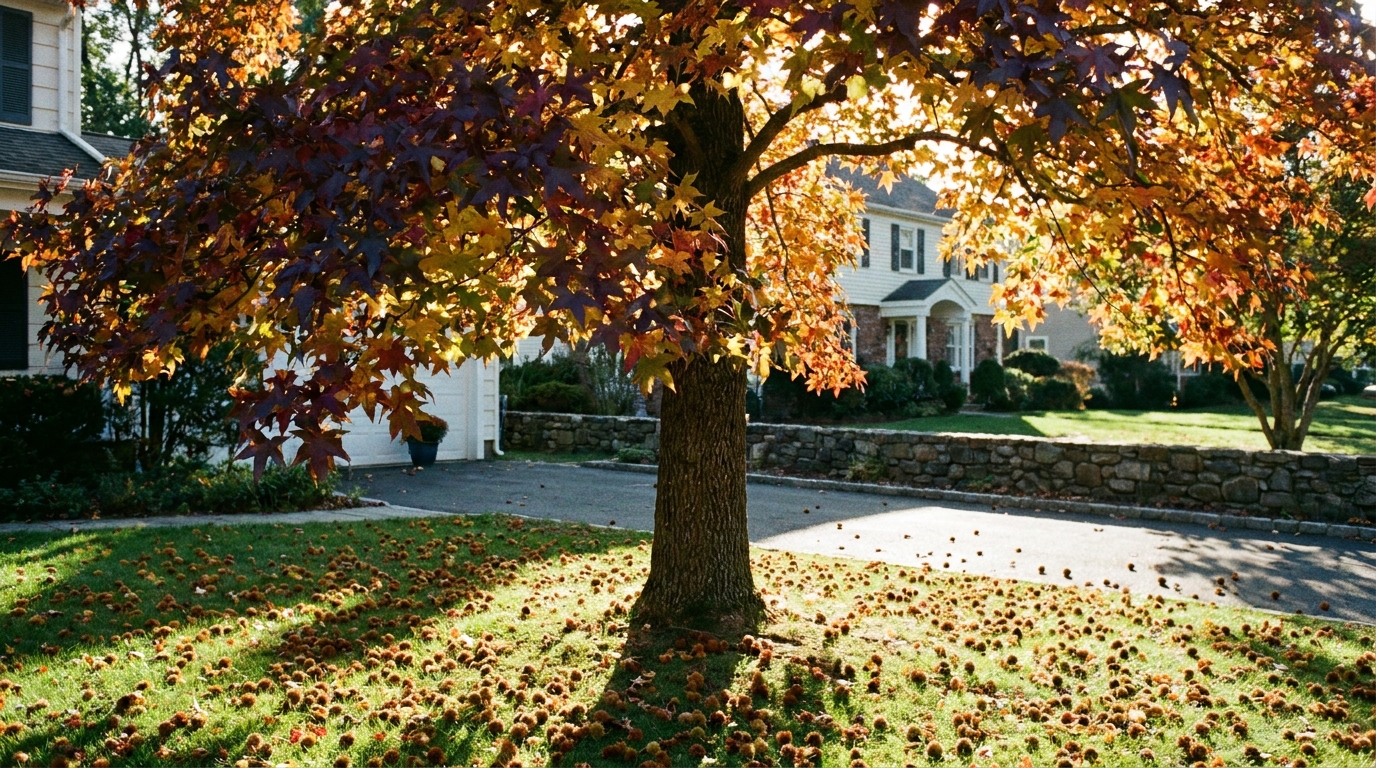
If you are picking sweetgum balls on the lawn and wondering whether the tree is failing, it is not. Those spiky balls are the normal fruit of sweetgum, Liquidambar styraciflua, a tree native to the eastern United States and common throughout North Carolina, including the Piedmont, except on the high mountains [1][2]. North Carolina Extension describes them as hard, bristly fruiting heads made of many small capsules, and it treats them as a litter problem on lawns and patios, not as a disease [1]. A heavy crop means the tree is fruiting, which is what a mature sweetgum does.
The balls are fruit, not a gall and not a disease
The ball is not a swelling the tree made around an insect, and it is not a canker that fell off the bark. It is the seed head. Female flowers, small and easy to miss in spring, develop into a round cluster of capsules [1]. Virginia Tech's dendrology fact sheet calls that cluster a spiny gumball: a woody brown sphere of capsules, about 1 to 1.5 inches across, that opens to release the seeds and matures in fall [3]. NC State's plant toolbox lists a wider size, 1 to 3 inches, and calls the fruit type a capsule [1]. A state wetland plant guide puts the gum balls at about 2 to 3 centimeters and uses the star-shaped leaf plus the prickly ball as the field marks [2]. The published sizes differ. They all describe the tree's fruit.
The leaves confirm the name. Sweetgum leaves are alternate, simple, and star-shaped, with five to seven lobes, glossy, and fragrant if you crush one [1][3]. Twigs often carry corky ridges, but a smooth twig does not rule the tree out [2][3]. The species is monoecious, so male and female flowers grow on the same tree [1][3]. A lone sweetgum in a Waxhaw yard is not waiting on a second tree in order to flower.
NC State lists webworms, caterpillars, borers, scale, leaf spots, wood rot, bleeding necrosis, and iron chlorosis in alkaline soil as problems that can show up, apart from the fruit [1]. It lists the fruit separately, as a litter problem in lawn and patio areas [1]. Sweetgum balls on the lawn are not that symptom list. A thinning crown, yellow leaves outside of fall color, or a trunk that is bleeding, hollow, or soft is a different question. Fruiting by itself is not decline.
The mess has a second side. The fruits persist through winter and attract birds, and a 1990 USDA Forest Service silvics account says the small seeds are eaten by birds, squirrels, and chipmunks [1][4].
Why Piedmont lawns fill up in fall and winter
Around Waxhaw and the rest of Union County, sweetgum belongs. It grows in wet bottoms, moist uplands, and old fields, and it is common across North Carolina except at higher elevations [1][2]. The 1990 Forest Service account also describes good growth on Piedmont soils, including in the Carolina Piedmont [4]. The glossy leaves turn red, purple, yellow, or orange and can hang on a long time [1].
The ball calendar is just as regular. Flowers open in spring. NC State places the bloom in April and May [1]. The 1990 account says March to early May, depending on latitude and weather, and notes that frost often damages the flowers [4]. Green heads mature from September to November, the capsules open and release one or two winged seeds each, and empty heads often stay on the tree over winter [4]. NC State says those balls usually remain through the winter and create cleanup from December through April as the clusters finally fall [1]. The pile on the grass is not a one-week event. One rake in November will not match a tree that is still dropping into spring. The seeds leave first. The sharp, open shell comes down later. That is why the lawn mess outlasts the fall color.
A heavy year is normal, and it is not a death sentence. That 1990 account says fair seed crops occur every year and bumper crops about every 3 years, and that trees start producing seed at 20 to 30 years old and can keep producing until at least 150 years [4]. A big sweetgum that dumps a heavy crop is inside that description. Do not let the volume talk you into "the tree is dying." Dying trees show it in the wood and the crown.
A spray will not retire a mature sweetgum
Homeowners ask us for a spray that will stop the fruit. We do not have one to offer. A December 14, 2021 note from N.C. Cooperative Extension in Henderson County explains why a chemical approach is a poor fit for a large yard tree [5]. Asked whether there is a way to prevent the fruit, the note says yes, but it is probably too expensive and too much trouble [5]. Hormone products can reduce fruit set, but preventing fruit on large, well-established trees is not practical, and the work usually has to be done by a professional arborist [5].
The note names two products, and the limits are the point. Ethephon, sold as Florel Brand Fruit Eliminator, releases ethylene when it is sprayed on the branches while the flowers are out, and at full bloom that can make the flowers drop [5]. The dose, the flowering stage, and the temperature all have to be right, and the tree can be damaged if the dose or the temperature is too high [5]. The other product is indole butyric acid, sold to professionals as Snipper, and it is injected while the flowers are still in bud [5]. The injection takes a skilled applicator, timing and dose are critical, and it has to be repeated every year [5].
That is an annual attempt to interrupt flowering, not a permanent off switch. It does nothing for the balls already on the ground. The extension author on that page recommends that people learn to live with sweetgum fruit or remove the trees [5]. We tell homeowners the same thing. If a spray is sold as a cheap way to end sweetgum balls on the lawn for good, ask for the product name and ask how it lines up with that note.
Trimming is not a side door. The balls are this year's seed crop, not water sprouts you prune off once. Shortening a few limbs will not stop a healthy sweetgum from flowering next spring. We prune when structure or clearance calls for it. We do not sell a trim as a way to retire the fruit.
What raking and a mulch bed can and cannot do
Raking deals with the balls you can see. It does not change next year's flowers. Because the balls keep falling from December into April, a lawn under a mature sweetgum needs more than one pass [1]. Rake walking paths, steps, the drive apron, and the strip where people cut across the yard before you mow. The balls are hard and bristly, and NC State flags them as litter on patios as well as in grass [1]. Hard capsules do not belong in a spinning blade, and they are a poor surprise underfoot after dark.
The 2021 extension note offers the useful middle step: mulch under the tree out to the drip line, and rake the fruit into that mulch, so most of the balls land in a bed instead of in the turf [5]. A wide bed will not make the tree fruitless. It moves the problem off the mowing line. The balls are woody, so they soften slowly. Keep the bed edge off the main walk, and sweep the patio on that same December-through-April schedule [1].
There is a small wildlife tradeoff. The fruits attract birds through the winter, and the seeds feed birds and small mammals [1][4]. If every ball goes into a trash can, that food goes with it. Leaving balls in a bed under the canopy, where feet do not have to cross them, keeps some seed in place and still gives you a cleaner path. Budget for the balls the way you budget for leaves.
Fruitless cultivars do not fix the tree you already have
A fruitless cultivar is a different plant you buy and plant. It does not convert the sweetgum already standing over the lawn. The mature tree keeps the flowers it has.
NC State describes Liquidambar styraciflua 'Rotundiloba' as a fruitless, or thornless, sweetgum introduced by J. C. Raulston in 1997, distinguished by a lack of the spiny balls the species is known for [6]. The same page says it rarely produces fruit and rarely blooms [6]. Keep the word "rarely." The common name says fruitless. The fruit line says rarely. That is a real reduction, not a written promise of zero balls for the life of the tree. NC State lists it at 60 to 75 feet tall and 20 to 40 feet wide, suited to the Coastal Plain and the Piedmont in zones 6a through 9b, in full sun to partial shade and acidic, well-drained soil [6]. It is not as cold-hardy as the species, it still has corky bark ridges, and the page says to keep it off driveways and sidewalks because of an aggressive root system [6]. You can lose most of the balls and keep the fight with pavement.
A September 20, 2002 University of Arkansas Extension note, offered as a plant profile rather than a recommendation to plant the tree, describes 'Rotundiloba' as a grafted tree traced to a sweetgum found wild in North Carolina in the 1930s [7]. That note says fall color varies on the graft, that cold hardiness is only to about -10 F, and that the form can be irregular, so young trees need pruning if you want a straight trunk [7]. "Fruitless" never meant "no other traits." Plant one only where a large tree and surface roots will still be acceptable decades from now. Do not plant it to solve the tree you are standing under today.
Read narrow sweetgums the same way. NC State says 'Slender Silhouette' looks fruitless at first and then gradually produces a few fruits, fewer than the species, in a fluctuating crop [8]. The tree is a tall column, about 50 to 60 feet by 5 to 6 feet [8]. Neither cultivar erases sweetgum balls on the lawn under the tree you already own. The species also has a shallow root system, so a new tree still needs room away from walks and walls [1].
When removal is the honest answer
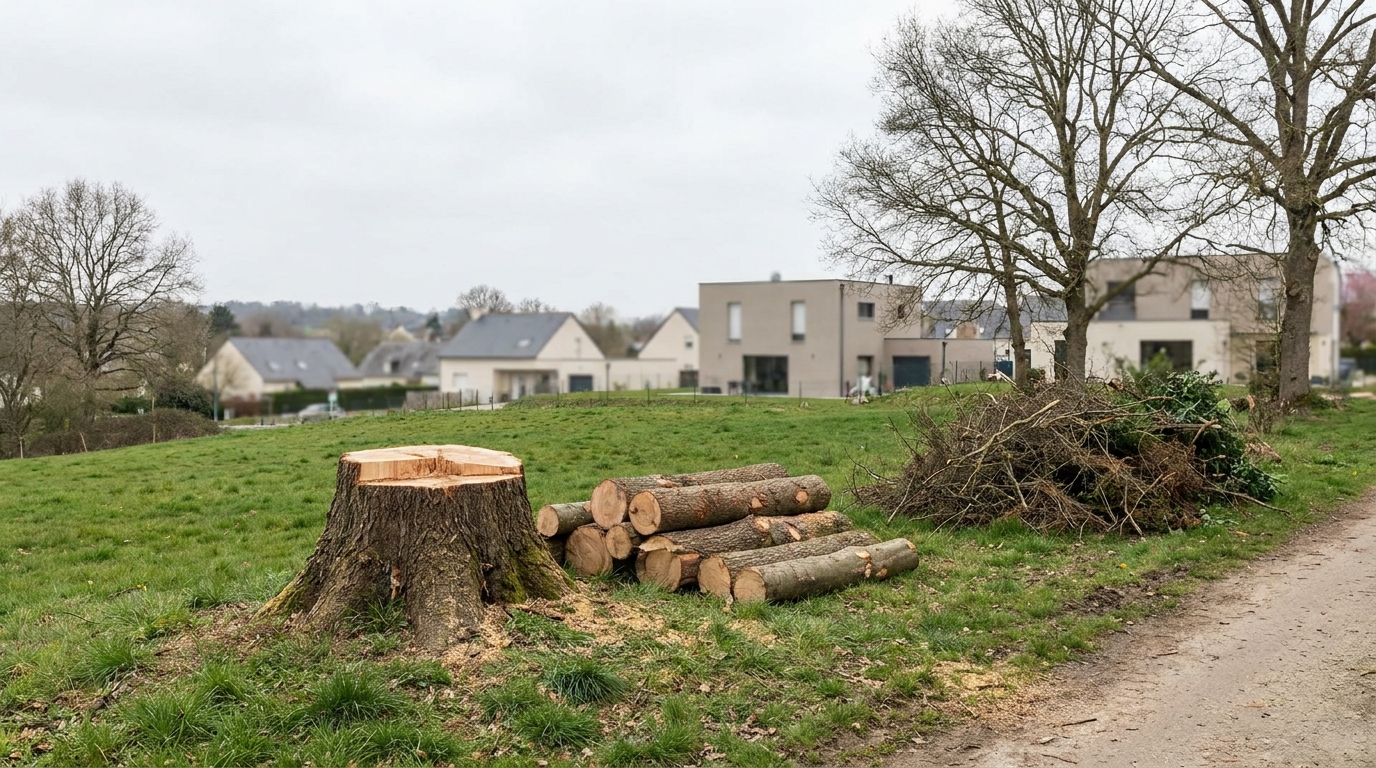
Removal is reasonable when the mess is the problem you actually want gone. It is not the right call because someone said a fruiting sweetgum is a sick sweetgum. If the tree is sound and the balls fall into a bed or a back corner you rarely walk, keeping it is reasonable. You get shade, fall color, and winter food for birds [1]. If the balls land on the path to the door, in a play yard, on a patio you use every week, or in a lawn you are tired of raking from December to April, you are allowed to be done with that tree. The fruit will not taper off because the tree settles down. The 1990 account has seed production continuing into old age, with a bumper year about every 3 years [4].
We judge removal the way we judge any other tree, not by the ball count. Is the trunk over a roof, a driveway, or a line? Is there decay, a lean, or a crack that would matter even if the tree never fruited? A yard sweetgum is often large, and taking one down over a house is a crew job with rigging, not a weekend chainsaw project. Our team handles tree removal across Waxhaw and greater Charlotte, including tight spots where a crane is the safer way to dismantle the crown. If the tree is sound and the only issue is the fruit, we will say so.
Sweetgum is also a stubborn sprouter. The 1990 Forest Service account says much of the sweetgum that comes back after cutting is from root sprouts on the parent root system, not only from seed, and that 40 or more stems on the roots of a single parent tree was not uncommon in the stands they examined [4]. If we remove the tree, we can grind the stump so the mowing line is clear, and you should still watch for soft sprouts from nearby roots the next couple of seasons. Do not remove a sound tree because a heavy fruit year scared you, and do not keep a hazardous tree because the balls are natural. If you are unsure which one you are looking at, we would rather walk the tree with you.
Practical takeaways
- Sweetgum balls on the lawn are woody capsules full of seed, not insect galls and not a disease. A heavy crop is normal for a mature tree [1][3][4].
- In North Carolina the ground litter often runs from December through April, after seeds have blown out of heads that hung on the tree [1][4]. One fall rake will not finish it.
- Hormone sprays and trunk injections can reduce fruit set only inside a tight spring window, with a risk of damaging the tree [5]. Extension calls that approach impractical on a large established tree [5].
- A mulch bed out to the drip line, plus raking the balls into the bed, is the realistic way to live with the tree [5]. It does not stop next year's flowers.
- 'Rotundiloba' rarely fruits, and it is a new tree you plant, not a treatment for the one you have [6]. It is grafted, it still gets large, and its roots can fight a walk [6][7]. 'Slender Silhouette' makes fewer balls, not none [8].
- Removal is a fair choice when you want the mess gone. It is not called for just because the tree fruited. A failing crown or a bad trunk is a separate safety call.
How we can help
Have more questions or want to get in touch?
If sweetgum balls on the lawn have you ready to be done with the tree, or you want a second set of eyes before you decide, our team can look at it in person. We will tell you if the honest answer is a rake and a mulch bed. When removal is the cleaner choice, we handle the takedown. Call (980) 247-TREE or request a free on-site estimate on our contact page. For the work itself, see how we approach tree removal.
Citations
- North Carolina Extension Gardener Plant Toolbox, "Liquidambar styraciflua" (undated)
- NC State University, NC Common Wetland Plants Guide, "Liquidambar styraciflua" (undated)
- Virginia Tech Dendrology, "sweetgum, Liquidambar styraciflua" (2025)
- USDA Forest Service, Silvics of North America, "Sweetgum (Liquidambar styraciflua)" (1990-12-01)
- N.C. Cooperative Extension, Henderson County, "Plant Health Alert - Preventing Sweet Gum Tree Fruit" (2021-12-14)
- North Carolina Extension Gardener Plant Toolbox, "Liquidambar styraciflua 'Rotundiloba'" (undated)
- University of Arkansas System Division of Agriculture, "Fruitless Sweetgum, Liquidambar styraciflua 'Rotundiloba'" (2002-09-20)
- North Carolina Extension Gardener Plant Toolbox, "Liquidambar styraciflua 'Slender Silhouette'" (undated)