hypoxylon canker on oaks Union County means removal
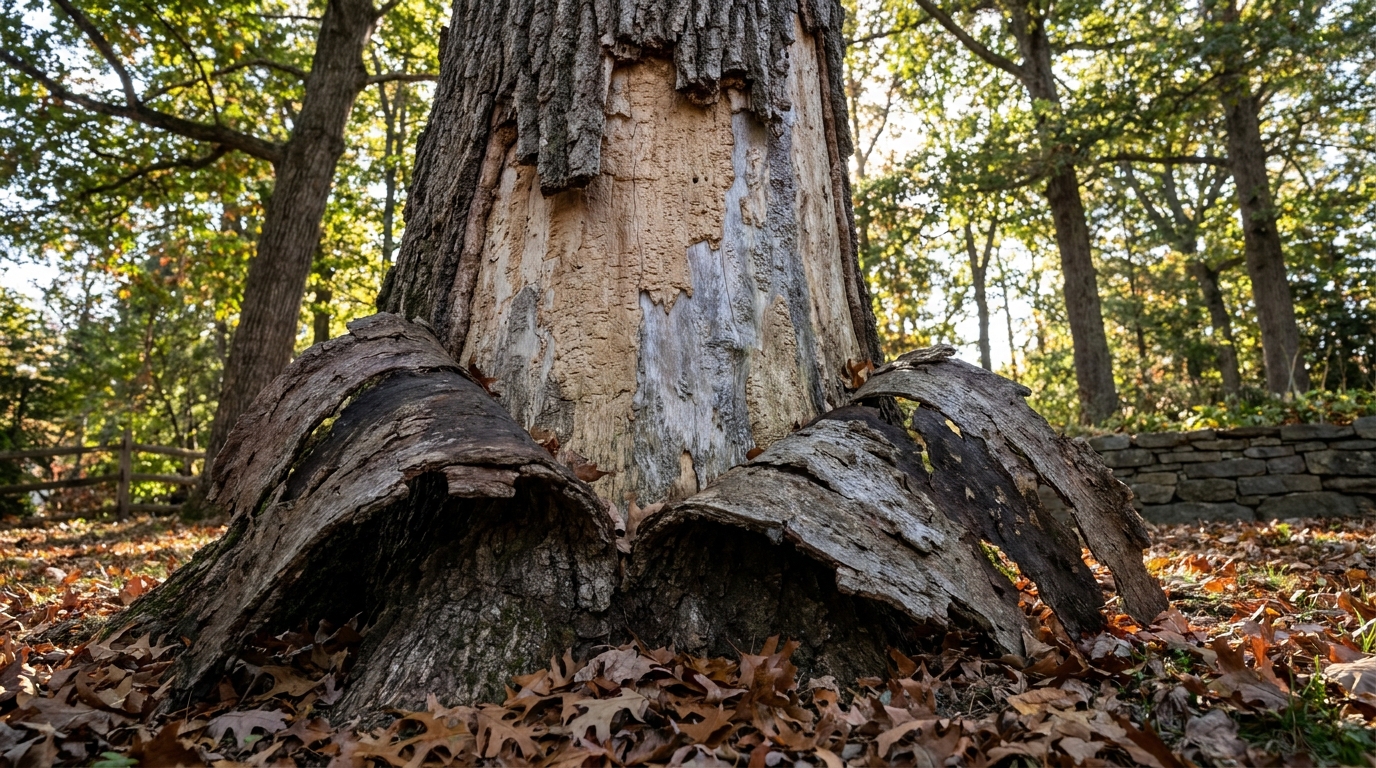
Bark falling off an oak this fall is often hypoxylon canker on oaks around Union County, the stress fungus NC State Extension describes when a flat crust forms under bark that has sloughed off [1]. The fungus, Biscogniauxia atropunctata, still goes by the older name Hypoxylon atropunctatum, and it can live in a hardwood without symptoms until drought, injury, or a poor site lets it invade the sapwood [1]. Once that crust is widespread, the tree is already in serious decline, and neither Mississippi State nor Clemson lists a chemical that will cure a trunk infection [1][2][3].
The crust under the bark
The fungus most often involved on southern oaks is Biscogniauxia atropunctata. NC State Extension also names a second southern species, Biscogniauxia mediterranea, formerly Hypoxylon mediterranea [1]. The fungus builds a flat mat, called a stroma, between the wood and the bark. That mat pushes the bark off in patches or long strips. What is left on the trunk is the fungus, not a scar and not sound wood.
The color changes as the mat ages, and the fact sheets do not list the shades in the same order. NC State describes an early mat that is reddish brown or tan and powdery, then black like tar, then gray [1]. Texas A&M Forest Service describes tan, olive green, or reddish brown powder, a hard dark brown to black surface within four to eight weeks, and silver-gray after several months [4]. Clemson has the stroma moving from brown to gray or silver and finally to black, and Missouri's Department of Conservation says the mature surface can look like thick paint [3][5]. Look for a flat crust in that tan, brown, black, or silver range, stuck to the wood.
The mat may run several inches to several feet, and bark collects at the base [3][4]. Before much bark falls, the crown may thin and leaves may look small, wilted, or scorched [1]. Mississippi State Extension says those leaf symptoms mimic water stress, so the diagnosis depends on seeing the fungus [2]. Smaller leaves, dead branches, yellowing, and brown sapwood travel with the crust [2].
Under the crust the sapwood is failing. Mississippi State describes a white rot that leaves the wood pale and spongy, with black zone lines [2]. Missouri ties those lines to a brittle stem [5]. Texas A&M Forest Service says the sapwood decays quickly once the fungus is active [4]. Thinning or browning leaves can still be hanging while that decay is underway [2][4].
This is not hypoxylon canker of aspen. NC State Extension warns that the aspen disease is a separate fungus, so those photos will not match a Piedmont oak [1].
Red oaks are more susceptible than white oaks. NC State links that to drought hardiness. White oaks generally handle dry weather better, but they are not immune [1]. Clemson lists post oak, water oak, southern red oak, white oak, and blackjack oak, along with hickory and pecan [3]. A white oak with the same crust is the same disease.
Why a dry summer shows up as bare wood in the fall
This fungus is an opportunist that is already around, not a stranger that seeks out the healthiest oak on the block. NC State Extension, citing a 1984 study, reports that Biscogniauxia atropunctata was present in healthy, symptom-free oaks in Arkansas forests, and that girdling stress brought the canker on even in trees researchers had not inoculated [1]. Mississippi State puts the same idea in yard language. In a healthy tree it survives in small colonies in the bark and sapwood, and the tree's defenses hold it. Drought, heat, wounds, root damage, toxic chemicals, and other diseases lower those defenses [2].
Clemson calls drought the most significant factor, and lists construction injury, trenching, grade changes, compaction, and root disease alongside it [3]. Texas A&M Forest Service adds fill dirt, saturated soil, excavation, topsoil removal, herbicide injury, defoliation, heat, and overcrowding [4]. The fungus has a hard time developing while wood moisture stays normal. Stress that dries the wood lets it invade the sapwood, and once it is actively infecting the tree, the tree will likely die [4].
Mississippi State says the fungus is favored by warm, dry weather in the 85 to 95 degree F range, and that outbreaks in Mississippi are often seen a year or two after a significant drought [2]. A 1983 survey of oak death after drought on the South Carolina coast, cited in the 2025 NC State fact sheet, reported that trees did not survive for more than a few weeks after the stromata were visible [1]. A Missouri Botanical Garden page updated in September 2024 describes a wider window: trees may die in one to two years, or sooner if the early dieback is missed [8]. A main stem already covered in crust is the fast end of that range.
Bark on the lawn is not the diagnosis
Plates and strips of bark in the grass are not, by themselves, hypoxylon canker. The fact sheets hang the diagnosis on the crust left on the wood, not on the pile alone [1][2][4]. Bark at the base matters when the bare spot above it is coated with the fungus [3][4].
Stand where the bark left. If the surface is still ridged or firm bark, you are not looking at this canker. If the surface is a smooth, flat crust, tan and dusty, black and tar-like, or silver-gray, you are looking at a stroma [1][4][5]. Touch a tan area. Powder means spores.
Clemson says a stroma may run several inches to several feet [3]. A sheet of crust on the main stem is the pattern that means the trunk is unsound. A single small patch on an upper limb, with a full crown and a clean lower trunk, is a closer look, not an automatic whole-tree cut. Crown dieback and bark on the ground can resemble other problems, so the crust has to be there before the name is the right one [3].
Smooth patch, bacterial leaf scorch, and oak wilt
Three other oak problems get mixed into this question. None of them is a flat Biscogniauxia crust on the sapwood.
Smooth patch does not threaten the tree. Purdue Extension, in a March 2025 note, describes a fungus limited to the nonliving outer bark, often Aleurodiscus oakesii [6]. That outer layer sloughs and leaves a smoother, lighter patch, from a few inches across to a foot or more, on the trunk or limbs [6]. Tiny gray or beige discs on that bark are usually less than half an inch across [6]. Because the fungus never leaves the dead outer bark, Purdue says it does not affect tree health and needs no control [6]. People sometimes read the pale areas as lichen. Smooth patch still has bark under your hand. Hypoxylon has left a fungal crust on the wood, and the crown or the sapwood is failing with it [1][6].
Bacterial leaf scorch is caused by the bacterium Xylella fastidiosa. Clemson's oak fact sheet, updated in February 2026, describes browning at the leaf edges, leaf drop, and a slow decline that often shows in early fall after summer drought [3]. Clemson says it may take five to ten years before removal, that sprays are not available, and that some arborists inject oxytetracycline at the root flare to suppress that bacterium [3]. That injection is for leaf scorch, not hypoxylon. Clemson says there are no controls for hypoxylon once the infection is on the trunk [3]. Brown leaf edges, with tight bark and no flat crust, are not this canker. An April 2022 NC State guide describes the same scorch pattern, with a yellow margin between dead and live tissue [7].
Oak wilt is the disease people hope a fungicide will solve, and it is a different fungus, Bretziella fagacearum. That same April 2022 NC State guide describes it as a lethal wilt, worst on red oaks, with leaf loss across the crown [7]. Dead trees may form spore mats that rupture the bark and smell sweet, beetles can carry the spores, and the fungus can move through root grafts [7]. Where it is identified, the guide lists root-graft cuts, systemic fungicide, and resistant replanting, and it says to avoid spring pruning where oak wilt is present [7]. As of that 2022 publication, oak wilt had been found in several counties in western North Carolina, which is not Union County [7]. Ranges can change, so a red oak that wilts across the crown in a few weeks still needs a real diagnosis. A sweet-smelling pad pushing bark out is not the same sign as a flat crust left after the bark has already fallen, and hypoxylon on the trunk is the problem those other fact sheets say has no chemical control [1][2][3][7].
Why a spray is the wrong tool
Mississippi State Extension states that no chemicals are registered for Biscogniauxia dieback of oaks, and that management is prevention plus removing infected trees [2]. Clemson says there are no controls once the infection has begun on the trunk [3]. NC State Extension says maintaining vigor is the only effective tactic, and that cutting one symptomatic tree often does not protect the others because the fungus is already common [1]. Texas A&M Forest Service says there is no known control besides vigor, and that by the time the spores are visible the tree is dead [4]. Missouri's Department of Conservation says there is no treatment, and that once the tree is showing the disease it is too late. The tree will die [5].
We do not recommend a fungicide for this. A spray or an injection meant for another oak problem will not push this fungus out of decayed sapwood. Widespread crust means removal, because the wood is failing, not because cutting one tree sterilizes the yard.
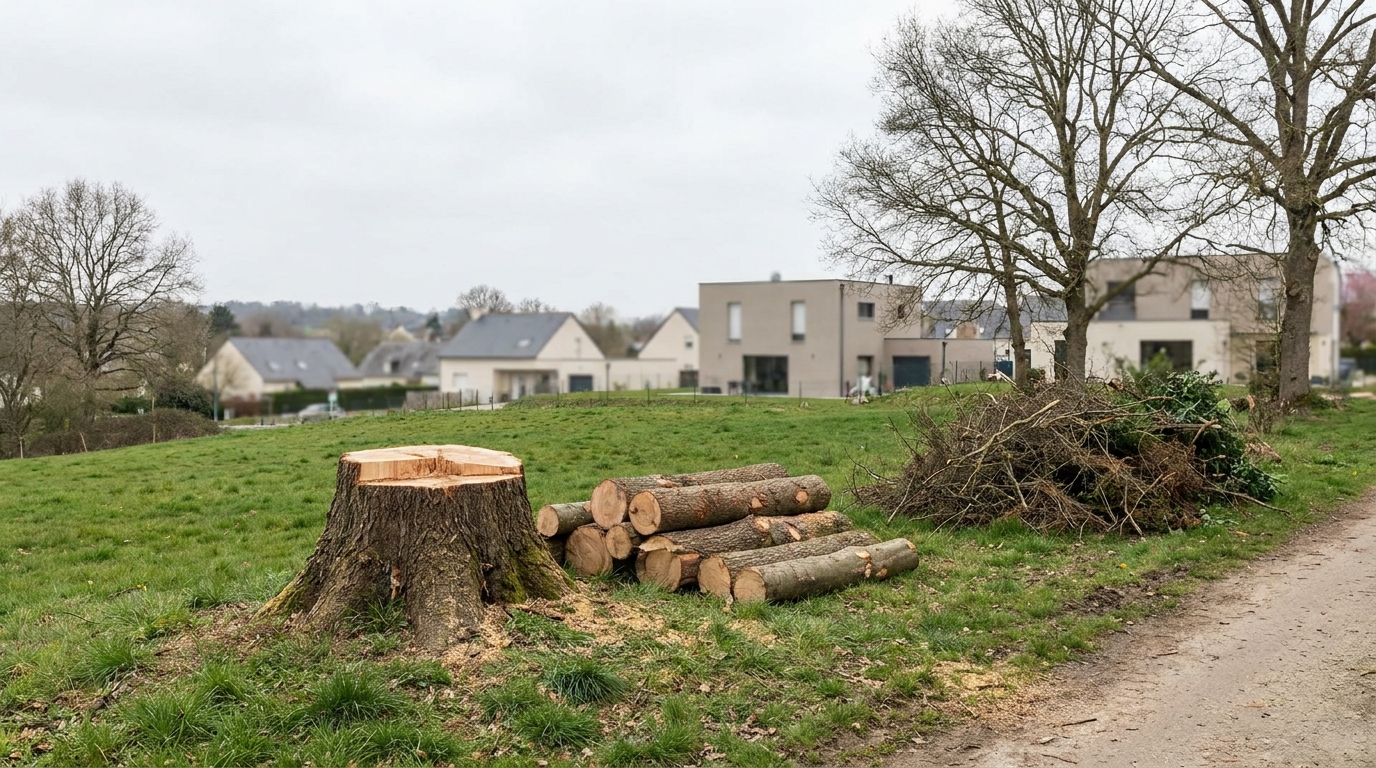
Texas A&M Forest Service says trees that have died from this canker, and that could fall on a structure, road, fence, or power line, should be removed as soon as possible. The same page says climbing them is very dangerous, because the decayed wood may not hold a climber, and it tells crews to use a bucket truck or another lift [4]. That is how our team treats a widely crusted trunk over a house, a driveway, or a play area in Waxhaw or elsewhere in Union County. We do not put a climber on a stem this fungus has already softened. A bucket or a crane keeps the weight off that wood.
A limb-only find is a narrower job. Clemson says infected branches may be removed, with the warning that other infection sites may not be visible yet [3]. Mississippi State says pruning dead or declining limbs may help on a tree that can still gain vigor, if the stress is dealt with too [2]. Trimming and pruning fits a dead, crusted limb in a crown that is otherwise intact. It is not a cure, and it is not the plan for a trunk already sheeted in stroma.
Spores do move, and that fact gets oversold. Clemson notes that wind carries asexual spores to other trees, and that sexual spores can move in rain splash or on insects [3]. NC State says cutting one symptomatic tree often does not protect the others, because the fungus is already common [1]. Texas A&M Forest Service says it does not kill groups of trees by spreading from tree to tree, and that infected firewood is not considered a source of new infection [4]. Missouri's Department of Conservation says that firewood is safe to burn, but that firewood should move only locally so other pests do not hitch a ride [5]. Do not chip the wood and spread it under oaks you want to keep. The Missouri Botanical Garden page updated in September 2024 says the fungus can stay active in dead wood and should not be used as mulch [8]. Haul it off.
Keeping the oaks that are still sound
Care only helps the oak that has not lost its sapwood. NC State Extension names water during drought, and avoidance of compaction, root damage, and herbicide injury [1]. Missouri's conservation department says the same for high-value trees [5].
During summer drought, Clemson says to water with 1 inch of irrigation per week [3]. Mulch with a 3-inch layer of organic mulch from the trunk to the dripline, kept off the bark [3]. Do not put weed killer on the ground under the canopy [3]. Mississippi State adds a soil test before fertilizer, watering in hot dry weather, and relief of compacted soil [2]. Clemson also lists a slow-release tree fertilizer in early April as a South Carolina vigor step, not as a cure for a crusted trunk [3].
On a wooded Union County lot, the preventable injuries happen during building. Fill dirt, a utility trench, equipment on the roots, and a grade change over the root flare are on the stress lists from Clemson and from Texas A&M Forest Service [3][4]. If the crust is already widespread, watering now will not reverse it. Save the hose and the mulch for oaks that still have tight bark and a full crown. The decaying tree comes down because it can hit something, not because cutting it clears spores out of the neighborhood [1][4][5].
Practical takeaways
- A flat tan, black, or silver-gray crust on the wood, with bark at the base, is hypoxylon canker. Bark flakes alone are not.
- The fungus is already common. Drought, root cuts, fill dirt, compaction, and herbicide stress let it take the sapwood.
- No chemical is registered, and there is no control once the infection is on the trunk.
- Widespread trunk crust means decaying wood. Do not climb it. If it can reach a house, drive, fence, or line, removal is the safety step.
- One crusted limb in a full crown can be pruned. That is not a promise the rest of the tree is clear.
- Smooth patch stays in dead outer bark and needs no treatment. Leaf-edge scorch and oak wilt are different problems. Oak wilt is the one extension sources discuss treating with fungicide.
- Do not chip infected wood into mulch under other oaks. Water, mulch, and keep construction and weed killer off the roots of trees you want to keep.
How we can help
Have more questions or want to get in touch? If the crust already runs across the trunk or a major limb over a house, drive, or play area, the usual next step is removal rather than a spray. Our team takes down hazardous oaks in Waxhaw, Union County, and greater Charlotte, including crane-assisted removals when the stem is not safe to climb, and you can reach us at (980) 247-TREE or send the details through our tree removal page.
Citations
- NC State Extension, "Biscogniauxia (Hypoxylon) Canker" (2025-09-30)
- Mississippi State University Extension, "The Plant Doctor: Biscogniauxia (Hypoxylon) Dieback of Oaks" (2026-03)
- Clemson Cooperative Extension Home & Garden Information Center, "Oak Diseases and Insect Pests in South Carolina" (2026-02-13)
- Texas A&M Forest Service, "Hypoxylon Canker" (n.d.)
- Missouri Department of Conservation, "Hypoxylon Canker" (n.d.)
- Purdue University Extension, Forestry and Natural Resources, "Smooth Patch of Oak" (2025-03-27)
- NC State Extension, "Common Disease Pests of Oak in North Carolina" (2022-04-05)
- Missouri Botanical Garden, "Hypoxylon Dieback of Oaks" (2024-09)