Heavy Acorn Crop on Oaks Does Not Mean the Oak Is Dying
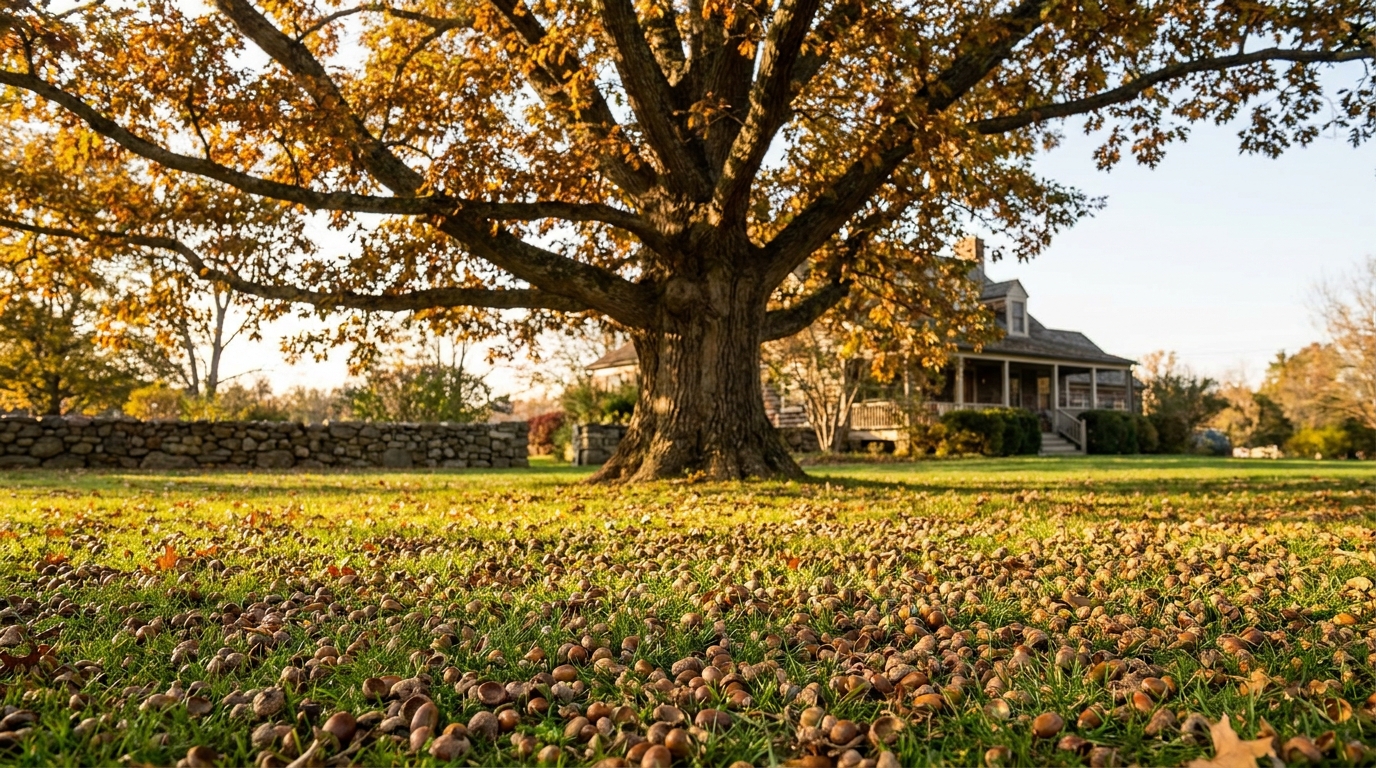
A heavy acorn crop does not mean the oak is dying. Around Waxhaw and the rest of Union County, a year when the driveway disappears under nuts is a mast year, and in a mast year a single oak may produce thousands of acorns [1]. That crop is how the tree makes seedlings, not a final act. Late spring freezes, extreme heat, and summer drought are weather stresses that reduce acorn pollination and production [2].
A heavy crop is a mast year
Oaks do not set a similar crop every year. An N.C. Cooperative Extension article from November 2025 puts it plainly: some years bring very few acorns, and other years bring an overwhelming abundance [1]. Those heavy years are mast years. Mast is an old word for the nuts and other forest food wildlife eats. In a mast year the trees can load up together across a wide area, so a whole neighborhood, not just one yard, may be full of acorns at once [1].
The same article describes why the swing helps the oaks. In thin years, animals that live on acorns have less food. In a heavy year the surplus is more than squirrels, deer, turkeys, and insects can finish, so some acorns are left to sprout [1]. A loaded oak in Waxhaw is following that habit. It is not a sign the trunk is failing.
Homeowners call when a roof pings, gutters fill, or acorns roll underfoot in Monroe or Indian Trail after a quiet October. Quiet years belong to the same cycle. A 2021 Purdue Extension post said a large mast event, for many oak species, may happen every two to five years depending on the species and other factors, and that a heavy year may be preceded or followed by a small crop, a moderate crop, or a complete failure [2]. A huge acorn crop takes a lot of the tree's resources, and that level of production may not be possible every year [2]. A lighter year afterward is expected, not collapse.
A hard season is a poor reason to condemn the tree. The 2021 Purdue post lists late spring freezes, extremely high temperatures, and summer droughts as conditions that reduce the crop [2]. A 1994 USDA Forest Service brief said late spring frost and summer drought tend to work against acorn production and can blur whatever cycle a species might have [3]. A 2024 Mississippi State University Extension publication lists poor pollination, late freezes, drought, acorn weevils, soil, and the genetics of the individual tree as reasons a crop varies [4]. Those sources treat a dry summer as a reason the crop may have been cut short, not as proof of a farewell crop.
Stress can still change timing. In a September 2026 report, the Virginia Department of Wildlife Resources said many observers saw acorns falling earlier than usual, which could be attributed to drought stress and the tree conserving resources [7]. Earlier drop is not the same fact as a bigger crop, and that report does not treat the early nuts as a dying tree. We do not have a matching public mast survey for Union County, so one Waxhaw yard is not a county forecast.
White oaks and red oaks are not on the same clock
The oaks we are called about most often around Waxhaw fall into two groups. White oak and post oak sit in the white oak group. Southern red oak, water oak, willow oak, and black oak sit in the red oak group. They ripen acorns on different schedules, so two sound trees on the same lot can tell different stories in the same October.
White oak acorns mature in about three months, one growing season. Red oak acorns take about 15 months, two growing seasons [4]. A 2016 Purdue Extension note puts that in calendar terms: white oak acorns falling this fall came from flowers pollinated this spring, and red oak acorns falling this fall came from flowers pollinated last spring [5]. On a red oak twig you can often see both. Fat acorns on last year's wood are this fall's crop. Small ones on this year's wood are next year's [4].
A late frost can wipe white oak flowers and leave that group thin by fall, while the red oak crop, already set the year before, still drops [4]. Two late frosts in a row can fail both groups, because the red oak crop needs two springs to come through [5]. A heavy red oak year beside a bare white oak is a normal mismatch, not a split verdict on health.
Virginia's 2026 survey shows the groups parting company, and it is Virginia, not Union County. White oak production sat above the long-term median, with an index of 14.8 against a 2007 to 2026 median of 10.8, while red oaks fell below average at 11.4 against a long-term median of 19.5, the first below-average red oak year in that survey since 2022 [7]. Staff also saw the start of small acorns on many red oaks that should mature in fall 2027, which fits the two-year clock [7]. A full willow oak beside an empty white oak in a parking lot is that biology, not one healthy tree and one dying tree.
Published schedules do not share one number
The guides disagree, and they often split the answer by species. None of them says a heavy year means the tree is failing.
A March 1994 USDA Forest Service brief said that, on average, most oak species produce a good acorn crop one year in three or four [3]. The same brief said evidence then suggested cycles of about 2 years for black oak, 3 years for white oak, and 4 years for northern red oak [3]. A 2016 Purdue note said white oaks tend to produce reliably only 2 years out of 5, so in 3 out of 5 years (60 percent) the white oak crop is poor or fails, while red oaks may produce a good crop every 2 to 5 years and a bumper crop on average every 5 to 7 years [5]. A 2024 Mississippi State publication said most oak species produce a good mast crop only every 3 to 4 years [4]. The 2021 Purdue post put a large mast event for many species at every 2 to 5 years [2]. An Iowa State University Extension answer last updated in February 2022 said most oak species produce a good crop once every two or three years, while white oak tends to do so once every four to six years [10].
Those figures come from different species, states, and decades, so they cannot all be the schedule for one yard tree. Good years are occasional, and so are failures. A heavy acorn crop on oaks is a known habit, and so is a quiet year after it, unless the trunk or the way the tree is standing says otherwise.
Individual trees also refuse to match the average. The 1994 Forest Service brief, drawing on a 1958 Pennsylvania study, reported that only 30 percent of large, healthy white oaks produced any acorns even in good seed years, and an even smaller share produced a good crop [3]. That figure is for any acorns at all, on healthy trees. A full crown and a heavy crop are not the same measurement.
Closer to home, a 2009 paper from USDA Forest Service researchers measured 200 white oaks in western North Carolina and eastern Tennessee from 2006 to 2008 [6]. About one-third of the trees produced about 75 percent of the acorns collected, and about half the trees were poor producers that yielded only 10 percent [6]. Weather, insects, and genetics were the main reasons the crop varied [6]. A loud oak and a quiet oak on the same Waxhaw street can both be healthy.
Age matters too. In natural settings, oaks usually take somewhere in the neighborhood of 25 to 30 years to produce acorns consistently [4]. A young tree with a clean crown and no nuts is often just not old enough. The Virginia report said some long-running survey sites are probably nearing the biological end of acorn production because of tree age [7]. That is a reason a crop can shrink, not a reason a heavy crop is fatal. Large crowns in full sun also tend to bear more than shaded crowns [4].
What the nuts change, and what they do not
Most of what a heavy crop changes is the ground.
Deer, turkeys, squirrels, and blue jays feed on acorns, and jays bury some they never retrieve, which plants new oaks away from the parent [1]. Extra squirrel traffic is the food supply, not a pest outbreak from a dying tree. In low or moderate years, insects eat most of the acorns [3].
Many nuts are still ruined, and the ruin stops at the nut. An Iowa State University Extension page, first published in 2016 and last reviewed in November 2021, says acorn weevil larvae can eat out the kernel and make the acorn worthless, but they do not damage the tree in any way [8]. The grub leaves a round hole about 1/8 inch across, then spends one to two years in the soil [8]. Pinholes under a yard oak are a weevil story, not a trunk disease. That page also says control of nut weevils on backyard oaks is not practical [8]. We do not offer a spray program for them.
Sprouts surprise people next. An Iowa State answer last updated in March 2022 says white oak and swamp white oak acorns germinate immediately after sowing in fall, while bur oak, pin oak, and northern red oak acorns wait through weeks of cold, moist weather [9]. Little roots under a white oak in November are the seed starting, not a parent tree quitting. Red oak acorns more often wait until spring, so wildlife has longer to eat them [7]. We do not rake acorn crops, and we do not run a planting crew.
The mess is still real. Acorns on a walk are a slip hazard, they stain concrete, and they clog gutters and skimmers. Sweeping is ordinary maintenance. It is not a reason to remove a sound oak, and cutting the top out of the tree will not end a mast cycle. If one limb conflicts with a roof or a drive, that is a clearance question, not an acorn question.
What still deserves a look
The crop is the wrong test of whether the tree is safe. We look at the tree.
A few small dead twigs are ordinary. Large dead limbs over a roof, a play area, a parking lot, or a sidewalk are not a mast issue. N.C. Cooperative Extension's storm-damage guidance, updated in January 2026, tells owners to remove dead, dying, diseased, or damaged limbs, and it says insect or disease damage can weaken wood and leave a tree more vulnerable to storms [11]. Bare limbs in a summer crown need a look whether the crop was light or heavy.
A sudden lean is separate too. The same page says to evaluate leaning trees, and after storms it lists large leaning trees, and trees with extensive trunk damage, among the cases to remove [11]. A lean carried for decades, with a trunk that grew to match it, is different from a tree that tipped and started lifting soil. The nuts will not tell those apart.
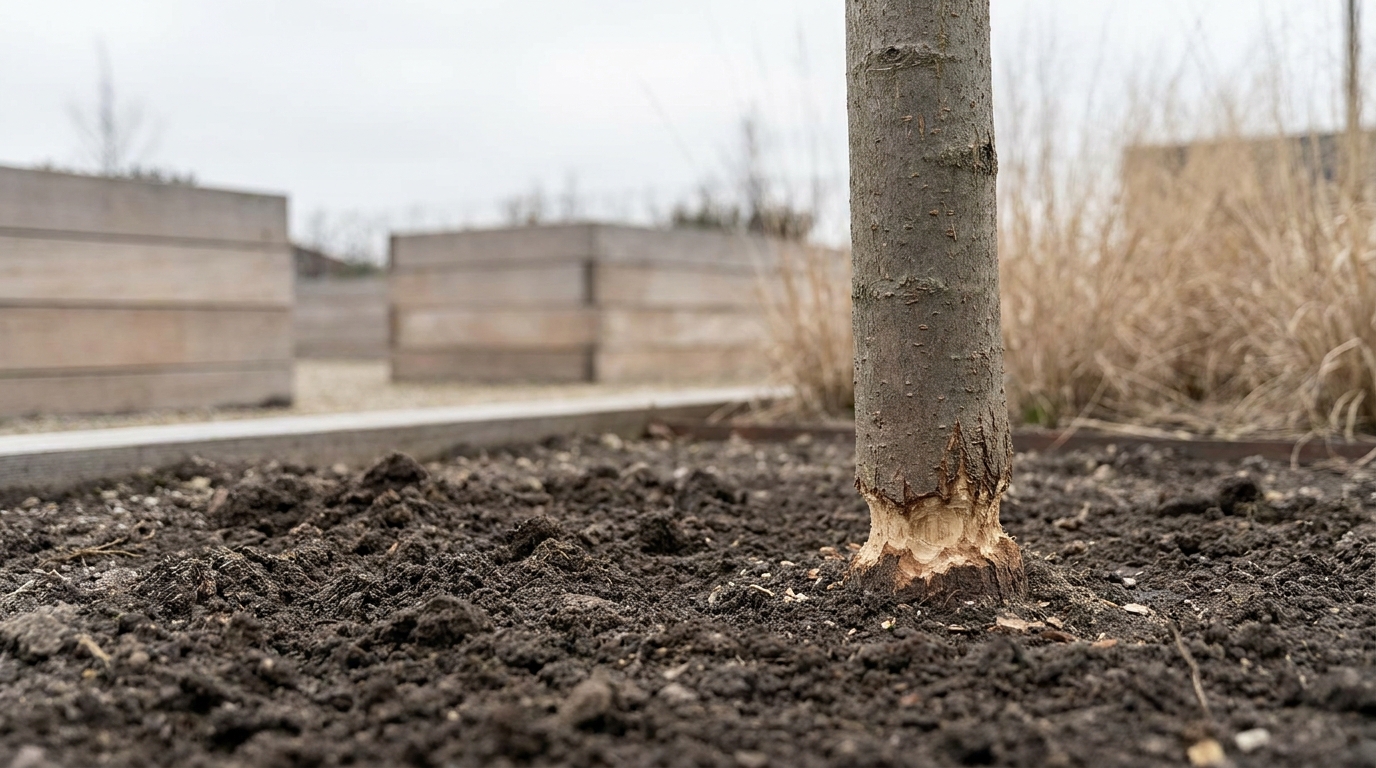
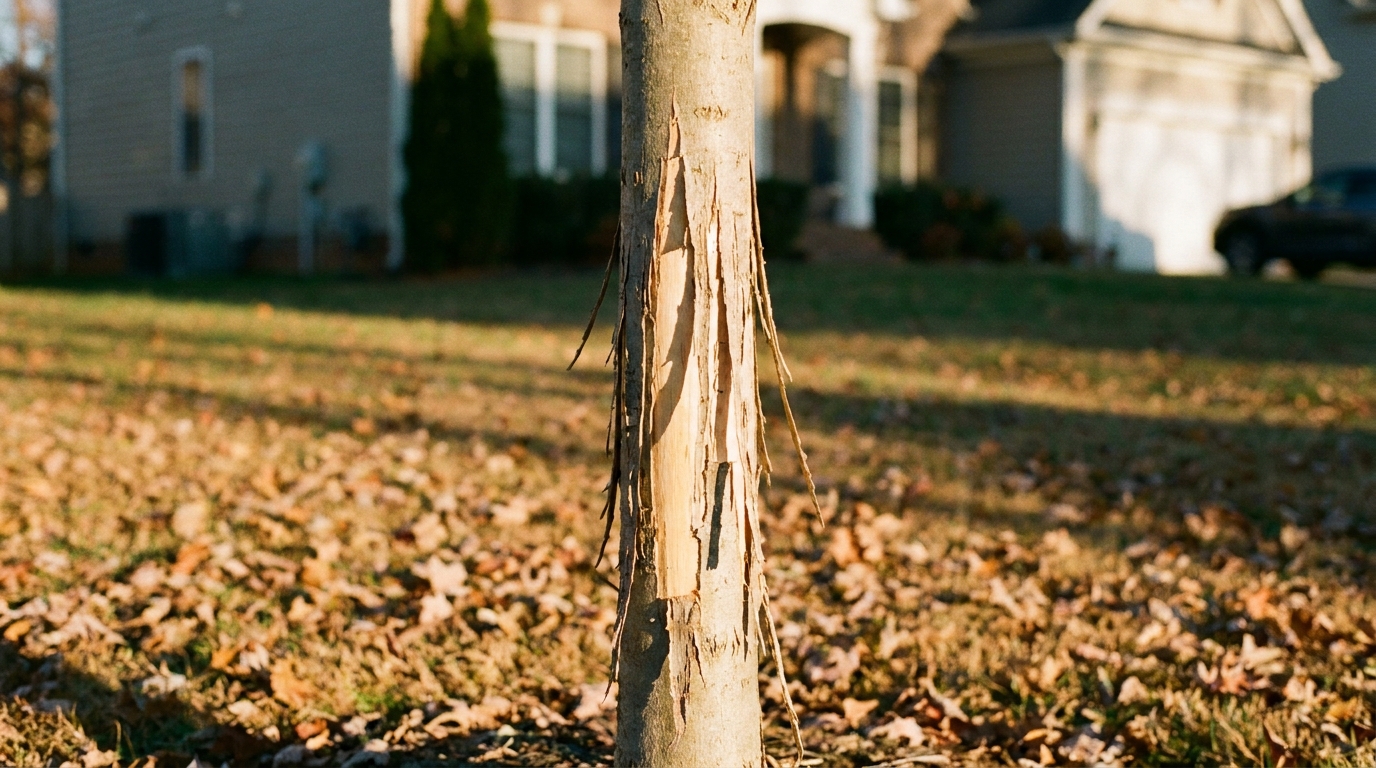
Cankers and bark coming off belong on this short list. A sunken or cracked patch on the trunk, or bark shedding from a section that looks dead, is about wood and bark, not seed. We will not diagnose that from the lawn. If those signs show up with deadwood or a new lean, call and we will look. If they are absent, a heavy crop is not a reason to take the oak down.
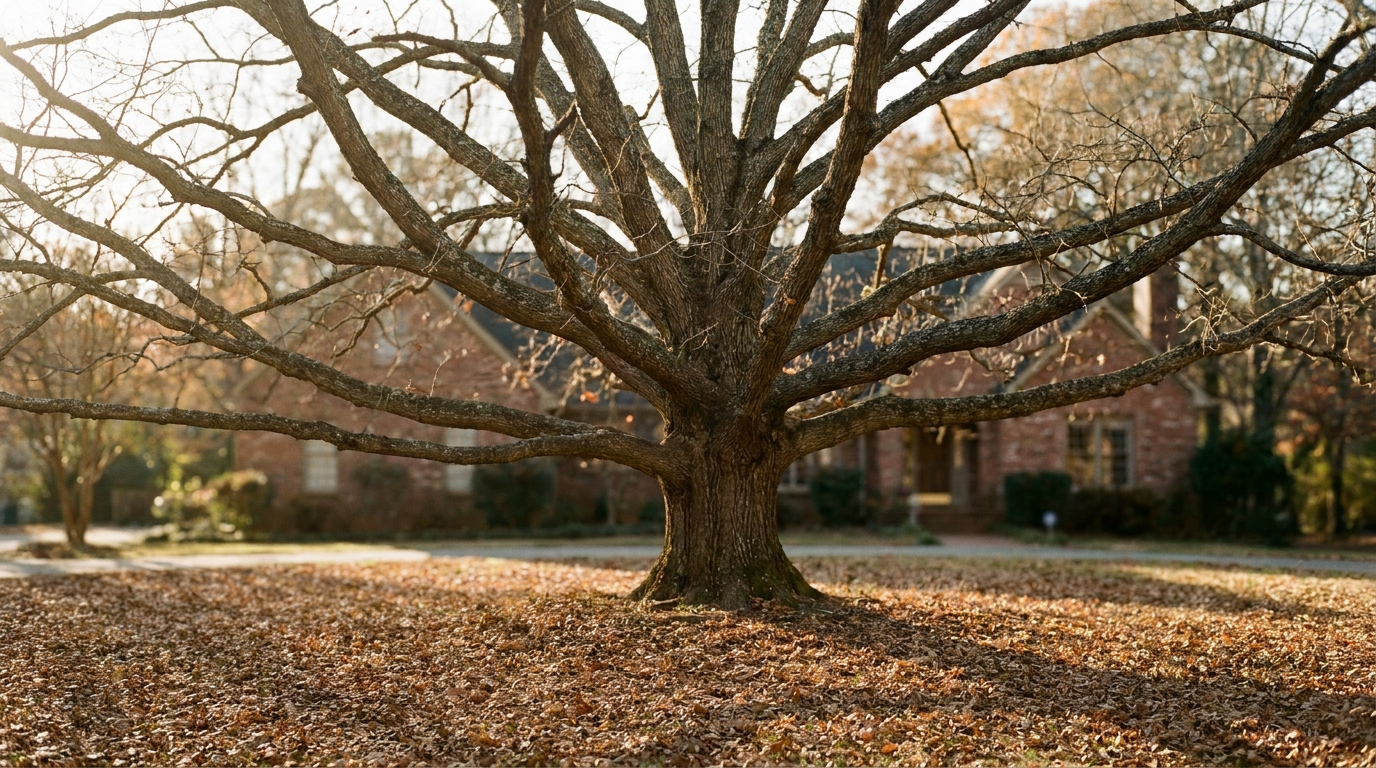
Judge the crown against itself. The neighbor's tree may be another species, another age, or one of the poor producers in a year when yours is loaded [6]. A summer canopy that matches what your oak has done for years is the reassuring sign. New thinning, especially one-sided thinning paired with dead wood, overrides the mast story. Do not judge a leafless oak in January. Deciduous oaks are supposed to be bare then.
Tiny green acorns on this year's red oak twigs are next year's crop, not a symptom [4]. Frost, drought, and insects can still cut that crop back before it falls [2].
Practical takeaways
- A heavy acorn year is a mast year. One oak may drop thousands of acorns, and that is a reproductive habit, not a death sentence [1].
- Printed intervals do not agree: about one good year in three or four for most species in a 1994 Forest Service brief [3], a red oak bumper crop about every 5 to 7 years in a 2016 Purdue note [5], and a good white oak crop about every four to six years in a 2022 Iowa State answer [10]. A quiet year next fall can still fit those guides.
- White oak acorns ripen in one season, and red oak acorns take two, so this year's red oak crop was set last spring [4]. White oak acorns can germinate as soon as they are sown in fall, while northern red oak acorns need a cold, moist period first [9].
- Late freezes, extreme heat, and summer drought are listed as reasons a crop gets smaller [2]. Virginia's September 2026 survey said earlier-than-usual drop could be tied to drought stress, while still describing the trees as variable producers [7].
- Weevil holes can empty an acorn. They do not damage the oak [8].
- Call about large deadwood or a lean that showed up suddenly. N.C. State Extension flags dead and damaged limbs, and leaning trees, as reasons for a harder look [11]. Cankers and bark coming off a dead section belong on that same visit.
How we can help
Have more questions or want to get in touch?
If the oak itself looks unsafe, our team can assess it and tell you whether pruning or removal is the right next step. A heavy crop alone is not that step. Reach us on our contact page.
Citations
- N.C. Cooperative Extension, Beaufort County Center, "The Secret Life of Acorns: Oaks, Wildlife, and the Science of Mast Years" (2025-11-14)
- Purdue University Extension, Forestry and Natural Resources, "Question: Why Are There so Many Acorns This Year?" (2021-10-11)
- USDA Forest Service, "How to Manage Oak Forests for Acorn Production" (1994-03)
- Mississippi State University Extension, "Managing Hardwood Stands for Acorn Production" (2024-09)
- Purdue University Extension, Forestry and Natural Resources, "Scout Your Oak Trees to Identify the Best Mast Producers" (2016-10-10)
- USDA Forest Service, Southern Research Station, "Masting characteristics of white oak: implications for management" (2009)
- Virginia Department of Wildlife Resources, "2026 Acorn Production Report: Still Solid" (2026-09-29)
- Iowa State University Extension and Outreach, "Acorn and Nut Weevils" (2021-11)
- Iowa State University Extension and Outreach, "How do I germinate acorns?" (2022-03-02)
- Iowa State University Extension and Outreach, "My oak tree produced just a few acorns this year. Why?" (2022-02-27)
- N.C. Cooperative Extension, "Preventing & Managing Storm Damaged to Trees" (2026-01-21)