Vole Damage on Tree Bark at the Soil Line
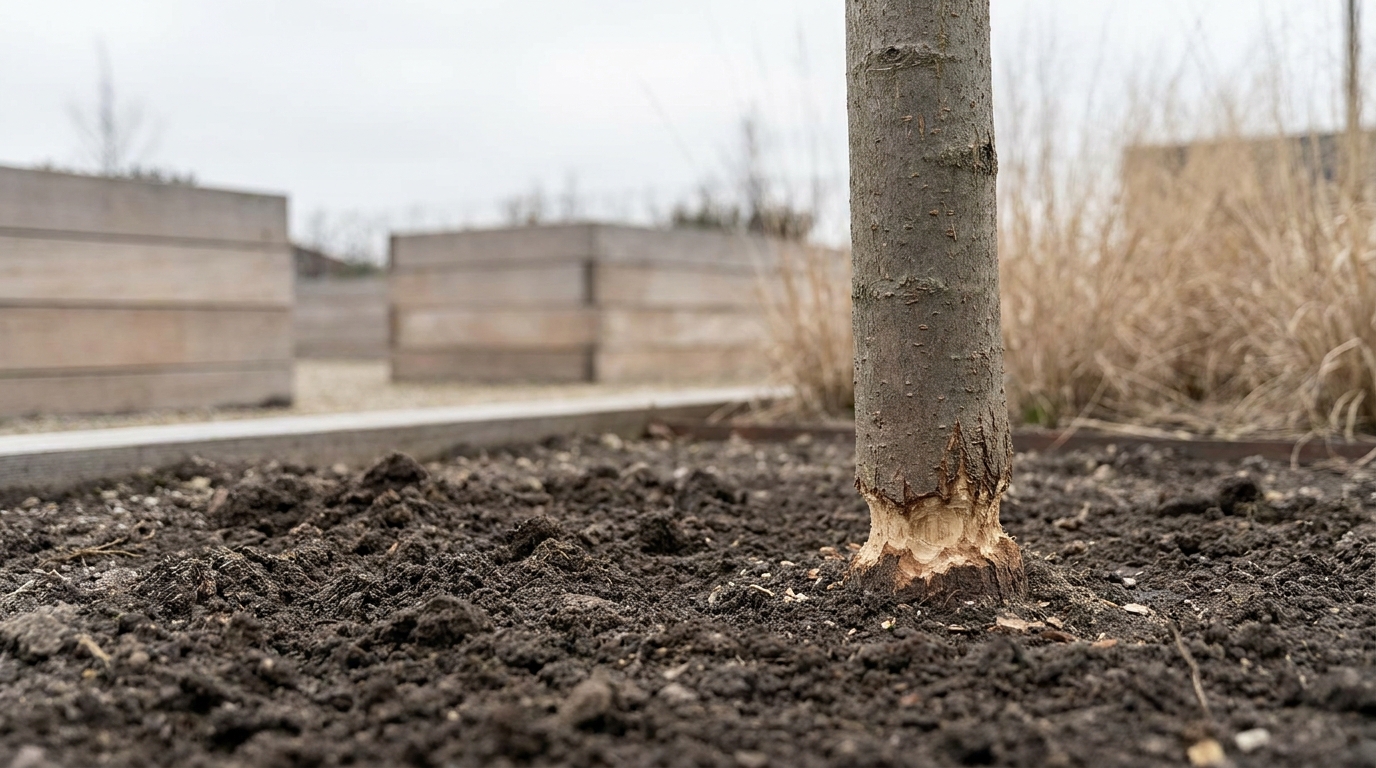
After the leaves drop around Waxhaw, a young tree can look fine from the street and still be in trouble at the ground. Vole damage on tree bark is a chewed ring at the soil line, or just under the mulch, on trunks and on shrubs. Pine voles and meadow voles both feed in cold weather, but they do not work the same part of the plant. We check that low ring on new plantings and fruit trees before we talk about pruning, because a complete circle of missing bark can kill the tree [1].
Two voles, two places on the trunk
"Mouse" is the word people use. In North Carolina the girdling is usually one of two voles, and they are not the same animal. NC State Extension, in a publication reviewed in 2022, describes the pine vole as the smaller one: reddish-brown fur, eyes and ears hidden in the coat, and a tail shorter than the hind leg. The meadow vole is larger and dark brown, often silvery underneath, with eyes and ears you can see and a tail longer than the hind leg [1]. Clemson Extension's 2025 homeowner fact sheet finds both in South Carolina. Meadow voles live mostly above ground. Pine voles live almost entirely underground [3]. Moles are a third animal. They eat insects, grubs, and earthworms. Voles eat plants [3]. A raised lawn ridge is a mole. Clipped paths, or bark gone at the trunk, are voles.
Pine voles damage woody plants below the ground. Gnawing on a small trunk shows just under the soil line, and heavy feeding can cut the top off the roots so a shrub lifts out of the bed [1]. Meadow voles girdle at the ground line. The 2022 review says that chew leaves paired grooves about 1/16 inch wide, and a complete ring kills the tree [1]. Penn State Extension's guide, updated in 2024, matches the split. Meadow vole injury is trunk girdling at or near the ground. Pine vole injury is easy to miss, because they eat small roots, girdle larger roots, and take bark at the base. The crown often looks weak only after the damage is already deep [4]. A meadow vole will sometimes nick roots, so one root scar does not name the species [4].
They do not hibernate [4]. They stay active all year, day and night, busiest at dawn and dusk [4]. In a severe winter, especially under snow, they turn to roots and trunks until shrubs topple [2]. Most of that bark feeding comes in winter, when other food is scarce [4]. A female meadow vole could potentially produce over 70 young in a year, and numbers swing about every 4 years [4]. Hawks, owls, snakes, and foxes usually hold them down, but a mulch pile against thin bark still needs a barrier [2][4].
What the ring looks like
Pull mulch and leaves back with your hands. Vole damage on tree bark is a band of missing outer bark, often a full circle, scored with small paired grooves rather than peeled in strips. Meadow vole grooves are about 1/16 inch wide [1]. The band sits at the ground, or just under the soil if pine voles worked the crown [1]. It sits higher on the trunk when snow raised the floor they used [4].
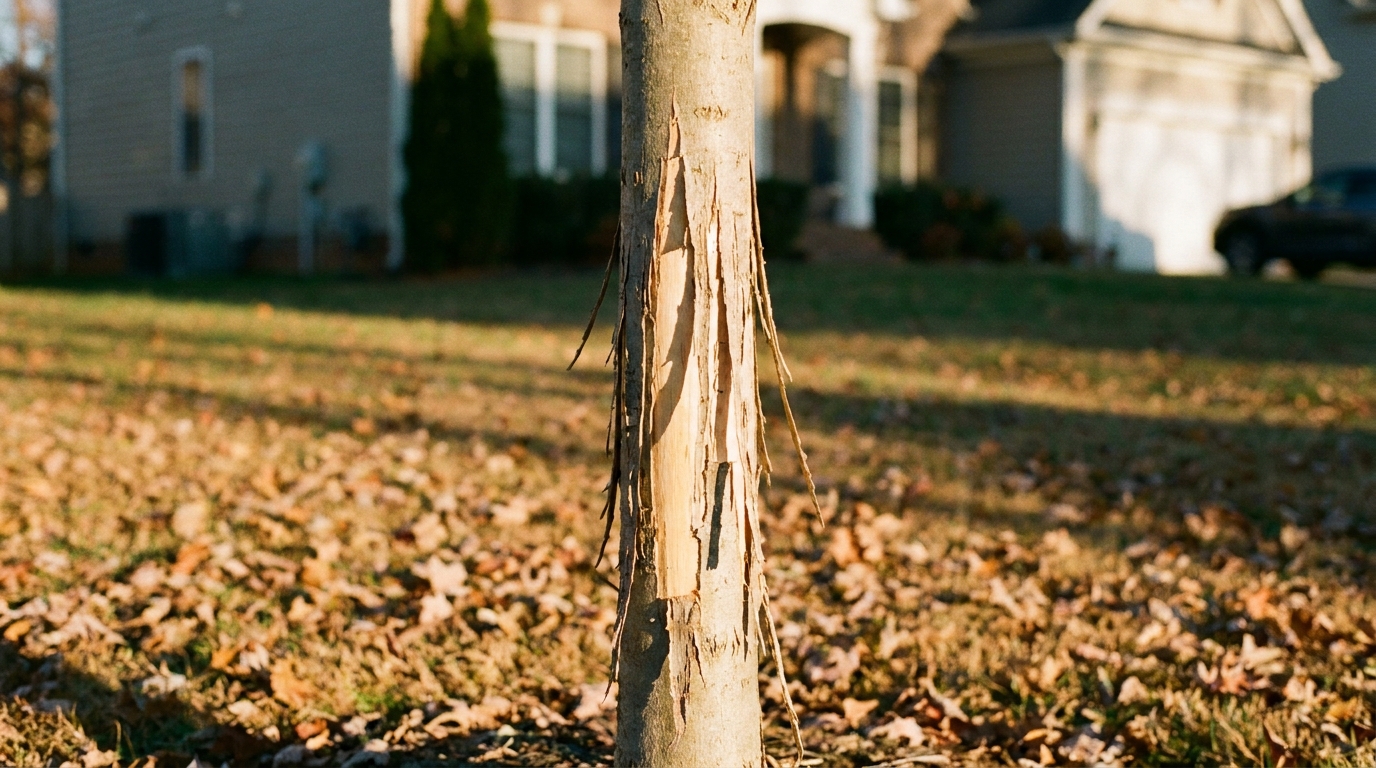
A buck rub sits higher and looks shredded. Bucks rub small trees about 4 feet up and tear at the trunk and branches, which is not this ring [8]. Rabbits start several inches above the soil and leave larger tooth marks [1]. A plastic guard may stop a rabbit. It will not prevent meadow vole damage [1].
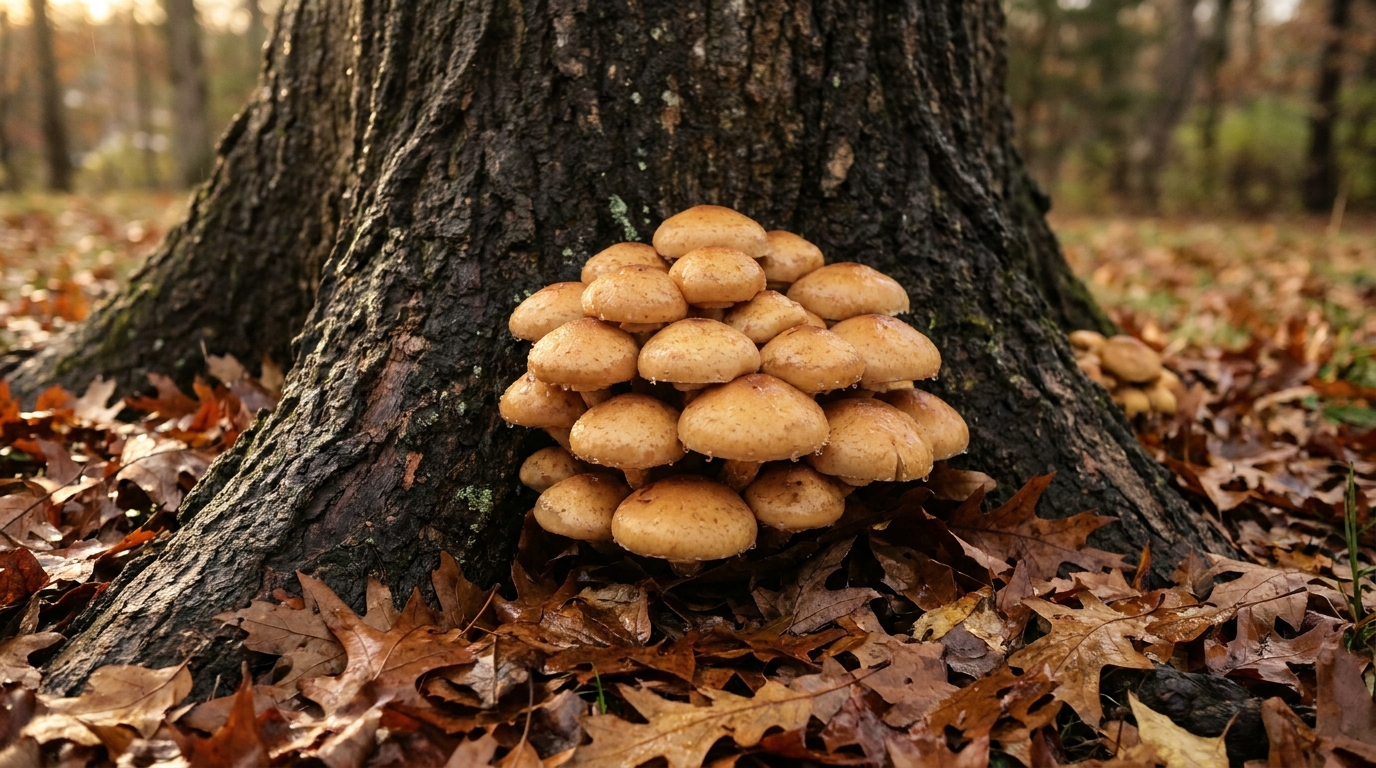
Twig-girdler litter is not the same clue. A 2021 note from N.C. Cooperative Extension in Pamlico County describes those beetles cutting twigs in the crown from late summer into fall, until severed twigs still holding dead leaves cover the ground [9]. Whole bark at the soil means that litter is not voles. A mushroom at the flare is not the ring either. Grooves mean teeth. Disease can enter the wound later. Vole damage can kill a tree, let disease in, or leave it weak, and on a fruit tree it can cut the crop for the life of the tree [1].
Meadow vole runways are about 1.5 to 2 inches wide, often easy to see by March or April, with cut grass and rice-grain droppings [2][4]. Plants, roots, or mold filling the path mean it is old [4]. Pine voles skip those paths. Look for soil piles about 3 to 4 inches wide, tunnels about 1.5 inches across and about 3 inches down, and exit holes about the size of a golf ball [1][3].
Voles tend to debark thinner trees [8]. A partial ring still weakens the tree and lets disease in [1].
The cover that hides them
Voles avoid feeding in the open, so changing the cover is the control Clemson Extension calls most effective [3]. Around Union County that cover is usually mulch on the trunk, long grass, and shrub skirts, not a month of deep snow.
Meadow voles use clumpy grass. Tall fescue in an orchard, or a lightly grazed pasture, is typical habitat [1]. What works is a small exclusion, clearing weeds, ground cover, and litter, and mowing on a schedule [2]. Wait too long between cuts and the clippings become thatch that still hides them [4]. A 2024 Minnesota Extension review, written for meadow voles and prairie voles rather than pine voles, says to keep grass short, trim bushes off the ground, and move woodpiles [6].
Mulch matters only as a roof on the bark. Do not let mulch, prunings, or rotting vegetation pile at the base, and keep a vegetation-free zone at least 2 feet from the trunk [4]. The wildlife-damage handbook says to pull mulch back 3 feet or more [7]. Keep it off the bases [3]. A New Hampshire fact sheet updated in 2016 says fine, small-particle mulch draws them, so any layer stays thin and off the bark [5].
Snow lifts the injury in years we get it. Meadow voles may girdle as high as the snow is deep, and heavy cover of snow can put the chew above the soil line [4][5]. Much of the bark loss stays hidden until melt [6]. Do not wait for a drift. Mulch is already a roof in a mild winter [3][5]. Spilled feeder seed feeds them too, including under snow, so clean that ground or take the feeder down [5][6]. Leave the woods if you want them. Just do not run a mat of cover from that edge up to the bark.
What to change around the trunk
Do the work at leaf drop, before bark becomes the winter meal [4]. Rake leaves, mulch, and prunings until bark meets soil. Keep an open collar at least 2 feet out, and pull mulch back 3 feet or more [4][7]. Any mulch left in the bed stays thin, with fine particles off the trunk [5]. Orchard rows in the 2022 NC State review use a grass-free strip about 4 feet wide on each side, narrower on steep ground [1]. A yard tree gets the same idea as a ring that stays short, mowed late so the clippings do not become thatch [4].
Then guard the trunks you cannot afford to lose. Use a cylinder of 1/4-inch hardware cloth, buried 4 to 6 inches, standing about 18 to 24 inches, and at least 4 inches above the snow you expect [4]. Leave room for about 5 years of growth so the wire itself does not girdle the tree, and keep it loose [4][6]. The cylinder stops the chewing you can see. It does not empty tunnels. Pine voles still eat roots underground, so the cover has to come off the bed too [1][3]. A shrub border can take a 1/4-inch mesh fence about 12 inches above the ground, with 6 to 10 inches buried [3]. A plastic spiral will not stop meadow voles at the soil [1].
Mow grass that touches the planting, lift shrub skirts, and move brush and firewood off the trunks [6].
Do not start with poison. Most orchard rodenticides in the Penn State guide are restricted-use products for certified applicators [4]. Zinc phosphide is acutely toxic to vertebrates and hazardous to people, other wildlife, and ground-feeding birds [1][2]. Check state rules before you use one [2]. For a few trees, covered mouse snap traps baited with peanut butter and oatmeal, or apple, can sit across a runway or inside a pine vole tunnel [4]. Fall and late winter are the better weeks [3]. South Carolina does not allow moving a live-trapped animal, including in Indian Land and Fort Mill [3]. Capsaicin or thiram repellents are not a plan by themselves, and frightening devices do not work [4][7].
If the bark is already gone
Measure the ring before you act. A complete circle at the ground line will kill the tree [1]. A partial ring can weaken it, admit disease, and cut fruit production for the life of the tree [1]. Pine vole injury often shows in the top only after roots are already cut hard [4]. A shrub that lifts out with gnawed roots is already loose from the soil [1][3].
Trimming will not grow bark or roots back. If the top is dead, removal is the straight step, and stump grinding lets a replant sit clear of the old wood. Set the guard and clear the collar first. On a partial ring we look at how much live bark is left and whether the wood is soft. Paint will not close it.
Practical takeaways
- Vole damage on tree bark is a low ring at the soil or just under the mulch, with small paired tooth grooves. A buck rub is higher and shredded. Twig girdlers leave cut twigs under the crown.
- Meadow voles chew at the ground line. Pine voles chew under it, on the crown and the roots.
- Cover hides the work: tall grass, thatch, fine mulch on the trunk, shrub skirts, brush, spilled seed, and snow when it sits.
- Pull mulch off the bark, keep a short collar at least 2 feet out, and mow late.
- Use 1/4-inch hardware cloth, buried and loose enough for growth. A plastic spiral does not stop meadow voles.
- A full ring can kill the tree. Pruning will not close it.
How we can help
Clark's Tree Care is based in Waxhaw and works across Union County, the greater Charlotte area, and nearby South Carolina towns. We can look at a young trunk, tell a soil-line chew from a rub or from cut twigs in the crown, and say whether the tree is likely to live. If a full ring has killed it, we remove the tree and can grind the stump before you replant. Trimming and height reduction will not grow that bark back. The next tree stays safer with open soil at the trunk and a guard voles cannot walk through.
Have more questions or want to get in touch? Reach us on the contact page, or see removal, trimming, and stump grinding on our services page.
Citations
- NC State Extension, "Voles in Commercial Orchard and Ornamental Nurseries" (2022).
- NC State Extension, "Voles in Turf" (2022).
- Clemson University Cooperative Extension, "How to Tell the Difference Between Moles and Voles" (2025).
- Penn State Extension, "Orchard Wildlife - Integrated Management of Voles in Orchards" (2024).
- University of New Hampshire Extension, "Pesky Winter Critters" (2016).
- University of Minnesota Extension, "How to manage vole damage on lawns, trees and shrubs" (2024).
- Internet Center for Wildlife Damage Management, "Vole Damage Prevention and Control Methods" (n.d.).
- Internet Center for Wildlife Damage Management, "Damage to Trees" (n.d.).
- N.C. Cooperative Extension, Pamlico County, "Pecan Twig Girdlers" (2021).