Honey Mushrooms at the Base of a Tree: Armillaria
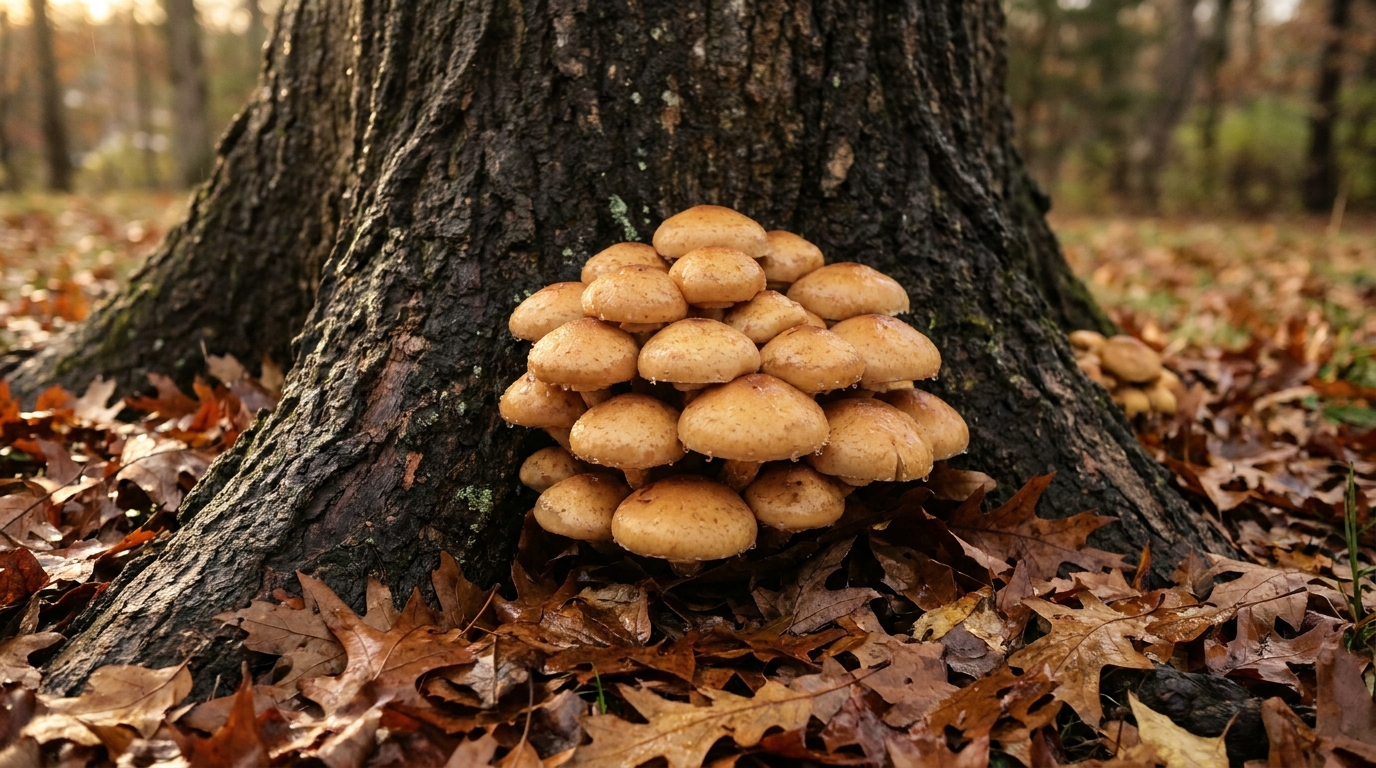
Honey mushrooms at the base of a tree in November are a clue of Armillaria root rot, also called shoestring root rot, mushroom root rot, or oak root rot. University of Minnesota Extension, on a page reviewed in 2026, says clusters of honey-colored mushrooms may grow at the base of an infected tree in fall, and that infected trees have decayed roots and lower trunks that often break or fall over in storms. [1] A skirt-like ring on the stem matches the classic description of some of these mushrooms, but where the cluster grows matters just as much: from the living base, from a root under the lawn, or from a nearby stump. [2] A hard woody shelf stuck to the trunk is a different fungus, and a lone mushroom in open grass, with no wood under it, usually is too.
A November cluster is a clue, not a lab test
Armillaria is a group of fungi, not one mushroom that looks the same in every yard. A 2021 NC State Extension note from Lee County says there are several species, that the disease decays the roots of many common trees and shrubs, and that clusters of yellow to honey-colored mushrooms appear in moist weather and then fade. [6] If the caps are gone a week later, the fungus in the wood did not leave with them.
The Latin name on the page depends on who wrote it. Clemson Extension, on July 30, 2025, says Armillaria root rot in the Southeast is caused by Desarmillaria caespitosa, and that the fruiting bodies at the base are often a good sign of the disease. On the peach in that note, they may show after a summer rain. [3] University of Florida IFAS says the species it sees most in Florida is Armillaria tabescens, with yellow to honey-colored clusters in the cooler, wetter weather of fall and winter, sometimes late spring, at the base or from roots under the turf. [5] University of Kentucky Extension describes dense honey-colored clusters at the base of infected trees, and on decaying roots and logs, in late summer or autumn, and says production is erratic. [4] A November cluster of honey to tan caps growing out of wood is the shared clue.
The ring is a real feature on some species and a bad reason to ignore a cluster that lacks one. University of California Statewide IPM, in a pest note updated in January 2020, says Armillaria mushrooms grow in clusters, are tan to honey colored, and have a ring, called an annulus, around the stem. That line is about Armillaria mellea, the species the note says is common in California landscapes. [2] Other mushrooms have rings, and the southeastern pages describe this root rot from the cluster and the base without requiring a ring first. [3][4][5] We do not call every mushroom at a trunk Armillaria, and we do not mark a tree for removal on cap color alone.
A hard woody bracket on the bark is a shelf fungus, not this mushroom. A single cap in open lawn, with no stump or root under it, is usually a short-lived yard fungus. NC State Extension in Pamlico County, in October 2023, says Armillaria feeds on decaying wood, that the honey-colored cluster can mean a tree has wood rot and should be treated as a possible hazard, and that the fungus also grows on old roots and stumps. [7] Do not eat them. That note tells homeowners not to pick yard mushrooms to eat, and to assume most mushrooms are toxic. [7]
One other root rot gets mixed up with this one. Kentucky says Phytophthora root and collar rot can hit many of the same trees, but its decay is usually a darker brown and wet, and it does not come with honey mushrooms, mycelial fans, or rhizomorphs. [4]
What you can see without a shovel
You do not need to dig the root system up to decide a call is worth making. Look at the crown first. These pages describe the same decline: poor growth, small or yellow leaves, dead branches, and a thinning crown. [1][4][6] Kentucky notes trees that collapse in midsummer with little other warning. [4] Florida describes a tree that browns overnight with dead leaves still hanging, and lists branch or trunk failure. [5] Evergreens may brown in the needles and set a heavy cone crop. [1] If the crown looks like that and honey mushrooms at the base of a tree came up after rain, those two facts belong together.
At the trunk, look and do not carve. Kentucky says bark at the base becomes loose or decayed as the cambium dies. [4] Minnesota says infected wood becomes white, soft, and stringy, and that this decay may run from the base up to 6 feet into the trunk. [1] The January 2020 California note adds a flat face on the lower trunk, cracked bark, or sap at the collar, and says the fungus kills cambium in the roots and can girdle the base. [2]
Two signs sit under the bark, so they are not a Saturday project. White to creamy fans of mycelium grow between the bark and the wood. [1][3][4][5][6] Dark brown to black rhizomorphs, the shoestrings, grow under the bark, on decaying roots, or in the soil beside the tree. [1][2][4] The California note says they are easy to mix up with fine roots: darker, smoother, and without a woody core. On A. mellea they run about 1/32 inch to 1/8 inch thick. [2] Kentucky says any one of three signs can confirm it: honey mushrooms, rhizomorphs, or mycelial fans. [4] Some trees die of this disease and never make mushrooms, so a bare lawn does not clear the tree. [2] Peeling bark and digging about 12 to 18 inches down is a check for a plant that is already dead or dying. [2] It is not the first move on a large oak over a house. If the tree is a removal candidate, we can look while the work is controlled.
Why spraying the caps does nothing for the roots
The mushrooms are the fruiting stage. Killing them does not kill the fungus in the wood. Kentucky says that stage shows the pathogen is present and is not considered important in how the disease spreads. [4] The January 2020 California note says the spores are thought to seldom infect a new host. [2] Infection is thought to happen when healthy roots grow into infected wood, or when rhizomorphs grow out and touch susceptible roots. [2] Minnesota says the fungus can survive many years in an old stump or root system, and a new infection starts when healthy roots grow close to diseased ones. [1]
There is no homeowner spray that cures this. University of Florida IFAS says there are no fungicides available to treat the plant. [5] The 2020 California note says no fungicides are registered for Armillaria control in California, because the fans sit under the bark, the rhizomorphs have a protective rind, infection starts in soil where microbes reduce a fungicide, and the fungus lives on in dead wood. [2] That registration line is about California. The same limits are why a trunk spray misses the fungus in the wood. [2] Kentucky says fungicides and soil fumigants have had mixed results once the pathogen is present, and that those approaches are only feasible in large commercial orchards. [4] Pamlico County says no control options are available for infected plants. [7]
Care can slow a decline. It does not clear the rot. Kentucky says good cultural practices can prolong life and will not cure an infected tree or shrub. Do not plant too deep, never mound soil or mulch on the lower trunk, avoid mower and string-trimmer wounds, and do not swing the tree between drought and saturated soil. [4] The 2020 California note adds that soil over the root collar makes trees more susceptible, and that the useful step is to stop overwatering and keep the collar dry in warm weather. [2]
The pages do not rank stress the same way. Kentucky says the rot is often tied to stress and can also attack a healthy tree. [4] Florida says symptoms may take as long as one to three years to show, usually on a plant that was already stressed. [5] Lee County says weakened trees are attacked more easily, young trees often die quickly, and a mature tree may die fast, linger, or pick up for a while. [6] Minnesota says a vigorous tree can often slow the fungus. [1] The 2020 California note says most deaths of infected landscape trees there were tied to too much water or other stresses. [2] A buried flare, a wet collar, and fresh wounds help the fungus. They do not explain away wood that is already soft.
Clemson's 2025 management lines are for peach: resistant rootstocks such as MP-29, and not replanting an infected site. [3] That is for a fruit tree. It is not a spray for the oak by the driveway.
Mushrooms on a stump, and the trees still standing
A living tree with a thin crown and a cluster at the flare is one call. Caps on an old stump, or in the lawn where a tree came out years ago, are another. The fungus grows on old roots and stumps, and a cluster can rise from a buried root in the turf where a tree used to stand. [2][7] It can remain after the top is gone, keep fruiting, and infect a new planting. Clemson says root fragments from oaks or peaches can carry it for many years. [3] Florida says dead roots and stumps can harbor it for years. [5] Kentucky says the same, and the January 2020 California note says inoculum can persist for decades in partly decayed residual roots. [2][4]
A fruiting stump is not proof that every healthy tree on the lot is infected. Spread is by root contact or rhizomorphs, not by the caps you mow. Minnesota says rhizomorphs can spread up to 10 feet from an infected tree or stump and infect healthy roots. [1] A tree whose roots run through that ground, especially a stressed one, should be looked at. Lee County says a mature tree may die quickly, die slowly, or pick up for a while if growing conditions favor the tree. [6]
If the tree comes out, grind the stump and take the large roots you can reach. Minnesota says remove the stump and as many roots as possible. [1] The 2020 California note says grinding or chipping can cut inoculum, while that benefit is not reliable in big intact wood, and soil solarization may not reach roots deeper than about 4 inches. [2] Grinding does not sterilize the soil. California and Clemson both warn against replanting a susceptible tree where this rot has already killed one, especially while large dead roots remain. [2][3]
When the tree should come out
The reason to call is that the tree can fail. Minnesota says infected trees frequently break or fall in storms, and that they die when the base is girdled, the roots let go, or the weakened trunk breaks. A tree care professional should inspect to determine if the tree is a hazard, and unstable trees should be removed before they fall on something. [1] Kentucky says remove infected landscape trees before they become a hazard. [4] Florida lists branch or trunk failure as a symptom, says a symptomatic plant generally cannot be saved, and says remove it, including the roots. [5] The January 2020 California note calls this a white rot that destroys wood strength in the roots and at the base, which increases the likelihood of failure. [2]
Read together, the pages do not say to cut every tree the morning a mushroom appears. They also do not say to wait once the base is soft and the crown is dying over a target. Culture can stretch the life of some trees and will not cure them, and a vigorous tree can only slow the fungus. [1][4] A declining tree with decay in the roots and lower trunk is the one to take out before it fails. [1][4][5]
In Waxhaw and the rest of Union County, that means the crown is declining or has collapsed, the lower trunk is loose, flat, cracked, or soft, and the tree can reach a house, a drive, a play area, a car, or a line. Do that check before a storm puts the tree on a roof. [1][4] We can watch when the mushrooms are only on a stump, nearby crowns are full, lower trunks are firm, and nothing important sits in the fall zone. Those nearby trees still get a look, because a vigorous tree may only slow the fungus. [1] Minnesota's figure for that reach is up to 10 feet. [1]
We will not promise a spray or a drench that clears this from a living tree. [2][4][5][7] If the tree is a hazard, removal is the work. Grinding the stump does not clear every buried root. [1][2] A decayed tree already on a structure is emergency removal, not a treatment visit.
Practical takeaways
- A fall cluster of honey to tan mushrooms at the base, on a root, or on a stump is a clue of Armillaria. A ring on the stem fits some species. Color alone is not a diagnosis.
- A woody shelf on the trunk is a different fungus. A lone lawn mushroom with no wood under it usually is too. Do not eat them.
- Check the crown, the lean, and the bark at the base without digging. White fans and black shoestrings are under the bark.
- No yard spray cures an infected tree. The fungus lives in roots and stumps. The mushrooms are a signal, not the main way it spreads.
- Fruiting on a dead stump does not condemn every healthy tree nearby. Check trees close enough for root contact. Minnesota cites rhizomorphs spreading up to 10 feet. [1]
- A declining tree with decay at the base should come out before it fails onto a target. Grinding the stump lowers the food source and does not sterilize the soil.
How we can help
Have more questions or want to get in touch?
If honey mushrooms at the base of a tree showed up on your place in Waxhaw, Union County, or the Charlotte towns around them, our team can look at the crown, the base, and what the tree could hit. Call (980) 247-TREE, or send the details through our contact page. When removal is the right call, our tree removal crew can take the tree down and grind the stump. If a tree is already failing onto a structure, use the phone so we can treat it as emergency work.
Citations
- University of Minnesota Extension, "Armillaria root rot" (reviewed 2026)
- University of California Statewide IPM Program, "Armillaria Root Rot" (updated January 2020)
- Clemson Cooperative Extension, Home and Garden Information Center, "Question of the Week: Armillaria Root Rot" (2025-07-30)
- University of Kentucky Cooperative Extension, "Armillaria Root Rot of Woody Plants" (PPFS-GEN-23, undated fact sheet)
- University of Florida IFAS Gardening Solutions, "Armillaria Root Rot" (undated page)
- NC State Extension, Lee County, "Don't Honey Me You Fungus" (2021-09-03)
- NC State Extension, Pamlico County, "Fire Ants and Mushrooms" (2023-10-13)