Buck Rub on Young Trees: Spot It and Guard Bark
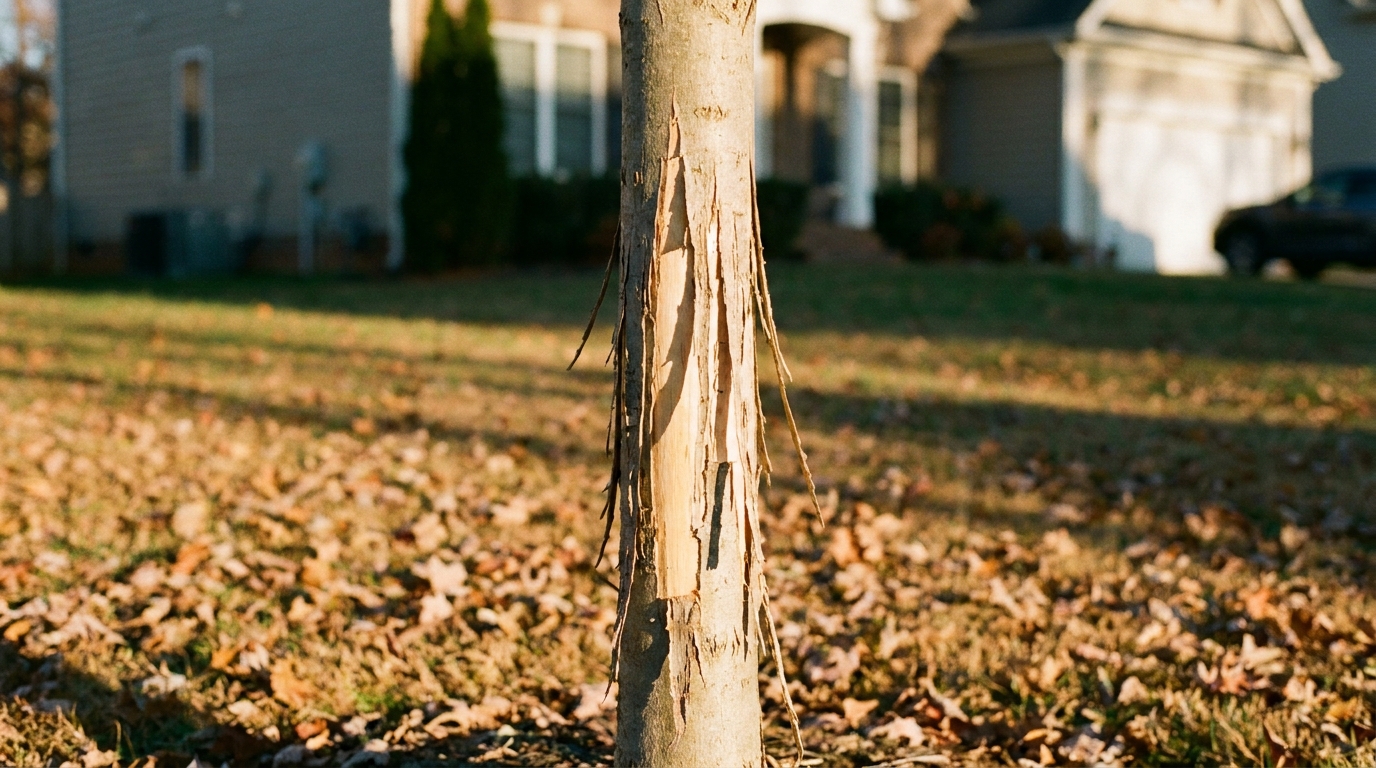
Shredded bark on a small trunk in November is often a buck rub on young trees, not a canker, a frost crack, or a beetle. Missouri Extension describes antler rubbing as vertical scrapes and shredded bark on saplings, with the wood underneath left exposed. [2] Mid-November in the North Carolina Piedmont sits in white-tailed deer breeding season, when bucks use small trunks as signposts. [1] [3] The fix that holds is a trunk guard rather than a spray or a removal.
What a rub looks like on the trunk
A fresh rub is a vertical scrape, longer than it is wide, with bark fibers still hanging and pale wood in the middle. It looks rasped, not chewed into tidy chips. Missouri Extension separates that from browsing. Browsing is torn leaves and ragged stems, because deer have no upper incisors and have to jerk the plant. Antler rubbing is the shredded trunk. [2] Ragged leaves and an untouched trunk mean feeding. A shredded trunk with the leaves still on means a rub.
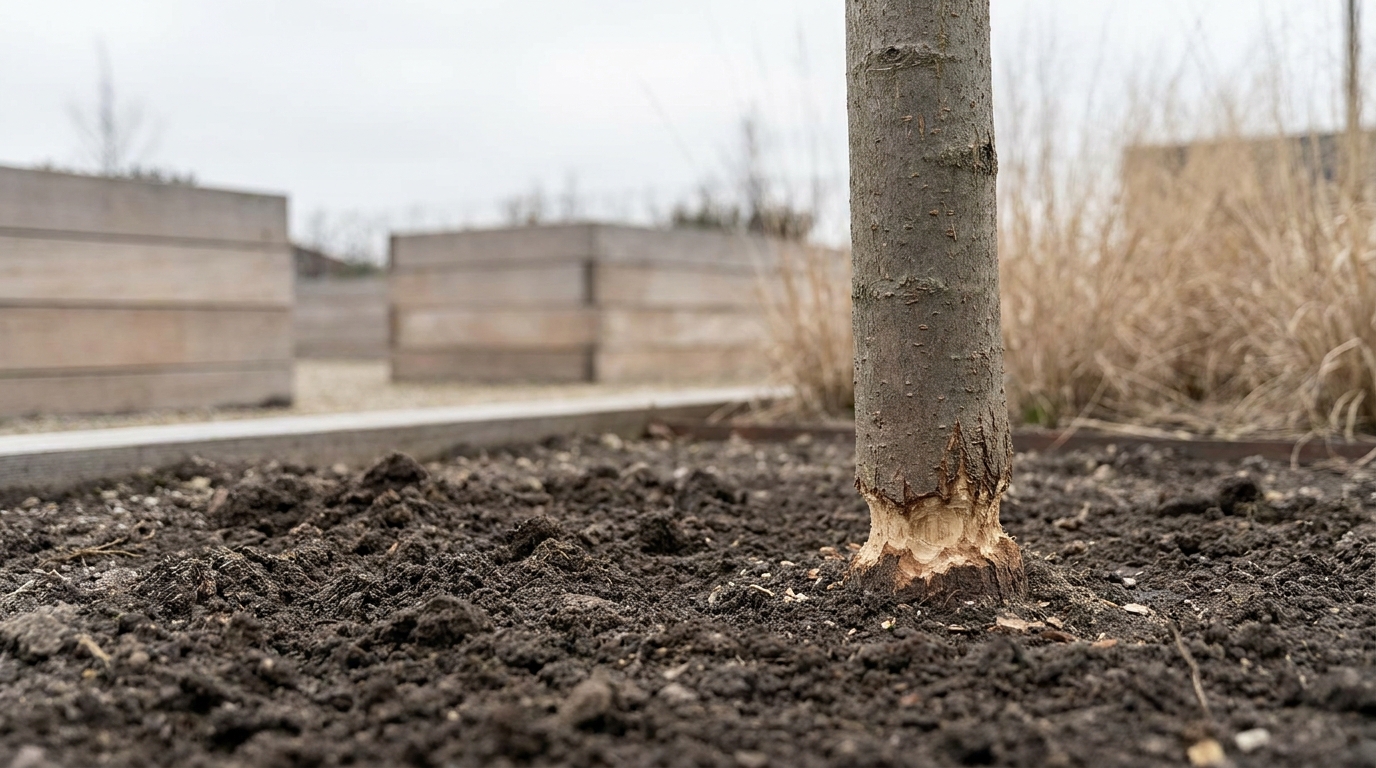
An Iowa State University answer last updated in March 2022 put typical rub damage at 1.5 to 3.5 feet above the ground, about knee to chest. [5] A gnawed ring at the soil line is a different animal. A USDA Forest Service animal-damage sheet, written for deer and elk in the Rocky Mountain Region, says rabbits and ground-dwelling rodents feed on bark near the ground, while deer rubbing leaves shredded bark attached to the wound. Tooth, claw, or antler marks usually show in the sapwood. [8] The same sheet says sapsuckers leave uniform horizontal rows of small holes, which is not this wound. [8] A frost crack is not this shredded patch, and neither is a canker or pine bark beetle damage. Use that sheet for the look of the wound, not as a Piedmont deer calendar.
If the crown is still green and that hanging strip is the only new damage, treat it as a buck rub on young trees until a closer look shows something else. Older rubs go dull. The tree may grow a callus ridge of new bark around the wound. [8]
Why mid-November shows up in Piedmont yards
The North Carolina Wildlife Resources Commission’s 2025 map of estimated peak conception dates puts the Central season zone average at November 15. [1] Zone averages on that map run from October 31 in the Southeastern zone to December 5 in the Western zone. [1] The dates come from reproductive samples, including roadkill and late-season hunter-harvested does, 1,776 of them collected through May 2025. [1] A county estimate is weaker when the sample is small. Union County’s row is 9 samples, too thin to treat as a Waxhaw calendar, even though the map prints a date there. [1]
Some does are bred before the peak and some well after, and the peak barely moves year to year because estrus follows shortening day length, not a cold front or the moon. [1] Mid-November lines up with the Central average, and county dates on the map are not all November 15. [1]
A 2025 Southeast apple guide from NC State Extension says that during September to November, after antler growth is complete, bucks damage trunks and scaffolds to leave their sign. They do not rub velvet off on trunks. Velvet falls off on its own. [3] An NC State wildlife page reviewed in 2024 says antler rubbing begins in August and ends by mid-October, breeding peaks from late October through December, and antlers drop from late December to mid-April. [9] A fresh shred this week fits that breeding season and the September-to-November sign-rubbing window. [1] [3] It is not a velvet job.
Which young trees are at risk
The usual buck rub on young trees takes the thin bark off a small trunk. The Iowa State note says that rubbing can seriously damage or destroy small trees. [5] Missouri Extension calls the targets saplings. [2] Penn State Extension, in a fruit guide updated in June 2026, says bucks can break limbs and can girdle the trunk if they take off enough bark. [4] The 2025 orchard guide says deer are drawn to nearly all species of fruit trees, and that rub damage lands on trunks and scaffolds of young plantings. [3]
A March 2023 Penn State note says that even a six-foot tree, tall enough to hold leaves above browse height, still gets the stem rubbed and needs that protection for years. [7]
A tag that says deer resistant is about feeding, not rubbing. That 2023 note says the label refers to what deer prefer to eat when they have choices, and that in a hard stretch they will eat plants people usually skip, including rhododendron and conifers. [7] Guard a young conifer or a fruit tree the same way.
Missouri Extension says damage potential is higher against woods and brush, where deer do not have to leave cover, and lower on open sites. [2] A sapling by the back fence is a likelier target than the same tree in an open front yard.
What actually protects the bark
The protection that works is something the antlers hit instead of the bark. Posts, wire, or a tough sleeve. Not a bottle.
Iowa State’s 2022 answer says to drive three sturdy wooden stakes or fence posts around each tree in late summer, spaced about 18 inches apart. [5] The orchard guide says the same thing for a single tree: three fence posts, 1 to 2 feet apart, in an equilateral triangle. [3] The 2023 Penn State note says an aggressive buck can push wooden stakes over, so drive them deep and reset any that rock. [7]
Where the pressure is heavier, add wire. Texas A&M Forest Service says fall rubbing can girdle a tree, damage the vascular tissue, and often kill it, and it specifies welded wire at least 48 inches tall, a cage at least 12 inches in diameter, on T-posts. [6] That height covers the 1.5 to 3.5 foot band. [5] Keep the wire off the bark.
A sleeve can work if it is tough. The 2023 Penn State note says a split tube up to four feet should cover the stem, but some tubes are weak enough for antlers to puncture, while a split piece of 4-inch corrugated drainpipe resists better. [7] Wider material means a later rub takes a smaller share of the diameter, so water and nutrients can still move. [7] Seat the tube a few inches into the ground so rodents do not nest inside and strip the base. [7] Remove it or widen it before the trunk fills it. Texas A&M says an outgrown tube can girdle the stem. On that same page, thin spiral wraps are for rodents and rabbits, not for bucks. [6]
Install it in late summer if you can. September is already inside the rubbing window the orchard guide names, so a bare trunk this week should get a guard now. [5] [3]
A spray is the step people hope will replace all of that. Missouri Extension, in a guide reviewed in May 2025, says repellents reduce antler rubbing only to the extent that they keep deer out of an area, and that deer may ignore taste and odor repellents when food is scarce. [2] A fall application may also prevent rubbing if it goes on before a feeding pattern sets, but rain washes many products off, and it is not a coating that stops an antler already on the bark. [2] Penn State’s 2026 fruit guide says results vary, home remedies often have limited success, and hungry deer may ignore them. Damage is rarely eliminated. [4] We would not count on a spray for a smooth young trunk in November.
A full fence is for a whole planting, not one yard tree. Penn State says an 8-foot woven-wire fence is the efficient exclusion when deer pressure is high. [4] The orchard guide says a nonelectrified deer fence needs to be at least 8 feet high. [3] For one or two trunks, posts or a cage are enough.
After the bark is already shredded
Do not reach for the saw first. Look at the whole circumference, including the back of the trunk.
The Forest Service sheet is blunt about a complete ring. If a stem is girdled, the part above the girdle dies. [8] Damage that does not ring the stem can still slow growth. In most cases callus forms and the tree recovers if disease or insects do not move into the wound. Those wounds can let in canker and wood-decay fungi. [8] That is a reason to watch the scrape next season. It is not a reason to remove every rubbed sapling because the bark looks bad in November.
Penn State’s 2026 guide names broken limbs, and a girdled trunk when enough bark is gone, as the serious case. [4] If a strip is gone on one side and the far side is intact, callus can close the wound. [8] Keep a guard on it so the buck does not finish the ring. If the scrape goes all the way around and the top is wilting, the part above the ring is in trouble and removal may be the honest call. Broken low limbs are often a trimming job instead. [4] Wound paint is not the fix these pages describe. Guard the trees that are still intact first.
Practical takeaways
- A vertical shredded patch with hanging bark, about 1.5 to 3.5 feet up a small trunk, is the rub. [2] [5] A soil-line gnaw and a row of holes are different wounds. [8] A frost crack, a canker, or beetle damage is a different problem too.
- The Commission’s 2025 map puts the Central zone average peak conception at November 15. Union County’s row is 9 samples, so do not treat one box on the map as a calendar. [1]
- September-to-November shredding is sign-rubbing on hard antlers. Velvet falls off on its own. [3]
- Young thin-barked trees are the targets, including trees tagged deer resistant. Guard the stem for years. [5] [7]
- Three sturdy posts about 18 inches apart, or wire at least 48 inches tall and 12 inches across, is the physical guard. [5] [6] Widen the guard as the trunk grows.
- Repellents only help by keeping deer away, and hungry deer ignore them. [2] [4]
- A one-sided scrape is not a removal. A full ring can kill the top. Look before anyone cuts. [4] [8]
How we can help
We are Clark's Tree Care, based in Waxhaw. A buck rub on young trees usually calls for a look at whether bark still connects around the trunk, not a saw at the base. Snapped low limbs are a tree trimming question. A ringed trunk with a failing top is the case where removal belongs in the conversation, and only after that look. The better call, when the tree can be kept, is to keep it and guard it. Have more questions or want to get in touch? Tell us what the trunk looks like on our contact page.
Citations
- North Carolina Wildlife Resources Commission, "Estimated Peak Conception Dates" (2025)
- University of Missouri Extension, "Controlling Deer Damage in Missouri" (2025)
- NC State Extension, "2025 Integrated Orchard Management Guide for Commercial Apples in the Southeast" (2025)
- Penn State Extension, "White-tailed Deer in Home Fruit Plantings" (2026)
- Iowa State University Extension and Outreach, "How can I prevent deer from rubbing off the bark on small trees in the yard?" (2022)
- Texas A&M Forest Service, "Temporary Browse Protection" (n.d.)
- Penn State Department of Ecosystem Science and Management, "Protection for Your Tree and Shrub Plantings" (2023)
- USDA Forest Service, "Animal Damage" (n.d.)
- NC State Extension, "White-Tailed Deer" (2024)