Holiday Lights on Trees Come Off When the Season Ends
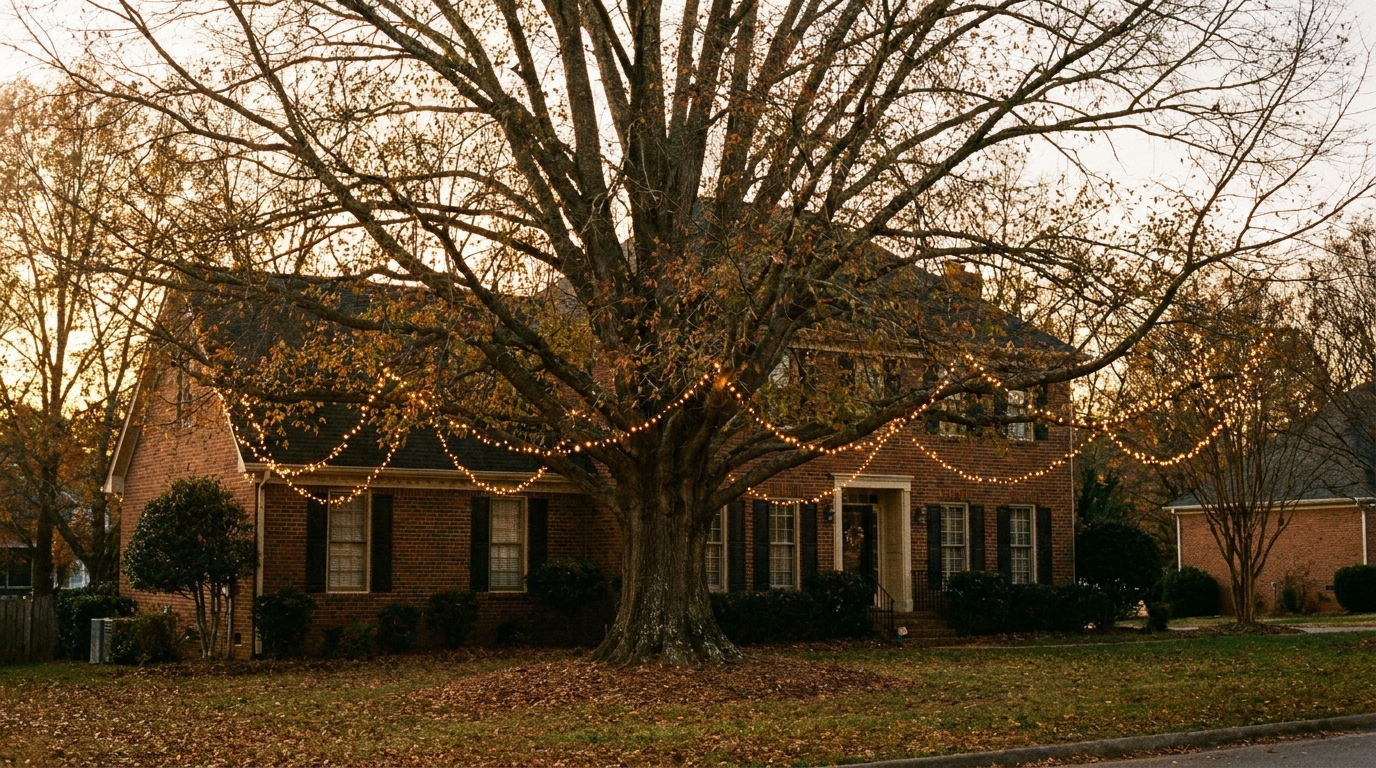
Holiday lights on trees should come down when the season ends. A wire left wrapped on a trunk or a limb can cut into the bark as that wood grows wider, and the Morton Arboretum's plant clinic says that injury can kill the branch or the tree [1]. In a November 2023 note, the Arboretum said it takes its own display off right after the holidays so the trees are clear before spring growth begins in March [1]. Around Waxhaw, a lot of strands go up in late November. January is the month to take them off.
A strand does not grow with the branch
The lights stay the same size. The tree does not.
Live wood expands outward as it ages. A December 12, 2024 garden Q&A in the Baltimore Sun, from University of Maryland Extension's Home and Garden Information Center, answered a reader who had seen shopping-center trunks wrapped in mini lights all year. Wire from lights or from a stake tie cannot stretch as the wood grows. Left tight, it stresses the tree and can kill it [2]. If the canopy is already dying back, cutting the wires loose probably will not save the tree [2]. Take seasonal lights down before the next growing season [2].
Vessels just under the bark move water and nutrients. The Morton Arboretum says a forgotten wire can slice those vessels as the branch grows wider, and the growing tissue sits right under the bark, so a nick matters too [1].
North Dakota State University forester Joe Zeleznik wrote about this after he pulled down Christmas lights left up from the 2015 season. A small twist tie was already digging into the stem. Every wire, strap, zip tie, cable, or rope left around a stem or a branch will eventually girdle the tree, sometimes in a couple of years and sometimes after many more [3]. The note is old. Trunks still add girth the same way. A tie that was only snug in December is still there in April.
Put the removal day on the calendar when holiday lights on trees go up. That is what the Arboretum's 2023 note recommends, so January does not slip past [1]. Rodents are a second reason. They can chew the insulation over the winter, and chewed wire can short [1]. LED bulbs do not fix the wire. The Arboretum does recommend energy-saving LEDs that are UL-listed and rated for outdoor use, along with outdoor-rated cords and timers, and it says not to overload the circuit [1]. Chewed insulation is the short-circuit risk that note describes [1].
What to cut off besides the bulbs
The bulbs are the easy part. The fasteners are what get left behind.
Plastic cable ties and thin twist ties are a poor hold. The Morton Arboretum says they can rub or cut the bark when the plant moves in the wind. If something has to secure the wire, the Arboretum suggests a soft strip, such as fabric from an old dark T-shirt, tied loosely so the branch can still move [1]. That soft tie only helps if it comes off with the lights. Zeleznik's note puts straps and ropes on the same list as wire. Anything left in a closed loop around the stem will girdle it [3].
Nails, screws, and staples are a different mistake, because they enter the wood. University of Illinois Extension forestry specialist Jay Hayek's advice is not to drill, tap, or hammer metal into a tree. That means no nails, no screws, and no staples [4]. If one is already deep in the bark, pulling it is not automatically better. Hayek said removal is not necessary, because taking the fastener out can make the problem worse, depending on its size [4]. Cut the light wire free. Do not lever against the bark.
In November and December most deciduous trees have already set next year's buds, even when the crown looks bare. The Arboretum says not to break those twigs, and to work on a warmer day because cold wood is brittle [1]. Keep a second person at the ladder [1]. Unwind the strand the way it went on. If the lights stop partway up a tree that was too big to wrap fully, leave that upper wood alone [1].
If the bark has already closed over the wire
Sometimes the strand has been up since the last holidays, and the trunk has started to swallow it.
University of Maryland Extension, on a page updated February 27, 2023, describes staking wires left around a growing trunk. The page is not about a light display, but the growth is the same. As diameter increases, the wire can cut in, restrict sap flow, and become embedded. The trunk may swell above the wire and break more easily there. Over time most of those trees die from the strangulation, though some survive [5].
If the wire is only partly embedded, Maryland says take it off as soon as you can [5]. If the trunk has completely grown around it, pulling it out may do more damage. Trim the excess wire, remove any stakes, and watch the tree, knowing it can break where the wire sits [5]. Do not carve into the trunk to free a wire the bark has closed over.
A loose strand in January is a short job. A wire inside the wood may be a removal rather than a repair, especially if the crown above it is already dying back [2]. Check young trees first. Zeleznik says to look at trees planted in the last few years and pull every leftover strap [3]. Wires left on a young trunk past the first year do not help, and they can strangle it as the caliper grows [5].
A groove from a wire is its own mark
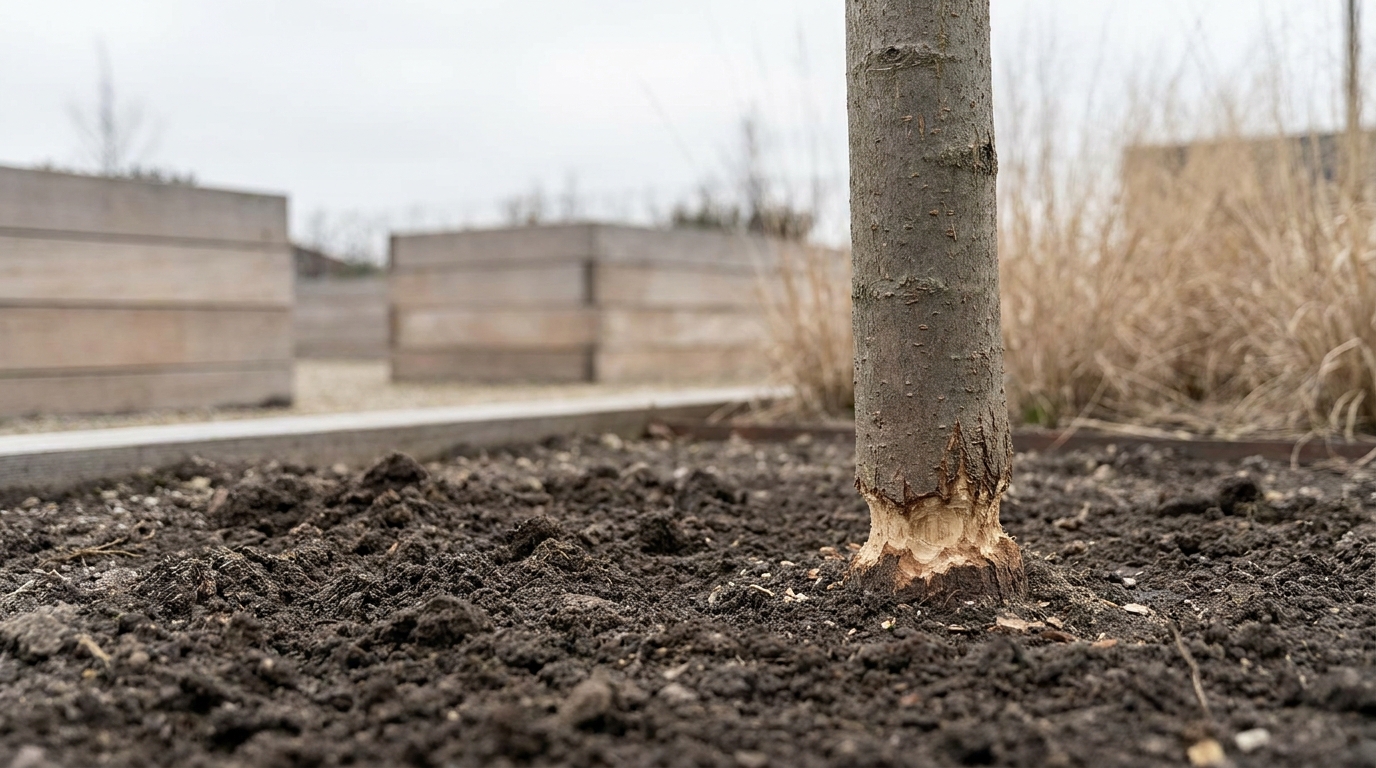
A smooth groove that follows a leftover light wire is not a buck rub, and it is not insect girdling. Penn State Extension, in a guide updated July 9, 2024, describes a buck rub as shredded bark and gouges, usually about 1 to 3 feet above the ground, showing up in autumn [6]. A twig-girdler beetle does something else. N.C. Cooperative Extension, in a note updated October 29, 2021, says the beetle chews a complete circle through the bark and into the wood of a twig or small branch [7]. A light wire does neither. It presses where someone wrapped it.
After the strand is off, feel the limbs you can reach without climbing. Look for a zip tie, a wire scrap, a staple, or a dent that follows the wrap. If the bark has closed over the wire, leave the buried part and trim only what is still outside the wood [5].
The line to the house is not a place to climb
Many displays sit on a tree that shares the sky with the service line, the wire from the pole to the house. That is not a place to learn ladder work.
Duke Energy says to look up before any outside work. Electricity travels readily through metal, water, trees, the ground, and people [8]. An aluminum ladder is an exceptional conductor, and touching a power line with a metal object can cause serious injury or death [8]. A roof puts you closer to the lines. Duke's house-painting example says not to let yourself, your ladder, or your tools touch the line that supplies the house [8].
Duke also states a distance. The company says OSHA requires anyone working or lifting within 10 feet of overhead power lines or poles to contact the utility, and that the distance may be greater at higher voltages. In North Carolina, Duke says the Overhead High-Voltage Line Safety Act requires a call to Duke Energy at 800.POWERON before working within 10 feet of power lines [8]. The page lists 800.769.3766 for Duke Energy Carolinas, the same 800.POWERON number, and 800.419.6356 for Duke Energy Progress [8]. If the ladder would put you inside that 10 feet, call.
Duke says only trained professionals should prune around power lines, and not to cut trees near overhead lines until you have met with a company representative [8]. Taking lights off a low limb is not that job. If a strand or a branch is already tangled in a line, stay away and call. Do not try to move it [8]. Keep electrical gear out of rain and off wet ground [8]. If the only reach is inside the 10 feet Duke names, leave that part and call.
When the lights show a limb that should not stay
Taking the lights down is a good time to look at the tree. It is not a good time to reshape the crown.
N.C. Cooperative Extension's pruning publication, issued April 7, 2020 and revised March 5, 2025, says broken, dead, weak, or heavily shaded branches can be removed anytime [9]. A large limb sometimes has to come off because it is a safety hazard or it was damaged in a storm, and large-tree pruning belongs with a certified arborist who has the right equipment and makes the right cuts [9]. The same publication warns against heavy pruning in the dormant season, and it calls the slide into dormancy one of the worst times to prune [9]. Flag the limb. Do not start cutting live wood with a light strand still in your hand.
What is worth a call is narrow. If the lights were wrapped on deadwood, or a weak limb stands over a roof, a walk, a drive, or a parking space, that is a trimming or removal question. Leaving the strand up until spring does not fix it. Our crew can look at the limb and tell you whether pruning is enough or the tree should come out. We trim and remove trees. We do not hang holiday lights.
Practical takeaways
- Take holiday lights on trees down when the season ends, before spring growth, not next November [1][2].
- Remove zip ties, twist ties, fabric knots, and wire scraps. A closed loop left on a stem will girdle it [3].
- Do not nail, staple, or screw a display into the bark. If a fastener is already deep, do not pry it out [4].
- If the bark has only started to swallow a wire, get it off. If the trunk has closed over it, trim the loose end and watch that spot [5]. Dieback above a tight wrap may mean the tree will not recover [2].
- Look up before the ladder goes up. Duke Energy says to call before working within 10 feet of a power line, and to leave a tangled strand alone [8].
- Dead or broken wood over a roof or a walk is a trimming or removal job, not a side task while the lights come down [9].
How we can help
Have more questions or want to get in touch?
If the lights come down and you are looking at deadwood, or at a weak limb over a roof, a walk, or a drive, our team can assess the tree and tell you whether pruning or removal is the right next step. Start with our contact page. The tree trimming and pruning page and the tree removal page describe that work. We are based in Waxhaw and work across greater Charlotte.
Citations
- The Morton Arboretum, "How to Take Care of Trees and Shrubs as You Light Your Landscape" (2023-11-08)
- Baltimore Sun, "Garden Q&A: Will leaving lights wrapped in trees harm them?" (2024-12-12)
- NDSU Extension, Tree Information Center, "Springtime spruces - 1, girdling Christmas lights" (undated; discusses lights left from 2015)
- University of Illinois Extension, "Placing Screws in Trees" (undated)
- University of Maryland Extension, "Embedded Wires, Nylon Cord, and Wire Baskets" (updated 2023-02-27)
- Penn State Extension, "Why Did My Young Streamside Tree Die?" (updated 2024-07-09)
- N.C. Cooperative Extension, Pamlico County Center, "Pecan Twig Girdlers" (updated 2021-10-29)
- Duke Energy, "Overhead Power Lines" (undated; accessed 2026-11-17)
- NC State Extension Publications, "General Pruning Techniques" (2020-04-07, revised 2025-03-05)