Watering new trees in winter until the ground freezes
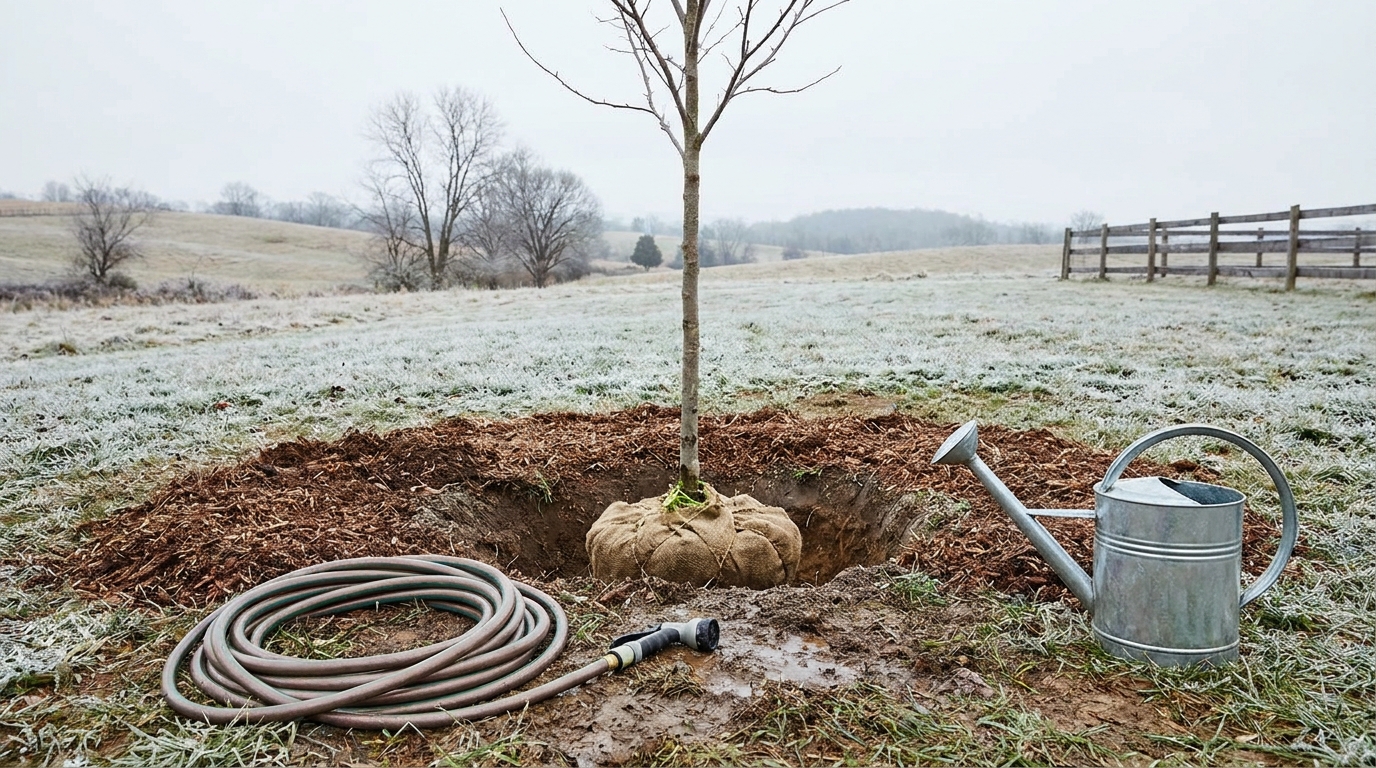
A tree that went in the ground this fall is not finished when the leaves drop. Watering new trees in winter means checking a still-shallow root ball while the soil is dry and unfrozen, then stopping once the ground itself freezes. Iowa State University Extension, in guidance updated in 2024, says tree roots keep growing until the ground freezes, and that a newly planted tree should keep getting water in dry weather until the soil freezes [2]. Around Waxhaw and the other Charlotte-area counties we serve, that is a soil check, not a date on the calendar.
The roots are still in a small patch of soil
Clemson University Extension explains why the hose is still part of the job. People plant trees and shrubs in cooler weather so roots can grow while the top of the plant is dormant [1]. Those roots have not spread. A developing root system cannot draw on the same volume of soil an established tree can, so what matters is the moisture around the root ball [1]. In that 2021 fact sheet, the dry-spell rule is plain: when it does not rain, check soil moisture weekly and water when the soil seems dry, and apply the water when temperatures are above freezing [1].
That is not a summer schedule carried into December. A March 2024 note from University of Georgia Extension in Bartow County says moisture evaporates more slowly in cooler months, so water less often then than in summer, and many landscapes need little or no extra water in winter [6]. The same note says a dormant plant can still grow roots through the winter, because it is not losing water through its leaves the way it does in hot weather [6].
Soil changes the answer. That 2024 guidance says clay holds more water, and holds it longer, than sand. If clay soil gets an inch of rain in a week, you probably do not need to add water. If it gets a half inch, add about another half inch a few days later when no more rain is forecast [6]. A sandy spot dries faster, so do not water every day out of habit.
The ball itself can be dry when the yard is not. The North Carolina Extension Gardener Handbook, published in 2022, says the mix in a container-grown root ball drains faster than the surrounding soil, and moisture outside the ball may not move in fast enough to replace what the plant uses [3]. For trees and shrubs in the 1-gallon to 3-gallon size, that 2022 chapter's establishment routine, if it does not rain, is 3 gallons to 5 gallons twice a week until roots grow into the surrounding soil, about three to four weeks [3]. Plants installed in the cooler part of the year may need less [3]. Read those gallons as a 2022 starting point for a small container plant in its first weeks, not as an order for every tree on the lot. After that window, use the finger test. Iowa State's 2024 update is the longer view: small trees usually need watering for 1 or 2 growing seasons, and large trees may need water now and then for 3 or 4 years [2].
Clemson put the rainfall in context in 2021: South Carolina receives 45 to 50 inches of rain a year, above a global average of 39 inches, and established plants suited to the climate often need little or no extra winter water when rain is adequate [1]. The exceptions are newly planted trees and shrubs, containers, and an unusually dry winter [1].
Feel the root ball before you open the hose
Pull the mulch aside and put a finger into the root ball, not only into the lawn a few feet away. The 2022 handbook says to check that way, and to water more, or more often, or both, if the ball is dry [3].
Once that mix goes bone dry, it is hard to rewet, and water can run off instead of soaking in [3]. The 2022 handbook's fix is to apply water two or three times in the day until the ball is wet, rather than one hard blast [3].
Stop if the soil is already wet. The same 2022 chapter notes that a lack of oxygen in saturated soil kills the roots of many plants [3]. University of Georgia Extension says roots left in soaked, airless soil begin to rot, so let the soil dry for a few days between waterings, and judge wilt in the morning rather than at midday, when leaves can flag and still recover overnight [6].
The 2022 handbook says to keep mulch at least 6 inches away from the trunk or crown [3]. Check each new tree on its own. Recent transplants, and plants near pavement or a wall that reflects heat, are the ones most likely to dry and scorch [3].
A frosty lawn is not frozen ground
The stop sign is the soil, not the first cold morning. Iowa State's 2024 guidance says to continue, in dry weather, until the soil freezes [2]. Clemson's 2021 fact sheet says to apply water when temperatures are above freezing [1]. The State Climate Office of North Carolina defines a freeze as a temperature at or below 32°F, measured about 2 meters above the ground, and it notes that a light freeze can happen at ground level even when the air is still a little above freezing [7]. We will not hand you one freeze date for Waxhaw, Charlotte, or the South Carolina side of the counties we work in. A station average is not the bed by the foundation, a low spot, or a south-facing slope. Check the tree you planted.
While the soil is still workable, dry ground is worth watering before a hard cold night. In its 2022 woody ornamentals chapter, NC State Extension says moist soil, compared with dry soil, absorbs and holds four times more heat, conducts that heat to the surface faster, and radiates 5°F warmer through the night, and that watering also cuts drying [3]. Water dry, open soil ahead of a freeze. Do not pour water onto ground that is already frozen. NC State's July 2026 guide draws the same line for roots: as long as soil temperatures are above freezing, roots can grow [4]. If a later mild spell opens the soil again, use the 2021 Clemson check: no rain, a dry ball, and temperatures above freezing, then water [1].
Evergreens keep foliage, so they keep losing water in wind and sun. The 2022 handbook says drying also happens in winter, and it says to water evergreen plants before high winds or a severe freeze [3]. Sudden browning after a storm, or a limb over a roof, a driveway, or a walk, is a call to us. Do not climb.
A late dose of fertilizer is the wrong help
The 2022 North Carolina handbook says to wait until spring to fertilize trees and shrubs planted in the fall, and to avoid late-summer fertilization because it pushes new growth that may not harden off before a sudden cold snap [3]. University of Georgia Extension in Forsyth County, in a December 2024 article, says to keep soil moisture up and avoid nitrogen fertilizer while plants are slowing into dormancy. Nitrogen pushes new leaves, which is the opposite of what the plant is doing, and a drought-stressed plant is more open to injury [5].
NC State's July 13, 2026 guide, A Gardener's Guide to Fertilizing Trees and Shrubs, is specific about the product. Do not fertilize during drought or other plant stress [4]. Avoid quick-release fertilizer between leaf drop and budbreak. Without leaves, the plant is not actively cycling water and nutrients, uptake would be minimal, and leftover fertilizer may leach or turn to gas [4]. Quick-release fertilizers are soluble salts, and too heavy a dose can burn or kill young roots [4].
That 2026 guide does not ban every fall feeding of every established tree. Slow-release timing is less critical, fall applications can be effective, and fall feeding has not been found to set plants up for winter injury unless the plant is already stressed, such as by shearing or by growing outside its normal range [4]. A tree that just went in the ground is in that stressed group, so the 2022 spring wait is the rule for it [3].
University of Maryland Extension, updated in 2023, agrees on planting: do not fertilize at planting time, because most of the plant's energy during establishment goes to root growth, and nitrogen applied then seems to suppress that root growth rather than help it [8]. Proper watering is the most important maintenance step for a new tree or shrub, and a drought-stressed plant should not be fertilized [8]. If you fertilize other landscape trees, that 2023 note allows late October through early December, or late winter into early spring, and it says not to fertilize in late summer or early fall, or when the ground is frozen [8]. None of that makes a November nitrogen push good care for a tree planted this fall.
What to do on a mild day
Leave live wood alone. The 2022 handbook says a new plant typically needs only light removal of damaged or broken branches, and that cutting shoot tips reduces the signal for new root growth [3]. Hanging wood over a building or a path is not a pruning project. Call (980) 247-TREE and let our team deal with it. When the soil is frozen, put the hose away, and check again only if a thaw leaves the ball dry and the air is above freezing [1].
Practical takeaways
- Water a dry root ball only while the ground is unfrozen. In a dry spell, check weekly, and water when temperatures are above freezing [1] [2].
- Feel the root ball, not only the lawn. If it sheds water, the 2022 handbook says to wet it two or three times until it soaks in [3]. Keep mulch at least 6 inches off the trunk, per that same 2022 handbook [3].
- On clay, a 2024 University of Georgia note says an inch of rain in a week may be enough, and a half inch may not [6]. A small plant in its first weeks is the only place the 2022 handbook's 3 gallons to 5 gallons, twice a week for about three to four weeks, belongs, and cooler weather may need less [3].
- Do not fertilize a tree planted this fall. Wait until spring, skip quick-release fertilizer after leaf drop, and do not feed a dry or stressed tree [3] [4] [5].
- Water dry evergreens before high wind or a severe freeze while the soil is open [3]. If the tree is wilted in the morning and the soil is soaked, stop [6].
- Iowa State's 2024 update says small trees often need dry-weather water for 1 or 2 growing seasons, and large trees sometimes for 3 or 4 years [2].
How we can help
Have more questions or want to get in touch? If a young tree is wilting on mild mornings, the soil stays soggy, or winter browning does not look right, our team can walk the property with you. Call (980) 247-TREE or send a note through our contact page.
Citations
- Clemson University Cooperative Extension, "Should I Water My Plants in the Winter?" (2021-12-13)
- Iowa State University Extension and Outreach, "How long should I continue to water a newly planted tree?" (2024-12-06)
- NC State Extension, "11. Woody Ornamentals" (2022-02-01)
- NC State Extension, "A Gardener's Guide to Fertilizing Trees and Shrubs" (2026-07-13)
- University of Georgia Extension, Forsyth County, "Protect plants from winter freezes" (2024-12-13)
- University of Georgia Extension, Bartow County, "How Often to Water" (2024-03-04)
- State Climate Office of North Carolina, "Freeze Explorer" (2026)
- University of Maryland Extension, "Fertilizing Trees and Shrubs and Nutrient Deficiency Symptoms" (2023-02-17)