when to plant a tree in Union County NC: October
If you are deciding when to plant a tree in Union County NC, October is a sound month for most hardy shade trees, and it is not the only sound month. A University of Georgia Extension bulletin reviewed in December 2024 says container-grown ornamentals can go in through much of the year, but fall and winter are the best time, and balled-and-burlapped trees transplant best from October through April [1]. The 2022 North Carolina Extension Gardener Handbook says most container plants do best, and need the least watering attention, in late fall or early spring [2]. October sits in both windows, so a tree planted now around Waxhaw can grow roots through the cool months before the next hot summer [1] [3].
Why October works, and what it does not promise
Spring feels like planting season because the nurseries are full. The roots do not agree. In fall and winter the top of a hardy tree slows down, and the roots can keep growing. A Lee County horticulture agent, writing for N.C. Cooperative Extension in November 2024, said plants still produce roots through fall and winter, which gives them time to settle before the hot summers this part of the South is known for [4]. In Eastern North Carolina, an October 2025 Extension article calls mid-September through early December the strong stretch, with cooler air, more reliable rain, and soil that often stays warm well into December [3]. That piece also says trees planted then are better set for the next summer than trees planted in spring [3]. A Sampson County note updated on September 30, 2026, names October and November for the same reason [5].
Union County is Piedmont, not the coast, and none of those pages measured Waxhaw soil, so treat them as Carolina guidance. October still sits in Georgia's October-through-April window for balled-and-burlapped trees and in the handbook's late-fall option [1] [2]. Early spring is the other easy time in that 2022 handbook, and winter planting after leaf drop is part of the same cooler season [1] [2]. Miss October and you have not missed the only chance. Wait until late spring and the tree has to root and leaf out in the heat [3] [4].
Frost is the limit. The November 2024 Lee County article is for non-tropical plants, and it says summer annuals and tropicals set out in September or October can be killed by frost [4]. Elephant ear and hibiscus, two plants it names, can live through a central North Carolina winter but do better planted in spring after frost risk [4]. A hardy shade tree is what this month is for. Size still matters. In a South Carolina Forestry Commission example drawn from research published in 1985, a 1-inch tree under good care can rebuild its former root spread by the end of the first year, while a 4-inch tree needs five seasons [9]. The 2022 handbook makes the same point without the inches: large plants take longer to establish [2]. October helps either tree. It does not finish a large one by next July.
Call before you dig, then test the spot
Planting a tree is digging. North Carolina 811 lists planting a tree with mailboxes, fences, and decks as work that needs a locate request, and it asks for three full working days' notice [10]. Dial 811, or 1-800-632-4949 [10]. Only publicly owned lines are marked, so a private line past the meter can still be in the hole [11]. Striking a line can mean injury, an outage, or a repair bill [10].
While you wait, test drainage. The 2022 North Carolina handbook says to dig a hole about 12 to 15 inches deep, fill it with water, and look again in 24 hours [2]. Water still there means poorly drained soil, and waterlogged soil suffocates roots [1] [2]. On very heavy ground, Georgia's December 2024 bulletin describes a raised bed 12 to 18 inches high [1]. For one tree, the handbook uses a mound about 6 inches high so the root ball sits above the wet spot [2]. Test again if you are reusing a place where a tree already failed.
Look up before you buy. Judge the mature crown against the house, the walks, and the power lines [2]. If a failing tree occupies the spot, tree removal comes before the new hole. Do not dig under a leaning or hollow trunk. If a stump fills the only open ground, stump grinding is what makes room for a wide hole.
Set the root flare where you can see it
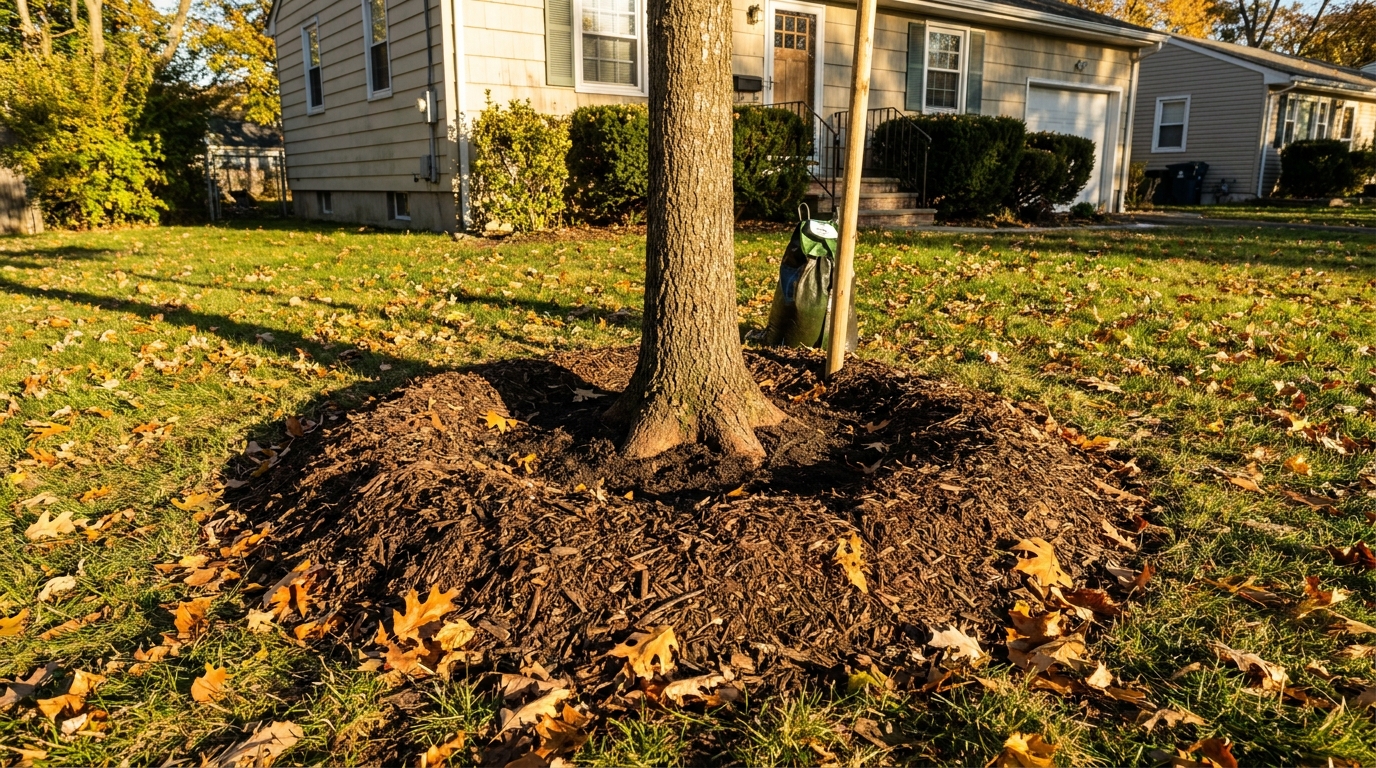
Depth decides whether the October head start amounts to anything. Clemson Extension's planting steps, on a university page that does not print a revision date, call proper depth critical [6]. The root flare is the topmost root, where the trunk meets the roots, and potting mix or burlap often hides it, so brush that material away until the flare shows [6]. Those steps set the tree slightly shallow, about 2 inches above grade, with the flare visible, and they say to lower the bottom of the hole if the flare would sit higher than that [6].
The December 2024 Georgia bulletin says to keep the top of the root ball level with the soil, or 1 to 2 inches high if you expect settling, and to dig the hole only as deep as the ball so the tree cannot sink [1]. The 2022 North Carolina handbook matches that shape: only as deep as the root ball, at least two to three times as wide, with rough sides instead of a slick wall, and the flare just above grade [2]. Do not amend the backfill [2]. Georgia reports that peat, compost, or leaf mold in a single hole can hold too much water, so the native soil goes back in, broken up but not stomped hard [1]. A hole at least twice as wide is what speeds root growth [1]. An August 2025 Burke County note describes the same hole, two to three times as wide, only as deep as the ball, top at grade or slightly higher [7].
Shave circling roots off a container ball, and cut any root wrapped against the trunk, before the tree goes in the ground [2] [6]. On a balled-and-burlapped tree, cut cord or wire off the trunk and pull burlap back from the top third of the ball [1]. On a wet site, remove the burlap completely, and take a fabric grow bag off entirely [1]. Cut away the top third to half of a wire basket once the ball is in the hole [2]. Water at the halfway point so the soil settles, finish the fill with your hand rather than your boot, and leave a soil ring about 2 to 3 inches high so water stays on the ball [1].
Skip granular fertilizer on planting day. Products such as 8-8-8 or 10-10-10 can damage tender roots, so the 2024 Georgia bulletin says to wait until the plant is established [1]. Burke County's August 2025 note says not to fertilize until spring, because an early dose pushes shoots before the roots catch up [7]. The October 2025 Eastern North Carolina article says the same thing in fewer words: let fall be for roots [3]. A soil test before you plant is still worth doing. It answers the pH question without a guess in the hole [1].
A short mulch ring, not a mound
Mulch is a short step, not the whole job. Georgia's 2024 bulletin calls for about 3 inches over the planting area, to hold moisture and slow weeds [1]. The 2022 North Carolina handbook says 2 to 3 inches, kept at least 6 inches off the trunk [2]. Clemson's steps allow 3 to 4 inches out toward the drip line, partly so mowers stay off the bark [6]. Penn State, updated in July 2026, says no deeper than 3 inches and about 3 inches off the trunk [8]. Stay around 2 to 3 inches deep and at least 6 inches off the bark, so the flare stays visible [2] [8]. Pine straw, bark, or shredded leaves all work. Refresh a thin ring. Do not stack a fresh layer on an old one until the pile is deeper than these guides allow.
The first-year watering habit
Penn State's July 2026 update says lack of water is the number one reason newly planted trees do not survive, and that new roots often stay inside the planting hole for weeks or the whole first season [8]. When a field-grown tree is dug, more than 95 percent of the absorbing roots stay in the nursery, which a South Carolina Forestry Commission guide ties to research it cites from 1985 [9].
For the first 6 to 8 weeks, keep the roots moist but not wet [1]. The December 2024 Georgia bulletin says trees may need water about twice a week if there is no rain, and that the soil should overrule the calendar [1]. An October planting fits the October 2025 Eastern North Carolina schedule more closely: every 2 to 3 days for the first 2 to 3 weeks unless rain is substantial, once a week in dry fall spells, and about every 2 to 3 weeks in winter if it is dry and above freezing [3]. A Sampson County note updated on September 30, 2026, says to taper the same way and to water only when a soil check calls for it [5].
Make the check with your hands. A few hours after watering, squeeze soil from just outside the root ball [5]. Drips or a sticky feel mean too wet, crumbs mean too dry, and a handful that holds together is about right, but water only if the root ball itself is dry [5]. Sandy ground dries faster than clay, and a tree on a mound dries faster than one set level [2].
When you do water, use Penn State's July 2026 floor: at least 1 to 1.5 gallons per inch of trunk diameter, spread over the root zone, deep enough to wet the top 6 to 9 inches [8]. Count rain only when about an inch or more falls over 24 hours, because a fast inch mostly runs off [8]. Do not copy that article's daily watering for the first 1 to 2 weeks, or its year-per-inch estimate for USDA Hardiness Zones 2 through 6, onto a Waxhaw yard, because those figures were written for a colder climate [8]. An older Forestry Commission ruler says about one inch of water a week in the first season, and it warns that checking the soil is better, that overwatering can hurt as much as drought, and that the watch lasts about three years [9]. It cites 1985 and 1986 root studies, so treat the one-inch week as an old rule of thumb [9].
The habit is the Carolina taper. Start nearer every 2 to 3 days, move toward weekly in a dry fall, and toward every 2 to 3 weeks in a dry winter spell above freezing [3] [5]. Start again when the leaves return, and stay with the checks through the first summer. Water slowly, in the morning, on the ball, not with a lawn sprinkler. In the 1985 example, a 1-inch tree may rebuild its root spread in one good year, and a 4-inch tree may need five seasons [9].
What to leave alone in the first year
Do not prune to balance roots you cannot see. The Forestry Commission guide says the leaves supply the carbohydrates new roots need, so remove broken wood and leave the live crown [9]. Clemson's steps say structural pruning should wait at least three years [6]. The 2022 handbook allows one extra cut on planting day: a second leader, if the tree came with two [2].
Stake only if the tree leans after a day. Most plants under 6 feet tall, with a trunk under 1 inch, do not need a stake, and any tie should be wide strapping that comes off within a year, often by mid-spring on a fall planting [2]. Trunks over 1 inch on trees taller than 4 feet usually need temporary support with some slack, and the 2024 Georgia bulletin says to take those fall-planted stakes off at the start of spring [1]. Do not leave the ties on past a year [2]. Remove nursery trunk wrap at planting, because that wrap is for shipping [1]. Then watch the water and the flare. Soil over the flare means the tree is too deep. Wilted leaves on a soggy ball mean you should stop, not add more water.
Practical takeaways
- October is a sound time for a hardy tree here, inside a fall-and-winter window that also includes early spring, not a month that cancels every other season [1] [2].
- Do not use this calendar for tropicals or other frost-tender plants [4].
- Call 811 at least three full working days before you dig, and remember that only public lines are marked [10] [11].
- If a test hole about 12 to 15 inches deep still holds water after 24 hours, raise the tree or move the spot [2].
- Set the root flare at grade or a little above it (about 1 to 2 inches in the Georgia bulletin, about 2 inches on Clemson's steps), in a hole only as deep as the ball and at least twice as wide, and put native soil back [1] [2] [6].
- Keep mulch about 2 to 3 inches deep and at least 6 inches off the trunk, and water when the root ball is dry rather than on a lawn-sprinkler schedule [2] [5].
- Skip granular fertilizer such as 8-8-8 in the hole, skip a heavy pruning, and take any stakes off by spring or within a year [1] [6] [7].
How we can help
Have more questions or want to get in touch? We do not run a planting crew, and we will not pretend a new tree is something we install. What we can do is clear a clean spot. If a failing tree is standing where you want the new one, we can remove it and leave you room to plant at the right depth. If a stump is in the way of the wide hole this job needs, stump grinding takes the wood out so you are planting in soil. Call (980) 247-TREE, or tell us what is in the way on our contact page. We will walk the property with you and price the removal or the grinding in writing before any work is booked. If a limb from a tree you are keeping hangs over the planting spot, tree trimming is the other job we can take off your list. The planting, the flare, and the watering habit stay with you.
Citations
- University of Georgia Extension, "Soil Preparation and Planting Procedures for Ornamental Plants in the Landscape" (Bulletin 932, full review 2024-12-06)
- NC State Extension, "Woody Ornamentals," Chapter 11 of the North Carolina Extension Gardener Handbook (2022-02-01)
- N.C. Cooperative Extension, Beaufort County, "Trees and Shrubs: Why Fall Is the Best Time to Plant" (2025-10-23)
- N.C. Cooperative Extension, Lee County, "Fall in Love in Planting: The Best Time to Get Your Perennials and Trees in the Ground!" (2024-11-01)
- N.C. Cooperative Extension, Sampson County, "Fall Greetings from Your Master Gardener Friends!" (2026-09-30)
- Clemson University Extension, "Proper Tree Planting" (Bradford Pear Bounty tree-care page, accessed 2026-10-10)
- N.C. Cooperative Extension, Burke County, "Fall Plantings Are Ideal" (2025-08-26)
- Penn State Extension, "Meeting the Watering Needs of a Newly Planted Tree" (updated 2026-07-20)
- South Carolina Forestry Commission, "Newly planted trees survival guide" (cites Watson, 1985; page undated)
- North Carolina 811, "811 Day" (2026)
- North Carolina 811, "Frequently Asked Questions" (2026)