Bald Cypress Needle Drop in November Is Normal
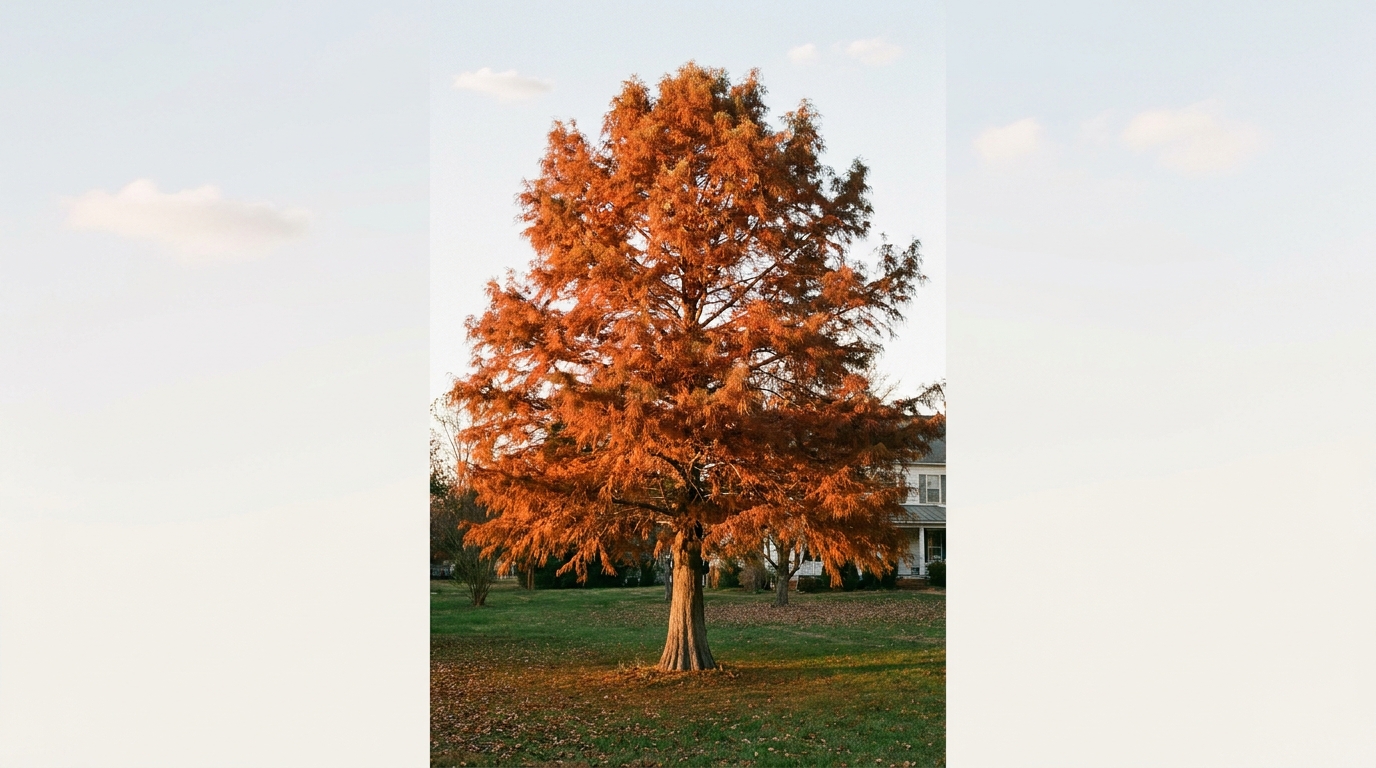
A bald cypress that turns copper across the whole crown in November is not dying. Bald cypress (Taxodium distichum) is a deciduous conifer, and a 2026 Clemson Extension factsheet calls it one of only five conifer species that drops its needles in the fall, after the foliage shifts from tan to orange-red and then reddish brown. [1] The small leafy branchlets fall with the needles still attached. [2] That bald cypress needle drop is the normal way this tree heads into winter, and it is not a reason to cut the tree down.
What a healthy drop looks like in a Union County yard
We get these calls every November around Waxhaw and the rest of Union County. A tree that was feathery and green in August is the color of a penny, or already bare. That worry makes sense when the other conifers on the street are pines. Bald cypress breaks that pattern on purpose.
The color change covers the crown, not one dead limb in a green tree. Clemson Extension describes branchlets and needles changing from tan to orange-red, then reddish brown, before they are shed in the fall. [1] NC State Extension gives the fall color as orange to cinnamon-brown and says the branchlets fall with the leaves still attached. [2] The Morton Arboretum calls it russet-red: the tree loses its needles each winter and grows a new set in spring. [3] University of Kentucky's Urban Forest Initiative says the foliage turns a bright copper color before the leaves drop. [4]
What lands on the lawn is soft sprays, the deciduous branchlets, not stiff needles from inside the crown. Clemson notes that bald cypress carries both deciduous branchlets and permanent ones. Needles on the deciduous stems sit in two rows, while needles on the persistent stems are arranged in a spiral. [1] The woody frame stays. Clemson traces the common name "bald" to that needle drop. [1]
Round cones often stay on the bare branches into winter, and male and female flowers are borne in separate structures on the same tree. [3] A 2022 NC State Extension note says peeling bark and persistent cones remain after the coppery-red needles drop. [5] Cones on a bare crown fit a dormant tree. They do not, by themselves, mean it has died.
New needles are a spring event. Clemson says chartreuse leaves emerge in spring and mature to light green in early summer. [1] The 2022 NC State note says fine pale-green needles are produced in spring, then turn coppery-red before dropping. [5] If the tree is copper or bare now, the fair test is that spring flush. November color is the wrong test.
This is not a pine's inner-needle shed
Pines on the same block can yellow in fall, and that is a different habit. The Morton Arboretum's guide to seasonal needle drop says white pines drop older needles in autumn while the current season's growth stays attached and green. [6] A bald cypress does not keep a green tip and shed only the inside. The whole crown turns, then the whole crown goes bare. If the newest growth at the branch tips is still green and only the older inner needles are brown, you are looking at an evergreen's seasonal shed, not bald cypress needle drop. [6] Under the cypress, the litter is those short feathery branchlets with the faded needles still lined up on them. [2]
Planted yard trees, not a local swamp
Bald cypress is not a tree of the upland oak woods that cover much of Union County. Clemson Extension maps the natural range along the Atlantic Coastal Plain from southern Delaware south to Florida, west along the lower Gulf Coast Plain to Texas, and inland through the Mississippi Valley to the southern edges of Oklahoma, Missouri, Illinois, and Indiana. [1] It typically grows in saturated soils, seasonally flooded ground, swamps, and along streams and riverbanks. [1] NC State places it in the same coastal swamps, bayous, and rivers. [2] A 2022 NC State Extension article also notes that the tree has been growing in popularity in residential landscapes. [5]
Clemson says it tolerates air pollution and poorly drained, compacted, and dry soils, which is why it gets planted in landscapes, parking lots, and streetscapes. [1] A 1992 Forest Service review, still posted, also describes it as a deciduous conifer planted as an ornamental and along roadsides through its range. [7] Around Waxhaw, the November calls are planted yard trees and pond trees. A copper crown is not a native cypress swamp behind the house.
In a landscape, Clemson lists about 50 to 70 feet tall and 20 to 30 feet wide, growing about 1 to 2 feet a year, in USDA zones 5 to 11. Wild trees on that same factsheet can reach 100 to 150 feet and live a few hundred years. [1] One copper November is not the end of that kind of tree.
A swamp is not required in a yard. Clemson says growth is often better in moist, well-drained soil and full sun than in the floodplains where the species grows naturally. [1] NC State says it takes full sun to partial shade and a wide range of soils, including standing water. [2] A lawn tree that stayed green all summer can still turn copper on schedule.
Dawn redwood turns copper too
Check whether the tree is a dawn redwood (Metasequoia glyptostroboides) before you decide anything is wrong. NC State Extension describes dawn redwood as a deciduous conifer in the cypress family, native to central and western China. The foliage turns a brownish copper, or red-bronze, in the fall before it is shed, after emerging light green in spring and maturing to deep green in summer. [8] The Morton Arboretum lists the foliage as deciduous, russet-brown in autumn, and notes that dawn redwood is closely related to bald cypress. [9]
NC State lists each as a tree the other is often confused with. [2] Bald cypress has flat needles about 1/4 to 3/4 inch long, in two ranks on each branchlet. [2] Dawn redwood needles are opposite and crowded on short shoots. [8] Bald cypress cones are round, about 3/4 inch to 1 inch wide. [1] Dawn redwood cones are pendulous and barrel-like, hanging on stalks up to 1 1/2 inches long. [8][9] A fallen spray settles the name: alternate needles point to bald cypress, and opposite needles point to dawn redwood. [2][8] Neither tree should be removed in November for fall color.
Pond cypress, which Clemson treats as a variety of bald cypress, also turns bronze to brown in the fall, on a narrower tree. [1] That is the same seasonal story.
Knees are not a death notice
Woody knobs around the trunk are a separate worry. NC State says knees usually occur when the tree grows near or in water. [2] A 2022 NC State note says it will not produce knees unless planted near water. [5] University of Kentucky ties them to very wet sites, where roots come above the soil and help anchor the tree. [4] Clemson describes pointed root extensions about 1 to 3 feet tall that can also appear in a heavily irrigated or waterlogged lawn, and it suggests a mulched bed so a mower does not hit them. [1] Knees mean the site is wet. They do not mean the crown failed.
Copper in the wrong month is a different problem
Timing is the cleanest split between a healthy bald cypress needle drop and a tree in trouble.
The normal shed is a fall event. A 2016 University of Kentucky pest report states it directly: bald cypress sheds its needle-like leaves in early fall after the foliage turns tan, cinnamon, and deep orange. [10] The trees in that report were not doing a normal fall change. Investigators found fall-colored needles on nursery bald cypress in western Kentucky in May, caused by the bald cypress rust mite (Epitrimerus taxodii). Needles turned yellow first, then brown and reddish. Landscape trees in the same 2016 report showed milder discoloration in early summer. The mite is described as specific to bald cypress. [10]
Clemson's 2026 factsheet makes the same point from the other direction. Mites can be troublesome in a dry summer without irrigation, and their feeding causes early leaf browning and needle drop during mid to late summer. [1] The Morton Arboretum lists spider mite, gall-forming mite, and twig blight among the problems bald cypress can get, and it notes yellowing in high-pH soil. [3] NC State calls twig blight an occasional disease and says chlorosis, a yellowing, often occurs in alkaline soils. [2]
A whole crown turning copper in November, in step with other bald cypress and dawn redwood nearby, matches the fall shed. [1][10] Browning that starts in May, June, July, or August, especially in a dry spell, is not bald cypress needle drop. [1][10] Clemson also lists Cercospora needle blight, bagworms, and fall webworms as growing-season problems, the kind that mark scattered shoots rather than one even November crown. [1] Look at odd summer shoots. Do not treat the whole crown as sick because the calendar reached fall.
Signs the tree actually failed
A failed bald cypress does not look like a uniform copper crown in November. It misses spring, or it shows dead wood and decay along with a crown that is already thinning.
Use the growing season for the life check. A 2024 Penn State Extension guide on young planted trees says a dead tree, looked at in the growing season, has no leaves, buds, or recent growth, a stem that snaps instead of bending, and no green when the bark is scratched. Green cambium means that part is alive. [11] Those checks were written for young plantings. Do not yank a mature cypress, and do not strip a patch of trunk bark. A small scrape on a low twig is enough. On a yard tree, the useful combination is no buds, no spring growth, brittle wood, and no green under the bark. [11]
A healthy bald cypress is bare in winter and grows a new set of needles in spring. [3] That flush is pale green or chartreuse. [1][5] Once other bald cypress nearby have leafed out and yours still has no buds and no new needles, it has missed the flush. [11] Compare it with the same kind of tree. A pine greening up early does not set the clock, and a dawn redwood is a better neighbor to watch. [8][9]
Dead wood can show before the whole tree is dead. A 2023 Penn State Extension guide says root failure shows up as slower growth, leaves that wilt, yellow, or fall early, dead side branches, and a lopsided canopy where major limbs have died. [12] Look for conks, shelf fungi, or mushrooms on the butt, the root flare, or the main roots, especially in late summer and early autumn. [12] A mushroom in the mulch, feeding on wood chips, is not that sign. Fruiting bodies on the trunk or root flare, plus early leaf loss, dead limbs, or a one-sided crown, mean decay. [12] An even copper crown, cones still attached, and no conks on the trunk is the normal shed. [3][12]
We do not take down a copper cypress in November for the color. A large dead limb over a roof, a drive, or a walk is a separate safety problem and should come down whether the rest of the tree is dormant or not. If the spring check says the whole tree is dead, removal is the right call when the trunk stands over a house. Our crew handles tree removal across Waxhaw and Union County, including trees tight to a structure. The decision waits on real failure, not on fall color.
What to do between now and spring
If the pattern above matches, leave the tree. Scheduled bald cypress needle drop does not need a spray, a heavy prune, or a chainsaw in November.
Rake branchlets off walks and drains. On the beds they can stay as a thin cover. Do not cut bare tips back to tidy the shape. The tree is supposed to stand bare until spring growth returns. [1][3]
Water is a summer question. Clemson ties early browning and summer needle drop to dry weather and mites when a tree is not irrigated. [1] Coppering that arrived after a green summer is not fixed with a November soak. Browning that started in midsummer is the case for water in the next dry stretch, and for a look at the twigs, before anyone assumes the species simply drops early.
Through winter, expect a standing frame. Cones may still hang. [3] Peeling reddish bark on a younger trunk is normal: NC State describes it as fibrous, dark red-brown to gray, in thin strips. [2] Bark gone to dry brown wood, with no green under a small twig scrape, belongs with the Penn State checks in the growing season. [11] Chartreuse or pale green new foliage in spring means the November copper was dormancy. [1][5] A crown that stays empty after similar neighbors have leafed out, with brittle twigs and no green under the bark, is the tree that failed. [11]
Practical takeaways
- A uniform copper, rust, or cinnamon crown in fall, then a bare winter, is normal bald cypress needle drop, not a dead tree. [1][2][3]
- Leafy branchlets fall with the needles attached. The woody frame stays, and round cones often hang on through winter. [2][3]
- Dawn redwood does the same fall shed. Opposite needles separate it from the alternate needles of bald cypress. [8]
- Browning in late spring or summer, especially in a drought, can be mites or another growing-season problem. That is not the November drop. [1][10]
- Wait for spring. No bud break once similar trees have leafed out, plus brittle wood and no green under the bark, means the tree failed. [11]
- Mushrooms or conks on the trunk or root flare matter when the crown is also thinning, lopsided, or dropping early. A mushroom in the mulch does not. [12]
- Do not remove a cypress in November because it turned copper. Call about hanging dead wood, or about a tree that misses spring.
How we can help
Have more questions or want to get in touch? If you are looking at a copper cypress and you are not sure it matches the normal drop, our team will look and tell you plainly. We would rather leave a healthy dormant tree alone than take it down for a color it is supposed to wear. When a tree has missed spring, or dead wood is over the house, we can schedule the work. Reach us through our contact page or call (980) 247-TREE.
Citations
- Clemson Cooperative Extension, "Bald-cypress (Taxodium distichum): Identification, Care, Growth Rate & Landscape Use" (2026-04-22)
- NC State Extension, "Taxodium distichum (Bald Cypress)" (undated)
- The Morton Arboretum, "Bald-cypress" (undated)
- University of Kentucky Urban Forest Initiative, "Tree Highlight: bald cypress" (undated)
- NC State Extension, "Bald Cypress Adds Year-round Interest" (2022-11-19)
- The Morton Arboretum, "Seasonal Needle Drop" (undated)
- USDA Forest Service, "Taxodium ascendens, T. distichum" (1992)
- NC State Extension, "Dawn Redwood (Metasequoia glyptostroboides)" (undated)
- The Morton Arboretum, "Dawn redwood" (undated)
- University of Kentucky, "Fall-Colored Damage in Bald Cypress (Taxodium distichum) Caused by Rust Mites in Late Spring" (2016-07-19)
- Penn State Extension, "Why Did My Young Streamside Tree Die?" (2024-07-09)
- Penn State Extension, "Diagnosing Root Death In Woody Ornamentals" (2023-11-14)