Frost Crack on Tree Bark After a Hard Freeze
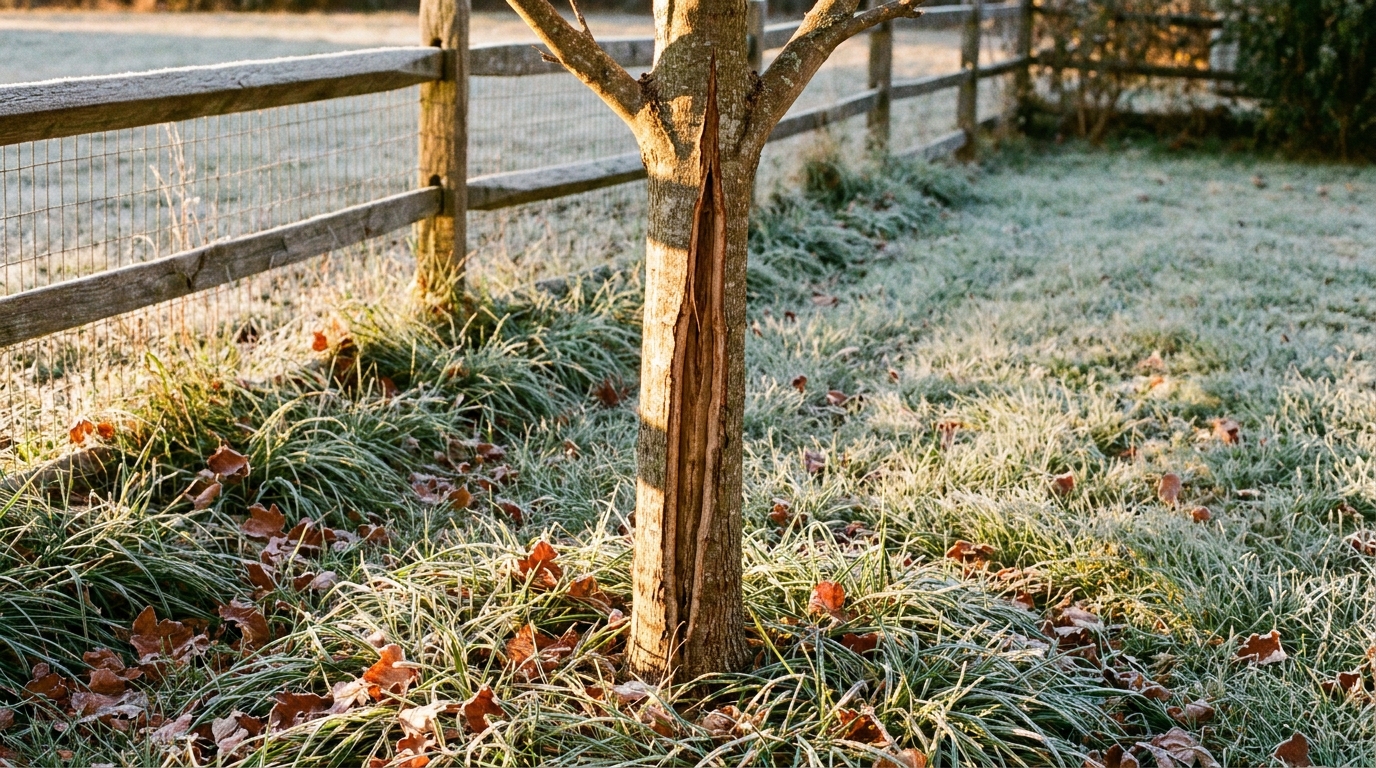
A fresh vertical split on the southwest side of a maple, showing up after the first hard freeze, is often a frost crack on tree bark. The low winter sun warms that face of the trunk, and a fast drop in temperature, from sunset or from a cloud, makes the outer wood contract faster than the wood inside. [2] The same weather can kill a strip of bark, which is sunscald, and the two injuries often show up together. [2] Most of these splits become a scar the tree closes with callus, while a crack that runs deep into the wood can later rot the heart of the trunk, and that is when a crew should look. [9]
What the split looks like
Around Waxhaw this usually shows up on a young maple, or another thin-barked tree, in the open. Purdue Forestry and Natural Resources, in a January 2026 note, described cracks from less than 1 inch long to the full length of the stem, often with sunken bark, usually on the south to southwest face. [1] Clemson's cold-damage fact sheet, updated in October 2019, calls a frost crack a long, deep, narrow split. It is most often on the south or southwest side, but it can show up on any side, on young trees and on older trees that still have smooth bark. [6]
You might see the opening the morning after a sharp freeze. You might not. N.C. Cooperative Extension in Durham County, writing in February 2026, says cold injury on woody plants can take days, weeks, or months to show. [4] The Morton Arboretum's plant clinic, in a November 2025 note, says a vertical crack can appear after a sudden cold snap below 15 degrees Fahrenheit, or after a large day and night difference, most often on the sunny south or southwest side. [3] We will not invent a first-freeze date for Union County. The pattern is the sunny side of thin bark after a hard drop, not a calendar day.
Maples split because the bark stays relatively thin. A March 2024 University of Georgia Extension note says maple bark opens when temperatures swing hard and the tree is not fully hardened. Young trees are worse off, because a small crown does not shade the stem, and maples in full sun on the south or west side are more likely to crack at any age. Stripping too many low limbs off a young tree leaves the trunk exposed. [5] Purdue's 2026 list also includes birch, apple, plane tree, cherry, and elm when the tree is already stressed. [1] The Morton winter-injury page adds linden, poplar, willow, and fruit trees. [2] New red maples and ornamental cherries beside pavement pick up extra heat. [8]
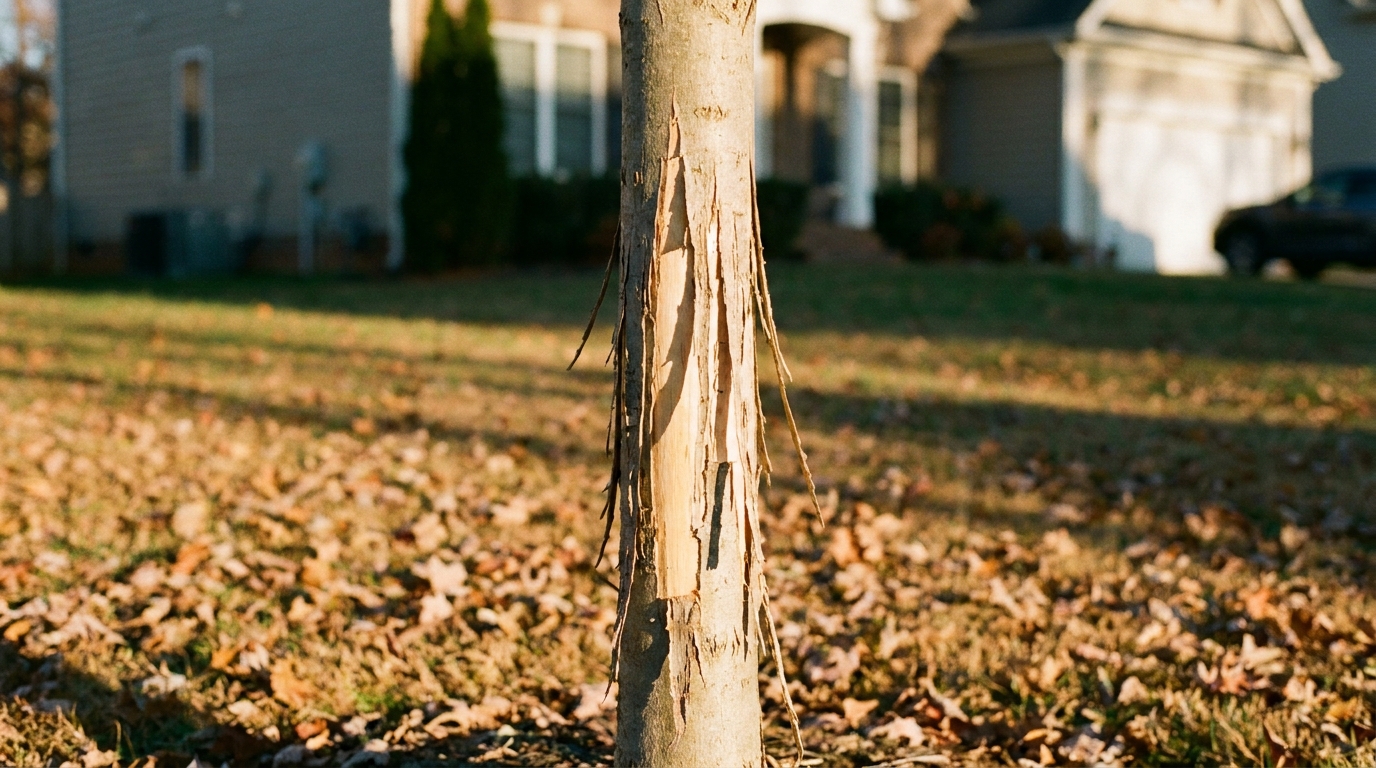
Normal bark shed is a different picture. The 2022 North Carolina Extension Gardener Handbook says sycamore, maple, and crape myrtle often shed outer bark as they grow. If that only exposes more bark, it is normal. If it leaves bare wood, sunscald, lightning, or winter damage could be a serious problem. [8] A frost crack on tree bark is a vertical seam, with bark usually still holding on both sides.
How a frost crack differs from sunscald
Sunscald, also called southwest injury, is dead bark and the living layer under it. On a cold, bright day the south or southwest bark warms, cells that should stay dormant wake up, and a night drop or a passing cloud freezes and kills them. [1][11] Colorado State University Extension, in a wrapping note reviewed in July 2024, says that dead strip is often a jagged wound and an opening for insects and disease. [11] The Morton Arboretum's winter-injury page, first published in 2021 and updated in September 2026, says temperatures on the sun side of the trunk may exceed the air by as much as 20 degrees Fahrenheit. [2] That warmth is thought to pull trunk tissue out of its cold-hardy state. Bark can darken and roughen, or only the outer cambium dies and the trunk looks sunken. Affected trees often leaf out thinly, die back, or grow slowly. [2] Repeated heating and cooling then dries the damaged patch, which is the scald. [1]
A frost crack is the split. The trunk cracks at a weak point when the outer wood contracts faster than the wood inside. [2] A 2011 USDA Forest Service note from the Rocky Mountain Region says the crack is usually vertical, a long one can spiral a bit, and unlike a lightning scar it usually loses little bark. [9] A University of Minnesota sheet posted in October 2021 separates a frost canker, its name for sunscald, from a true frost crack. The canker is dead or sunken bark, often on the south or southwest side. The true crack runs into the wood and can show up on any side. [12] A north-side split can still be a frost crack. [6]
Purdue's January 2026 note says southwest damage comes from an earlier injury that opens when temperatures drop. [1] The Minnesota sheet says one main cause of a frost crack is a flush pruning cut, or any accidental wound, on a young trunk. [12] A mower nick, a string-trimmer scrape, or last winter's seam can be where this winter's crack starts. The two injuries can happen together or on their own. Colorado State's reviewed note says frost cracks are usually not as hard on the tree as sunscald. [2][11] A crack that reopens each winter and calluses in summer is still a common pattern, not proof the tree is dying. [2][4]
This is not hypoxylon on an oak
Bark that falls off an oak in patches and leaves a flat crust is a different problem. Texas A&M Forest Service describes hypoxylon canker, caused by Biscogniauxia atropunctatum, as a fungus of stressed oaks and other hardwoods in the southern United States. It does not invade healthy trees. In a weakened tree it decays the sapwood, and the tree will likely die once that infection is active. [10] Bark sloughs off and piles at the base. The exposed wood shows tan, olive, or reddish brown powdery spores, then hardens to a dark crust like solidified tar and later turns silver gray. [10] Maple and several other hardwoods can get it too, so it is not an oak-only disease. The sign is still that crust and a thinning crown, not one fresh vertical split with bark holding on both edges. [10] Texas A&M says trees killed by hypoxylon that could fall on a structure, road, fence, or power line should be removed, and that the decayed wood is unsafe to climb. [10] Paint will not turn that trunk back into sound wood.
Why wound paint does not help
The can of black pruning sealer is the wrong tool. The March 2024 Georgia note says not to paint or cover injured maple stems. Nothing undoes the split. Some trees recover if other stress stays low. Some die back and keep declining, and severe damage leaves them open to wood decay fungi and ambrosia beetles. [5]
A September 2020 Purdue note says wound wood needs oxygen, and that painting a wound slows or prevents closure. Petroleum products are not recommended. That 2020 note says research indicates any type of wound dressing can slow healing. [7] The exception on that page is oak wilt country, where paint on a fresh cut may slow insect spread of that fungus. [7] A maple frost crack in Waxhaw is not that case.
Clemson's October 2019 fact sheet, written for South Carolina, says once the crack occurs, nothing can be done. [6] That means no product closes it. It does not mean the tree is finished. Purdue's January 2026 note says not to panic, because the tree may seal the damage with wound wood, faster if the tree is healthy. [1]
White latex is a different job. Clemson's 2019 sheet says fruit trees are sometimes painted white so intact bark reflects sun and is less likely to crack. [6] That coat goes on before winter. It is not a sealer in an open wound. Colorado State's reviewed note does not prefer latex in home yards. Nurseries and orchards use it because it is cheaper than wrapping each trunk. Use only water-based latex, never oil-based paint, and only when the air is above 50 degrees Fahrenheit so it dries. [11]
A scar you can watch, or wood that is failing
It is a scar when the split is narrow, the wood behind it is still firm, and the edges are rolling in with new tissue. [1] The Morton Arboretum's November 2025 note says the cracks are permanent, but a tree often seals the edges and leaves a thin vertical line in the bark. [3] The Georgia note says that if the maple survives, a thickened scar should form around the split over a few years. [5] A seam that opens in the cold and tightens by summer is still a scar, even on a frost crack on tree bark that has reopened for several winters. [2][4]
It is not a weld. The 2022 North Carolina handbook says that if the crack is not severe, it can look closed when warm weather returns, but the wood fibers inside may not actually grow back together. [8] The trunk can look healed and still have a plane of weakness. That is not a reason to remove a sound tree. It is a reason not to pretend the wood is new.
It needs a crew when the crack runs into the wood and the trunk is coming apart. A 2011 USDA Forest Service note from the Rocky Mountain Region says frost cracks can form deep in the wood and often lead to extensive heartrot when they do, even though they seldom kill the tree outright. Callus ridges still form on both sides. [9] Georgia's 2024 note says some injured maples were already dying back up high and might keep declining, and that severe damage leaves them open to decay fungi and ambrosia beetles. [5] Dieback in the top, soft wood in the split, or an opening so wide the trunk is no longer one solid stem is past a scar. Purdue says a certified arborist can assess a tree you are still worried about. [1] If that failing wood stands over a roof, a drive, or a play area, tree removal is the honest option. A scar stays in the yard, unpainted.
What to do now, and what the wrap advice actually says
Leave the split alone. Do not paint it, tar it, or screw it shut. [5][7] Do not cut a pile of live wood off to "balance" the tree. Clemson's 2019 sheet says not to rush pruning, because cold damage can take months to show, and to check for green tissue under the bark before you call a limb dead. [6] Do not fertilize while more freezes are likely. Tender growth freezes easily, and late-fall fertilizer drives soft wood that splits more readily. [4][5]
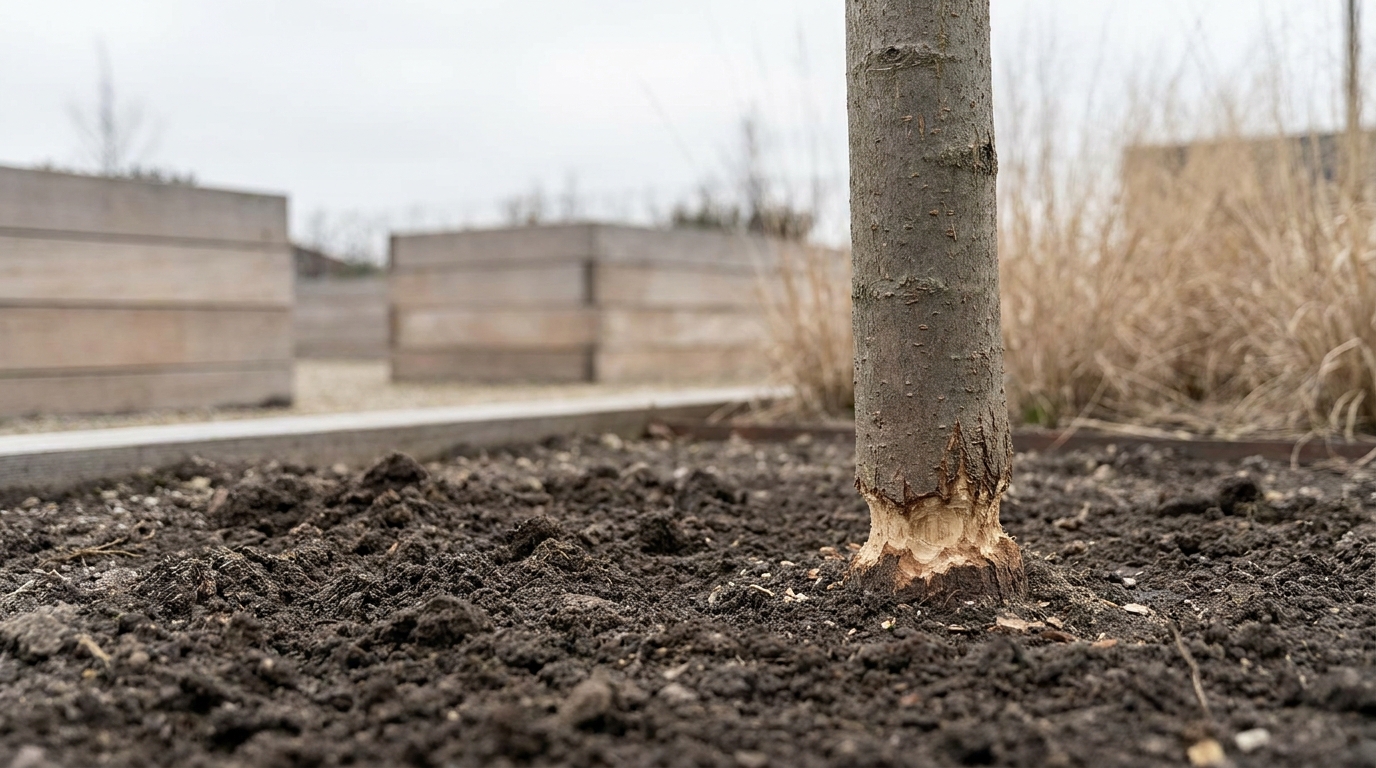
Water a living tree through the next growing season. It will not revive bark the freeze has already killed. [6] Mulch belongs on the soil, not piled on the trunk, and herbicide drift should stay off the bark. [1] Keep mulch a couple of inches back so mice and voles are not chewing underneath. [3] Deep watering in summer dry spells is the aftercare the Georgia note suggests. [5]
Wraps are for next winter, and the published advice does not agree.
Purdue's January 2026 note says white guards go on trunks less than 4 inches in diameter in fall and come off in spring. Year-round covers hold moisture and can rot bark, so the guard should be wider than the trunk. [1] The 2022 North Carolina handbook says research on wraps is inconclusive and most experts do not consider them necessary, though crews still wrap new thin-barked trees from the soil to the first branches, fall on and spring off. Left on too long, a wrap encourages insects and disease. [8] Colorado State's note, reviewed in July 2024, recommends light-colored crepe paper from the end of November to mid-April for the first one to three years, and says plastic, dark wrap, or burlap can damage bark. [11] Do not staple into the tree. Furrowed bark no longer needs a wrap. [11] That calendar is Colorado's, not Waxhaw's.
Clemson's 2019 sheet does recommend paper or burlap, which conflicts with the burlap warning. [6][11] The Morton Arboretum's November 2025 note does not recommend wrapping to prevent frost cracks. [3] A 2021 Minnesota sheet says research had not shown that wraps prevent the damage, and that they can hold moisture, shelter pests, and girdle a stem. [12] Wire mesh for deer and rabbits is an animal guard, not a sun shield. [3]
We do not sell wrap as a repair. On a young maple in an open yard, a loose white guard from fall until spring matches the recent Purdue guidance, and it comes off. [1] Skipping the wrap and relying on summer water plus mulch is the Arboretum's approach, and it is reasonable. [3] Evergreens planted on the south and southwest side can shade a trunk that has not split yet. [8]
Practical takeaways
- A vertical split on the sunny side of a thin-barked maple after a hard freeze is often a frost crack on tree bark, sometimes with sunscald beside it. [1][2]
- Do not paint or seal the open split. A 2020 Purdue note says wound dressings slow closure. White latex on intact fruit-tree bark, before winter, is a reflector, not a bandage. [5][6][7]
- A narrow crack that calluses in summer is a scar, even if it reopens next winter. The wood fibers may not knit, and that is still not a reason to remove a sound tree. [3][4][8]
- A crack that runs deep into the wood can lead to heartrot. Dieback in the top, soft wood in the split, or a trunk that is no longer one solid piece needs a crew, not another year of watching. [5][9]
- Guards are optional, disputed, and only for prevention on young thin bark. If you use a white guard, take it off in spring. A Colorado wrap calendar is not a Waxhaw date. [1][3][11]
- Bark falling off an oak down to a flat, tar-like or silver crust is hypoxylon canker, not a frost crack. [10]
How we can help
Have more questions or want to get in touch?
If you want a second look at a split trunk, our team can tell you whether we are seeing a scar or a stem that should come down. We remove trees in Waxhaw and greater Charlotte when the wood is actually failing, and we offer a free, no-obligation estimate if you want us on site. If the tree is already against a structure, call (980) 247-TREE. Otherwise start on the contact page.
Citations
- Purdue University Forestry and Natural Resources, "Southwest Damage, Scalding or Frost Cracking" (2026-01-30)
- The Morton Arboretum, "Winter injury to trees and shrubs" (2021-03-30)
- The Morton Arboretum, "Help Plants Handle Winter" (2025-11-24)
- N.C. Cooperative Extension, Durham County, "Calling Plant 911: Understanding Cold Injuries and Caring for Plants After Extreme Weather Hits" (2026-02-03)
- University of Georgia Extension, Bartow County, "Frost Cracks in Maples" (2024-03-04)
- Clemson Cooperative Extension HGIC, "Cold Damage" (2019-10-10)
- Purdue University Forestry and Natural Resources, "Tree Wounds and Healing" (2020-09-29)
- NC State Extension, "11. Woody Ornamentals" (2022-02-01)
- USDA Forest Service, Forest Health Protection, Rocky Mountain Region, "Abiotic Stem Damage" (2011)
- Texas A&M Forest Service, "Hypoxylon Canker" (2024-10-14)
- Colorado State University Extension, "Wrapping Trees For Winter" (2024-07-01)
- University of Minnesota, Urban Forestry Research and Outreach, "Frost Cracks and Cankers" (2021-10-05)