mistletoe on hardwood trees Waxhaw: prune outer clumps
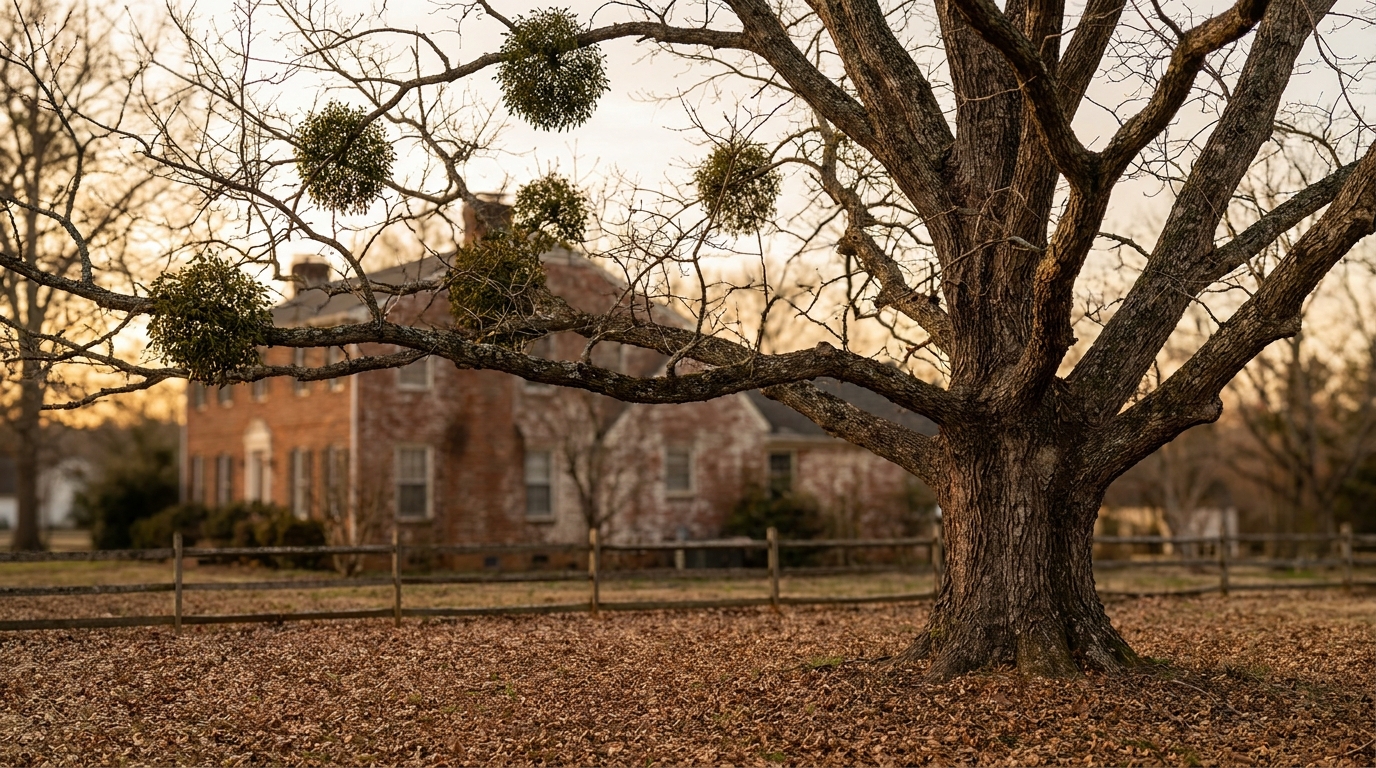
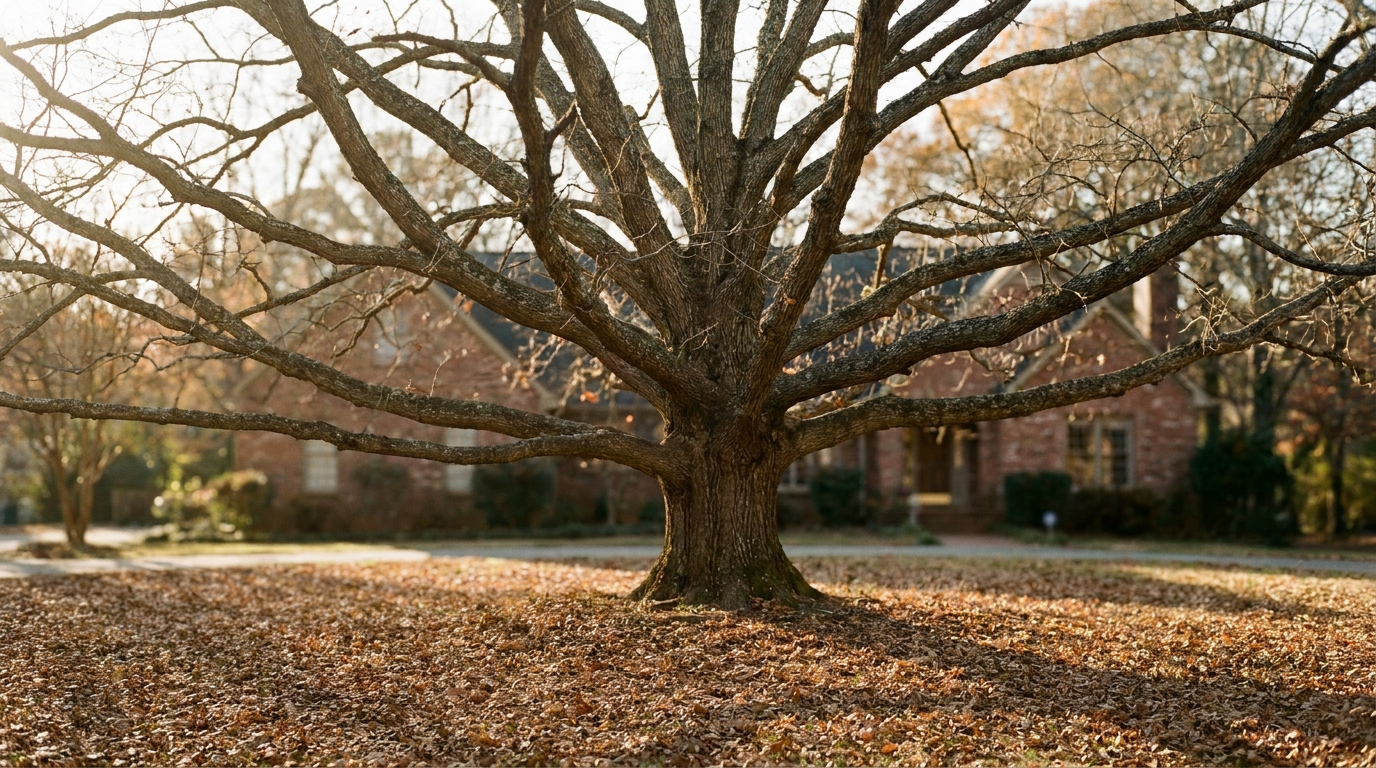
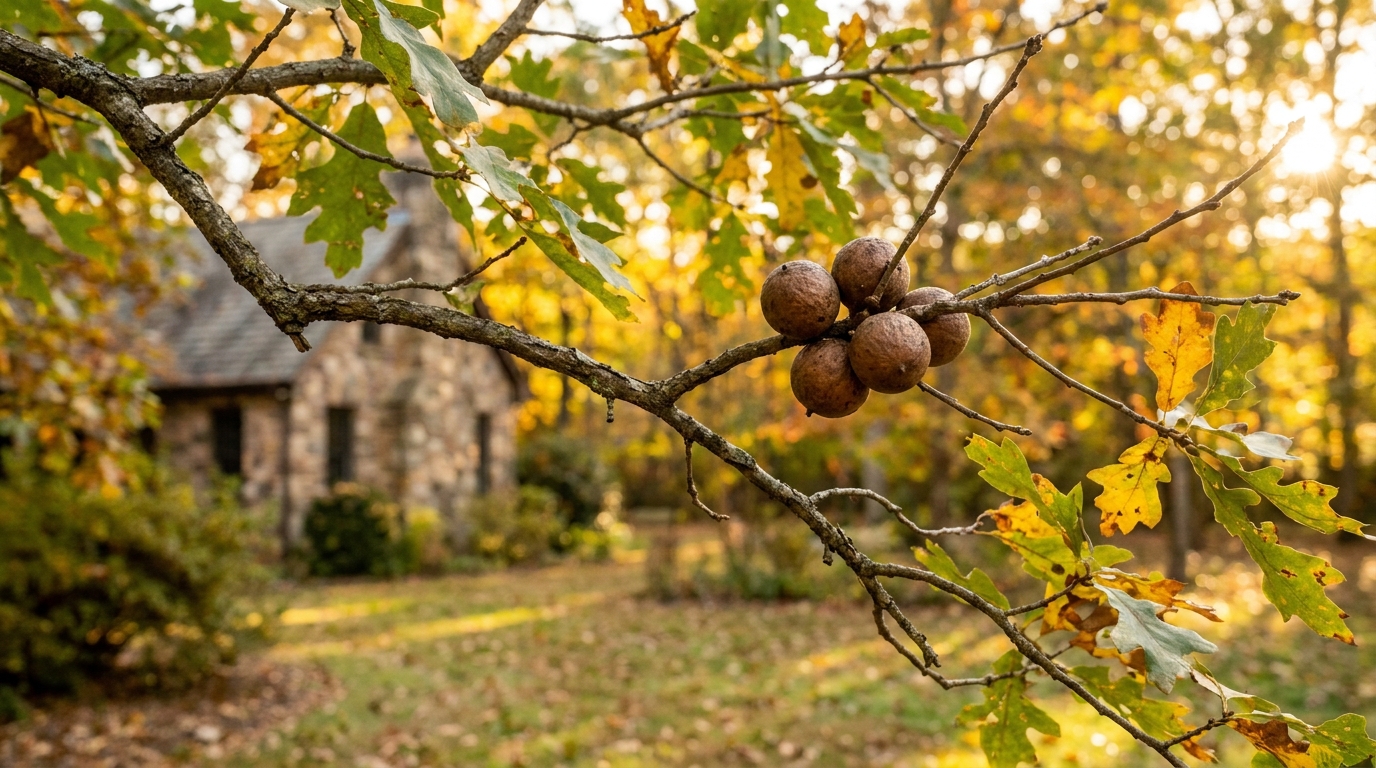
Those green clumps on hardwood trees around Waxhaw are mistletoe. American mistletoe is an evergreen, so the round balls stand out on a bare oak or other hardwood after the leaves fall in late fall [1]. The plant makes some of its own food in those green leaves, and it pulls water and nutrients out of the limb through specialized roots called haustoria [1]. One or two clumps on an otherwise sound tree are worth watching, not an automatic reason to remove the tree [2][3].
The plant behind the green ball
The species on hardwoods in this part of North Carolina is Phoradendron leucarpum, called American mistletoe or oak mistletoe. Older publications still say Phoradendron serotinum. The North Carolina Extension Gardener Plant Toolbox lists that name, and Phoradendron flavescens, as earlier names for the same plant [4]. A 2010 USDA Forest Service leaflet describes P. serotinum as the leafy mistletoe of the eastern United States, including the Carolinas, and says it affects more than 100 species of native and introduced trees [7].
This is not the dwarf mistletoe of conifers. Dwarf mistletoes, genus Arceuthobium, are a separate problem from leafy Phoradendron on hardwoods [7]. NC State Extension places American mistletoe on oaks, maples, ash, hickory, and elms [1]. The state plant profile calls it common on the coast and in the Piedmont, less common in the mountains, and typical of maple and oak [4]. Waxhaw and Union County sit in that Piedmont range.
It grows slowly. A 2022 Beaufort County note describes a full plant as a globe about three feet in diameter [2]. A 2025 UF/IFAS note says clumps often reach two feet or more, with sticky berries from October through December [5]. You notice the balls when the host drops its leaves in late fall and the mistletoe does not [1]. Female plants make the white berries. Birds eat them and move the seed [1][2]. Beaufort County Extension also names pecan, red maple, and water oak as hosts [2].
How mistletoe takes water from the limb
Mistletoe is a hemiparasite. It has chlorophyll, so it builds some of its own sugars in the sun. It has no roots in the ground. The water, and much of the mineral nutrition, comes out of the tree [1][6].
A bird leaves the seed on bark, and a sticky coat holds it there [1][3]. Texas A&M Forest Service explains that infection succeeds on the thin bark of small branches, when a root-like haustorium pushes in through a lenticel or a bud [8]. The plant then taps the xylem, the tissue that carries water and dissolved nutrients up from the soil [2]. A 2010 USDA Forest Service leaflet adds that these plants can also take some carbohydrates from the host, and that the internal system ties into that water-conducting tissue [7].
The green ball is the part you can see. The part that keeps the plant alive is inside the limb. That system grows up and down the branch from the shoots [7]. A 2018 Clemson Extension note says those roots may run up to a foot on either side of the attachment [6]. The branch often swells there [8]. An older swelling can split and give decay fungi a way into the wood [7].
Break the green ball off and the mistletoe is not gone. Tissue in the wood stays alive and sends up new shoots, and the 2010 USDA leaflet says that internal structure can live for many years after the shoots are removed [1][7]. Texas A&M Forest Service notes that breaking the green top usually wakes dormant buds and leaves more shoots than you started with [8].
A small infestation is not very harmful [2]. A large one can pull enough water to hurt the host, including a red maple in a dry season [2]. Where water is not short, many hardwood infections do not cause serious damage, but a severe infection can slow growth, and branch tips past the mistletoe often die in drought [7]. Extra stress also makes insect and disease attack more likely [6][7].
Why one tree is loaded and the next tree is clean
Birds plant mistletoe where they perch. The 2010 USDA leaflet notes that young or small trees are seldom infected, and that first plants usually show up in large or older trees growing in the open [7]. Berries bring birds back, so new plants start on other limbs of the same tree and on the tree next door [7].
A thick crown is harder to colonize. A 2025 UF/IFAS article says people often blame mistletoe for a sick tree, and in most cases the order runs the other way. A thin old crown lets light in. A dense crown can shade a seedling out, and a faster-growing tree sheds bark soon enough to shed the sticky seed [5]. A 2023 Lee County note adds that a stressed tree is less able to stop the haustorium [3]. A few high balls mean look at the whole tree. They do not prove the mistletoe made the tree old.
The clumps sit high because mistletoe wants direct sun [8]. Count them in the dormant season, when evergreen balls show on bare wood [3][7]. That 2023 note draws a plain line: one or two plants is okay, but if more than 50 percent of the canopy is full of mistletoe, the tree is unhealthy [3].
When a small infestation can be pruned out
A few plants on smaller limbs, and nothing on the trunk, is the case pruning is meant for. The 2010 USDA leaflet says pruning is practical when infections are few and they are not on primary stems or on large branches near the main trunk [7]. Removing even a few infected limbs can ease the water demand on the tree [7].
The cut has to land past the hidden tissue. The published distances do not match, and we do not pretend they do. The 2010 USDA leaflet says to prune at least six inches below the attachment [7]. The 2018 Clemson note says to cut the limb one to two feet below the plant, because the roots may extend about a foot to either side [6]. NC State Extension says the same idea without a measurement: take the branch back far enough to remove the visible shoots and the roots you cannot see [1]. On a small outer limb we can usually cut back to a sound lateral, or take the whole limb, and leave the structure intact. On a main leader, cutting a foot or two below the ball can remove a large share of the crown. That is a different decision, not a reason to saw halfway through a big limb.
Breaking the tops off encourages regrowth [6][8]. On an old tree, where cutting the limb would do more harm, it can still be a stopgap that removes the berry source for a while [5][6]. The plant comes back from inside the wood, birds can bring new seed, and the 2010 USDA leaflet suggests another look every three to five years [7]. Do not lean a ladder on the limb you are cutting. For a tall tree, hire someone who can work the canopy safely, and do not butcher the crown with random cuts [5][6]. Our team does tree trimming and pruning from the ground when a small limb is in reach, and aloft when the cuts are higher. After leaf drop, every ball and every dead tip is visible.
When the limb should come down
Take the limb when you can lose that wood without gutting the tree, and especially when the wood is already failing.
The tip beyond a mistletoe plant runs short of water first. In a drought those ends often die [7]. A green ball with a dead stick past it is not earning a place in the crown. The attachment often swells [8]. A heavy load can break the branch under the weight of the plants, and decay can enter a split swelling [7]. The 2010 USDA leaflet names the landing spots: buildings, electrical lines, parked vehicles, and people, particularly in wind or ice [7].
Under the limb is the local question. A roof, a driveway, a play set, or a walkway in Waxhaw is not the same as an empty field. If the branch is cracked or hanging, stay out from under it. If wood is in a utility line, call the utility before anyone cuts.
A clump on the trunk, or on a main leader near the bole, is harder. The 2010 USDA leaflet says large branches and main stems should be pruned only when the cut will not strip out a large share of the foliage, because drastic pruning can hurt the tree more than the mistletoe [7]. On sound wood with nothing important underneath, removing the green shoots for a while can be the better choice [5][7]. We say which way we are going before a saw starts.
When the whole tree should come down
Removal is for a tree you cannot prune back into a sound crown, or a tree that is already a structural hazard.
The 2010 USDA leaflet says that when many infections run through the crown and the main stems, it may be necessary to remove the tree and plant another [7]. A 2023 Lee County note treats a canopy more than 50 percent full of mistletoe as an unhealthy tree [3]. UF/IFAS and Clemson both warn that cutting every infected limb out of a heavily loaded tree can do more damage than the mistletoe [5][6].
We look at structure, what sits underneath, and how much live crown would remain. Swollen or decayed wood can fail in wind or ice over a house, a drive, or a car [7]. A thin older crown often filled with mistletoe because the light was already there [5]. If proper cuts would leave only stubs, stop. Topping, or shearing the crown just to chase the balls, can hurt the tree more than the mistletoe does [6][7].
Texas A&M Forest Service notes that mistletoe is generally not a serious pest on its own and is unlikely to kill a tree directly, though a heavy infection adds stress and branches may die [8]. A vigorous oak with a few outer clumps stays. An old tree with a sparse crown, dieback, and mistletoe on the trunk over a roof does not. We do not remove a tree for one ball at the top.
If it comes out, tree removal is the path, including crane-assisted removal when a large tree is tight against a house. Stump grinding is separate if you replant. The 2010 USDA leaflet suggests a replacement that is not a favorite local host and that fits the site [7]. Mistletoe still has a place in the woods. Birds nest in it, bees use the flowers, and the great purple hairstreak depends on it for its caterpillars, so there is no need to strip every tree that holds a clump and threatens nothing [1].
Skip the spray, and keep the berries away from people and pets
We do not spray mistletoe, and we do not sell a mistletoe treatment.
A 2018 Clemson note said no chemical control actually clears the plant. Tested herbicides can threaten the host. Ethephon, a growth regulator, can drop the shoots, and then the mistletoe resprouts [6]. The 2010 USDA leaflet says shoots can fall off in one to three weeks, the portion inside the branch is not killed, and new shoots can appear in one to three years [7]. Texas A&M Forest Service does not recommend herbicide here, because it is easy to damage the host and plants nearby [8]. A 2025 UF/IFAS note says a licensed pest control operator has to apply ethephon, and the wrong timing can damage the tree [5]. That is a temporary knockdown, not a cure, and it is not work we do.
Berries that fall during pruning are a separate hazard. NC State's plant profile rates American mistletoe as medium severity and lists the fruit as the poisonous part. A large quantity of berries can cause stomach and intestinal irritation, diarrhea, vomiting, difficulty breathing, lowered blood pressure, and a slow pulse [4]. A 2021 Hoke County note calls the leaves and berries mildly toxic and says to keep clippings from children and pets [1]. A 2022 Beaufort County note says berries and foliage are poisonous [2]. If someone swallows any, call Poison Control at 1-800-222-1222 [5]. Wash your hands after handling it, and do not hang a fresh sprig over a heater or a fireplace. Dried mistletoe can become a fire hazard [5].
What to do after the leaves drop
Once the hardwoods thin, note which tree, about how many balls, whether they sit on outer limbs or the trunk, and what is underneath. A ground photo is enough to start. Water a stressed tree in a dry spell, and mulch the root zone without piling it on the trunk. Replacing lawn against the trunk also keeps mowers off the roots [2][3]. That does not remove mistletoe. It helps a sound tree carry a light load.
Then sort the tree. A few outer clumps on a full crown can be pruned, or watched if they threaten nothing. A limb with dieback, swelling, or weight over a target should come off. A crown that is more mistletoe than tree, with decay over something you cannot lose, is a removal talk.
Practical takeaways
- Green balls in a bare Waxhaw hardwood are American mistletoe, easiest to see after leaf drop [1][4].
- It takes water through haustoria in the limb, and the inside part lives on if you only snap off the top [1][2][7].
- Prune a small infestation by cutting the limb back past the attachment [1][6][7].
- Remove a limb that is dying past the clump, swollen, or hanging over a target [7][8].
- Remove the tree when infection and weak wood run through the crown and trunk, and proper cuts would leave too little live crown [3][5][7].
- Do not spray mistletoe, and keep berries away from children and pets [4][6][8].
How we can help
Have more questions or want to get in touch?
If you want us to look at mistletoe on a hardwood in Waxhaw, Union County, or the greater Charlotte area, call (980) 247-TREE or write through our contact page. We will walk the property with you, prune the limbs that should come off, and remove the tree only when the structure calls for it. We do not spray mistletoe.
Citations
- N.C. Cooperative Extension, Hoke County, "What Is Mistletoe?" (2021-12-10)
- N.C. Cooperative Extension, Beaufort County, "Mistletoe- Why Are Parts of My Tree Staying Green?" (2022-11-21)
- N.C. Cooperative Extension, Lee County, "Using Mistletoe to Diagnose Tree Health" (2023-01-12)
- North Carolina Extension Gardener Plant Toolbox, "Mistletoe - Phoradendron leucarpum" (n.d.)
- UF/IFAS Extension Duval County, "Mistletoe: A merry Christmas decoration or menace to trees?" (2025-11-13)
- Clemson Cooperative Extension, Home & Garden Information Center, "Managing Mistletoe" (2018-12-03)
- USDA Forest Service, "Mistletoes on Hardwoods in the United States" (Forest Insect and Disease Leaflet 147, revised 2010)
- Texas A&M Forest Service, "Mistletoe" (page modified 2025-12-15)