Oak Galls on Twigs: Not Proof the Oak Is Dying
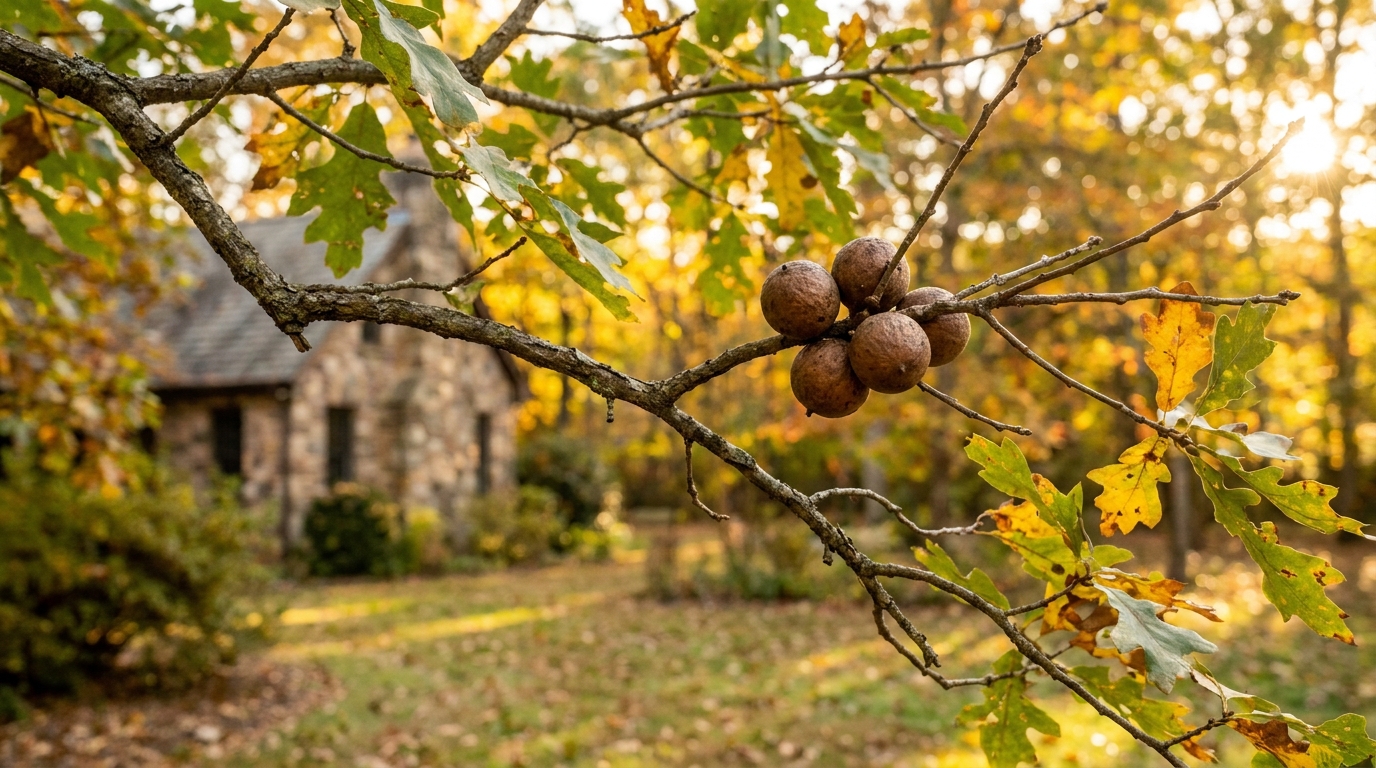
Those round lumps on oak twigs are galls, growths the tree built around tiny wasp larvae, not proof the oak is dying. Most leaf galls do little or no harm to the tree, and a spray is rarely the right response [1]. Around Waxhaw and the rest of Union County they stand out in fall, when oak apples, woolly leaf galls, and horned oak galls show once the leaves thin. We prune a heavy twig-gall load only when that is practical, and we talk about removal only if the crown is already failing.
What the lump is made of
A gall is the oak's own tissue, not a nest glued to the bark and not a fungus. Penn State Extension describes these swellings as plant cells pushed into an odd shape by growth-regulating chemicals from an insect [1]. The usual makers are tiny gall wasps in the family Cynipidae. They are called wasps, but they do not sting [2]. University of Wisconsin Extension says they are minute and stingless, and that they spend most of their lives inside the gall [5].
A female lays an egg in young leaf or twig tissue. Secretions from that wasp, or from the larva, redirect normal growth, and the tree builds a walled chamber with food inside [2]. Cut a fresh oak apple open and you find a small larva, not rot. Once that wall is up, a spray on the outside misses the insect. Wisconsin Extension says the fear that galls will kill the tree is common, and that galls are usually cosmetic on an established tree [5]. The exception that guide flags is a heavy attack on twigs and branches [5]. A Wisconsin guide revised in January 2026 counts more than 300 galls known on oaks in the Upper Midwest, most of them from these wasps [5]. That is a Midwest tally, not a Union County census, and it is a reason not to treat every lump as the same insect.
Oak apples and the woolly galls
Oak apple galls are the balls that stop people in the yard. NC State Extension describes them as round growths on oak leaves, green and apple-like at first, usually about two inches across, often with purplish bumps [2]. They show up most often on scarlet oak, red oak, and black oak [2]. Most of the wasps that make them sit in the genus Amphibolips, and a single wasp develops inside each gall [2]. After the wasp leaves, the shell turns brown and an exit hole may show [2]. That brown ball is what people find in the grass around Waxhaw in October. Oak apple galls do not typically harm the oak, so management is usually unwarranted [2]. Some other cynipid wasps can injure or kill small branches, but most species do not [2]. If the ball lets go with the leaf, it is not the woody twig gall below.
The other fall leaf gall we get called about is the woolly leaf gall. In an October 2024 note, a Wisconsin Department of Natural Resources forest health specialist describes it as a clump of fuzzy galls on a leaf that later drops and breaks into separate kernels [3]. Each kernel holds a gall wasp larva ready to pupate. The photo caption names the wasp Callirhytis lanata and says the kernels form on the leaf, then drop to the ground to overwinter [3]. Many of these galls do little or no damage, and insecticides are not recommended, because a spray generally cannot touch the larvae inside [3].
Do not mix that with the wool sower gall, the cotton ball people photograph in spring. Illinois Extension says those galls are made by a different wasp, Callirhytis seminator, and that they start fuzzy, white to whitish pink, and round, with a seed-like capsule for each larva [6]. They grow mainly on white oak, and also on chestnut oak, swamp chestnut oak, and swamp white oak [6]. Adults usually leave in June and July, lay eggs in the stems, and produce indistinct stem galls. Wasps from those stem galls return to the buds in spring [6]. Wool sower galls do not cause significant damage that would justify management [6]. Adults are about an eighth of an inch long and cannot sting, and once the gall exists, pesticides are unlikely to reach the larvae [6]. Cotton balls on a white oak in April are wool sower galls. Fuzzy kernels under a red oak in October are woolly leaf galls.
Horned oak galls, and the gouty gall without horns
Horned oak galls are the lumps that belong to the twig. Penn State identifies the maker as Callirhytis cornigera and says it attacks twigs of pin, scrub, black, blackjack, and water oaks [1]. The gall is a hard woody swelling with small horns, and one adult emerges from each horn [1]. The gouty oak gall wasp, Callirhytis quercuspunctata, makes a similar woody gall without horns, on pin, scarlet, red, and black oaks [1]. Both wasps are known from southern Canada to Georgia [1]. That band covers the Piedmont, including Union County. Wasps in woody twig galls need two or more years to mature [1].
A 2014 University of Kentucky Extension fact sheet traces horned oak gall on pin oak and willow oak. The growths are golf-ball-size and woody [4]. Females leave through a horn from late March through mid-April, lay eggs in swelling buds, and the next generation leaves tiny leaf blisters from late May through early June, then places eggs on twigs a year or two old [4]. About 10 months after those eggs hatch, slight swellings show [4]. They grow for about 24 months, horns appear at about two years, and the twig generation takes about 33 months from egg hatch to adult emergence [4]. That sheet, drawing on earlier research, says one gall may house as many as 160 developing wasps [4]. A knot you notice after the leaves drop may already be a couple of years old. Dried clusters are easy to see after autumn leaf fall and can stay for years after the wasps leave, so cutting every empty gall out of a tall crown does not reset the cycle [4].
Kentucky is not giving the oak-apple answer on harm. Lightly infested pin oaks can live for many years without apparent harm, but outbreak numbers can disfigure the tree, cause extensive branch dieback, and even kill it [4]. Penn State says twig or branch galls may injure or even kill a heavily infested tree, while most leaf galls do not [1]. Nearby oaks often differ for reasons Kentucky says are unknown, and parasitic wasps suppress the gall on many trees [4]. A few horns on a full crown are an ugly habit. Bare wood past the knots on a pin oak, willow oak, or water oak deserves a real look [1][4].
Keep the horns as the field mark. A University of Missouri Extension guide reviewed in 2014 describes gouty oak gall on scarlet, pin, and black oaks [7]. The two lists share pin, scarlet, and black oak. Penn State also names red oak, which that Missouri sentence does not [1][7]. In that 2014 guide the gouty gall can grow 3 to 4 inches long and 1.5 inches across, solid wood with many chambers, often side by side on a small branch [7]. Wasps inside may take a couple of years [7]. During heavy infestations, twigs, parts of branches, or entire trees may die [7]. That is a heavy load, not one smooth knot. The control note is to prune out the twigs and burn them [7]. We do not tell anyone in Waxhaw to burn brush. If we cut galled twigs, we haul the wood off.
The pages disagree on degree, not on the basic split. Leaf galls are the minor issue [1][2][3][6]. Wisconsin Extension says most oak galls are cosmetic and larger oaks generally tolerate them, though a few twig galls can cause leaf drop or dieback [5]. The 2014 Kentucky and Missouri pages are sterner: an outbreak of horned oak gall, or a heavy gouty oak gall load, can kill twigs and branches, and sometimes the tree [4][7]. None of them says one lump means the oak is dying. What we see is a dead tip beyond a hard knot, not a failed tree, unless large limbs are already dead or the bark is sunken and loose.
Why we do not spray for galls
Clark's does not sell a spray program, and we do not spray oaks for galls.
Penn State says chemical control is seldom suggested for leaf galls [1]. Unless a registered insecticide hits the short window when the wasps are flying, it offers little or no control [1]. The Wisconsin DNR note says insecticides are not recommended, because the spray does not reach larvae inside the gall [3]. Wisconsin Extension says pesticides work poorly if at all, treating a large tree is not feasible, and pesticides are not recommended for oak galls [5]. Illinois Extension says pesticides are unlikely to reach wool sower larvae once the gall has formed [6].
The 2014 Kentucky sheet is the page that still discusses sprays for horned oak gall, and it does not describe a clean win. There is no easy solution [4]. Canopy sprays in early spring, or in late spring as wasps leave the leaf galls, may give partial control, but spraying tall trees is impractical and also kills natural enemies that help with other pests, such as scale [4]. Several ages of gall are on the tree at once, and maturation takes almost three years, so one application does not end an infestation [4]. That 2014 account is not a service on our truck.
Missouri's 2014 guide says chemical control is not recommended in most situations, since galls are usually not harming the plant [7]. It also says nonsystemic insecticides are virtually useless once the gall has formed, and that the best spray window is often vague [7]. It also says a chemical response may be advised after several heavy years [7]. That caveat is not a product list from us, and it is not a service we sell. Parasitic wasps are already using many of these galls [2][4][6].
Prune the twigs you can reach
Pruning is the step these pages support, and only when the twigs are in reach. Kentucky says a few woody galls are worth removing promptly with a pole pruner, and that this is not practical in a mature tall tree [4]. Penn State says to prune and destroy the twigs when the woody galls are small and just starting, because once a gall has begun it is almost impossible to stop [1]. Wisconsin Extension says that early removal may help on small, recently planted trees, and that larger oaks generally tolerate the galls [5]. Missouri's line for gouty oak gall is the same kind of cut: prune out the infested twigs [7].
That is a low-twig job, not a reason to climb a mature oak or to push a pole saw through a power line. If the twigs are low enough for an ordinary cut back to sound wood, our crew can take them on a trimming visit and haul the pieces away. High galls in a healthy crown can stay. Empty galls do not repay a risky climb [4]. Raking fallen leaves may help a little with leaf galls [1], including woolly leaf kernels that drop to overwinter [3]. A rake will not shrink woody galls still on the branches, and we do not shear a crown just to chase them.
Removal is for a failing crown
We remove oaks that are failing, split, or standing where they can hit a house. We do not remove them because they grew galls. Heavy horned or gouty loads can kill twigs and, in the cases those pages describe, sometimes the tree [1][4][7]. If the crown is already open or major limbs are dead, removal can be the right job. The lumps are evidence about the twigs, not the verdict on the whole oak. Scattered horned galls on a normal canopy get a pruning plan, or no work at all. Brown balls in the lawn this month, on a tree that leafed out fully last summer, are almost always that first case.
Practical takeaways
- Oak apples are leaf galls, usually about two inches across on scarlet, red, and black oaks, and they do not typically harm the tree [2].
- Woolly leaf galls (Callirhytis lanata) drop as kernels to overwinter [3]. Wool sower galls are a different spring cotton ball on white oaks [6].
- Horned oak galls have small horns. Gouty oak galls are the woody knots without horns. They are not the same insect [1].
- A light horned-oak-gall load can sit on a pin oak for years [4]. Outbreak numbers, and heavy gouty oak gall, can kill branches and sometimes the tree [4][7].
- A spray does not reach larvae inside a formed gall, and we do not offer one [3][5].
- Prune galled twigs only when they are small, low, and safe to reach [4][5].
- Removal is for a crown that is already failing, not for the lumps.
How we can help
Have more questions or want to get in touch?
If the galls are on small twigs and a normal pruning cut can take them, our crew can handle that on a tree trimming and pruning visit and haul the wood away. If the crown is already failing, we will say so and talk about tree removal instead of treating the lumps. Send a few photos or schedule a look through our contact page.
Citations
- Penn State Extension, "Galls on Oak" (2026-06-24)
- NC State Extension, "Oak Apple Galls" (2025-02-13)
- Wisconsin Department of Natural Resources, "Galls On Oak Leaves Are Plentiful, Varied" (2024-10-03)
- University of Kentucky Extension, "Horned Oak Gall" (2014-07)
- University of Wisconsin-Madison Extension, "Deciduous Tree Galls" (2026-01-26)
- University of Illinois Extension, "Fuzzy growth on oak trees: Wool sower galls" (2025-06-20)
- University of Missouri Extension, "Insect and Mite Galls on Missouri Trees" (2014-08)