Tree Cabling and Bracing: When a Structurally Weak Tree Can Be Saved Instead of Removed
When a large tree in your yard develops a crack at a major fork or leans a little harder after every storm, removal can feel like the only safe answer. It is not always the right one. Tree cabling and bracing is a supplemental support approach that can, in the right circumstances, keep a structurally weak but otherwise healthy tree standing for years instead of sending it to the stump grinder. The choice between saving a tree and removing it is not a guess. It rests on a qualified arborist's assessment of the specific defect, the soundness of the wood, and where the tree stands in relation to people and property.
Here in Waxhaw and across Union County, many of the trees worth this effort are mature shade trees with a correctable structural flaw rather than a fatal one. This article explains what cabling and bracing actually do, which trees are and are not candidates, how long the hardware lasts, and why this is never a do-it-yourself project. The honest bottom line comes first. These systems reduce risk, they do not eliminate it, and sometimes removal really is the responsible choice.
What tree cabling and bracing are
Cabling and bracing are two related techniques arborists use to limit the movement of weak parts of a tree and to hold them together. They are usually discussed as a pair because they are frequently installed as a combined system on the same tree.
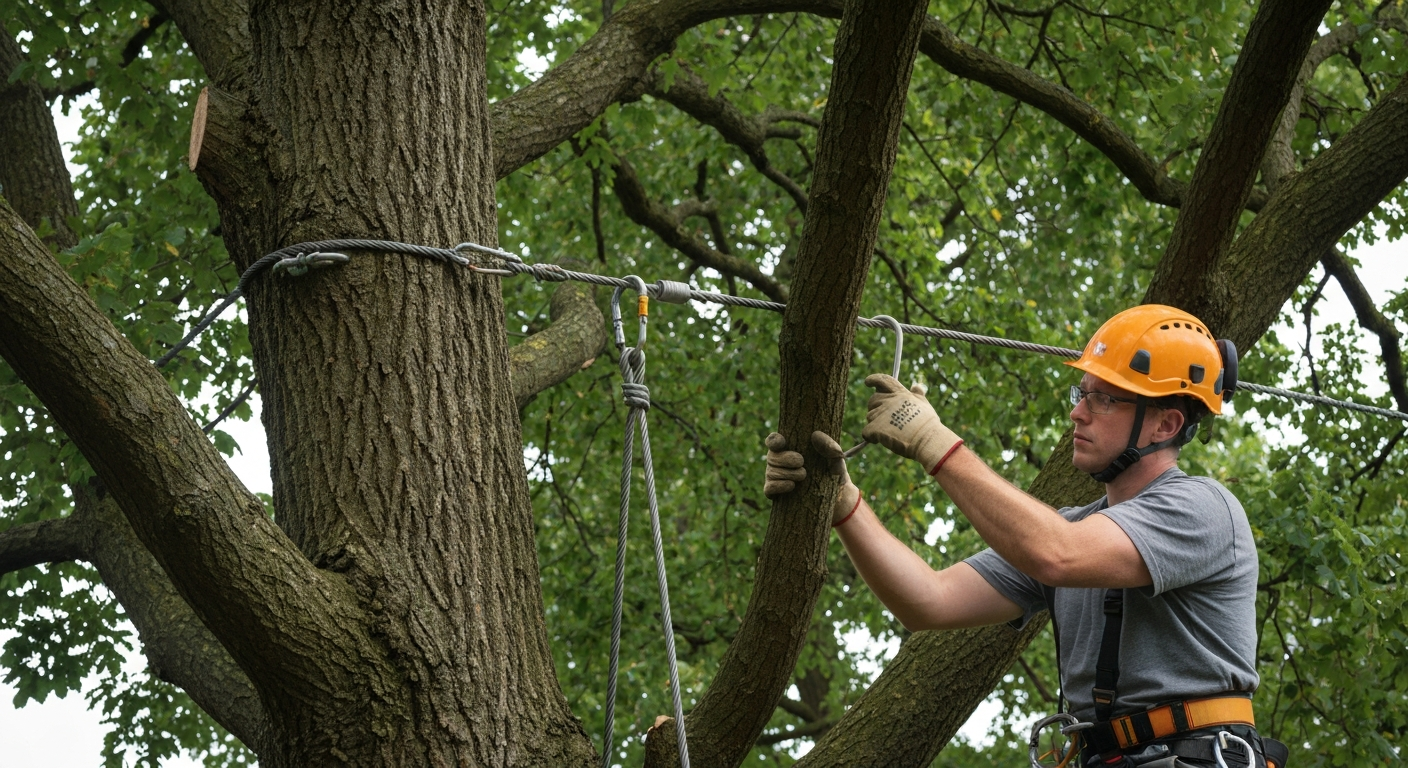
According to Purdue University Extension guidance (bulletin FNR-550-W, 2017), a cabling system uses flexible, extra-high-strength steel strand cables attached to bolts installed in the upper crown of the tree. The cables restrict how far a limb or leader can move relative to the rest of the tree, which reduces the dynamic loads that wind, ice, and the weight of the canopy place on a weak union. Bracing, by contrast, uses threaded steel rods installed directly through the union of weak or co-dominant leaders, providing rigid lateral support at the point of weakness. Purdue notes that a combination of cabling and bracing is often used to obtain the safest, most stable support for the defective parts of a tree.
Placement is deliberate, not improvised. University of Tennessee Extension (publication SP659, 2005) describes anchoring cables at a point roughly two-thirds of the distance from the weak crotch out toward the ends of the branches, the geometry that best restrains movement. Brace rods are used where multiple leaders exist, and they are typically accompanied by at least one cable for additional support.
Not every system is steel and bolts. Purdue also describes dynamic, or soft, cabling that uses synthetic rope rather than hardware drilled into the wood, an option an arborist may consider for certain trees. Whichever system is chosen, the work is governed by a national consensus standard. The American National Standard for supplemental support systems, ANSI A300 Part 3, is the reference a qualified arborist installs to, and it is explicit on one point that matters for your expectations: supplemental support systems provide additional support or limit movement. They do not provide primary support to a tree.
The structural defect these systems address
Most candidates for cabling and bracing share a particular kind of flaw, namely a weak union where two stems, or a stem and a large limb, meet. The most common version is a pair of co-dominant stems, two roughly equal stems that grow from the same point instead of one clearly dominant trunk.
Clemson Cooperative Extension (2026) explains the mechanism plainly. Trees with co-dominant stems of equal size that join at the same point can develop included bark, which creates a weak spot prone to breakage. Included bark is bark that becomes trapped between the two stems as they grow, so the wood never knits together into a strong, continuous union. Closer to home, NC State Extension (2025) documents the same defect and its consequences, describing a maple that failed years later precisely because a co-dominant stem had been left in place with a bark inclusion at its union. NC State's guidance is direct. It is best to contact a certified arborist to assess a tree with this kind of structure.
This is a species-agnostic problem. It shows up in oaks, maples, and many other shade trees whenever two leaders compete or a long limb over-extends. The point is not the species but the geometry, a union carrying more load than its structure can safely bear over time. When these competing leaders are caught early, while a tree is still young, correcting them is often a matter of structural pruning rather than hardware. On a mature tree that window has usually closed, and supplemental support becomes the tool that keeps the union intact.
When a tree can be saved, and when it cannot
Cabling and bracing are not a blanket alternative to removal. They are appropriate for a specific profile of tree, and a professional assessment is what separates a good candidate from a lost cause.
Purdue University Extension frames candidacy around the health of the tree as a whole. Support systems are used to strengthen a structural weakness, such as co-dominant trunks, on an otherwise healthy tree. Where the wood is sound and the defect is correctable, bracing can, in many instances, be used to repair a crotch or branch union that has already split, whether from storm damage or from years of accumulated load. The opposite is equally important. Purdue is clear that not all trees are candidates for support systems, and not all trees should be saved. A tree with poor overall health, extensive internal decay, or little value because of its species or location may not be a reasonable candidate no matter how much a homeowner wants to keep it.
This is the honest heart of the preservation-versus-removal decision, and it is worth stating plainly. Candidacy is a qualitative judgment about sound wood, tree health, and a correctable defect. It is not a simple numeric rule about how far a split has traveled through the trunk. A careful arborist evaluates the whole tree, not a single measurement, and will sometimes conclude that tree removal is the safer and more responsible path. Overselling preservation would do a homeowner no favors.
How long the hardware lasts, and the inspections it requires
A support system is a long-term commitment, not a one-time fix. Two questions come up constantly. How long does the hardware last, and what maintenance does it need? The honest answer to both is that it depends on the system and the tree, and that a single flat number would be misleading.
Service life is tied to the type of system. University of Tennessee Extension reports that the service life of steel cables may range from roughly 20 to 40 years depending on environmental conditions, while the long-term service life of synthetic-rope systems is not established, and those systems should be inspected about every 10 years. Purdue University Extension frames the hardware itself in terms of being ready to reconsider or replace the system in the range of 7 to 10 years as the tree keeps growing around it. None of these figures is a guarantee. They are planning ranges a qualified arborist adjusts to the specific tree, its growth, and its exposure.
| Support system | Typical service life | Inspection guidance |
|---|---|---|
| Steel-strand cables | About 20 to 40 years, depending on environmental conditions (University of Tennessee Extension). | Annual ground check, plus a closer climbing inspection roughly every 3 years (Purdue Extension). |
| Synthetic-rope (dynamic) systems | Long-term service life not established (University of Tennessee Extension). | Inspect approximately every 10 years (University of Tennessee Extension). |
| Hardware overall | Reconsider or replace in the range of 7 to 10 years as the tree grows (Purdue Extension). | Exact interval set by the arborist for the tree, device, and site. |
Inspection is where many well-meaning tree owners fall short. The pattern the extension literature describes is layered, not a single visit every year or two. Purdue University Extension recommends a ground inspection conducted annually to check for loose hardware or needed adjustments, and then, usually every three years, a closer inspection by an arborist who ascends the tree for a detailed look. University of Tennessee Extension adds that the exact inspection interval is determined by the tree, the supporting device, and the site, so the schedule is set by the arborist rather than by a fixed calendar. ANSI A300 Part 3 places the responsibility for scheduling those periodic inspections on the tree owner. As the tree grows, hardware may need to be adjusted or replaced, which is exactly why the system cannot simply be installed and forgotten.
Why cabling and bracing is never a DIY job
Everything above points to the same conclusion. This is skilled, standards-governed work, and doing it wrong is worse than not doing it at all. Purdue University Extension states that cable and bracing installation is a complicated process best completed by qualified arborists, and warns that done incorrectly, these systems can create an even greater hazard. University of Tennessee Extension is just as blunt. Improperly installed systems can increase the risk of tree failure, in turn increasing the potential for personal injury and property damage. Hardware placed at the wrong height, at the wrong angle, or under the wrong tension does not simply fail to help. It can add its own point of failure to a tree that people, cars, and homes sit beneath.
The safe path starts with the right professional. Penn State Extension advises that a Certified Arborist who is trained and qualified in tree risk assessment (the International Society of Arboriculture's TRAQ credential) should examine the tree closely before any decision is made. NC State Extension likewise directs homeowners to contact a certified arborist to assess the tree. When you engage an arborist, it is reasonable to confirm their qualifications and experience, and to verify that they carry the proper business credentials and insurance. A qualified arborist installs to ANSI A300 Part 3, documents the work, and sets the inspection schedule that keeps the system honest over its life.
It also helps to be clear about what a support system is and is not. Under ANSI A300 Part 3, supplemental support does not replace a tree's own structure. It supplements it. Purdue Extension puts the limit in a single sentence. Cabling and bracing are no guarantee against failure. A well-installed, well-maintained system meaningfully reduces the chance that a weak union will fail catastrophically. It does not make the tree invincible, and it does not remove the owner's ongoing responsibility to have it inspected. That is not a reason to avoid the approach. It is the reason to treat it as the professional, long-term commitment it is.
Frequently asked questions
Can a tree that has already split be saved?
Sometimes. Purdue University Extension notes that bracing, often combined with a cable, can in many instances repair a crotch or branch union that has split, provided the wood is sound and the tree is otherwise healthy. The decision is a qualitative one made by an arborist who examines the whole tree, not a fixed rule based on how large the split is.
How long will cabling and bracing last?
It depends on the system. Steel cables commonly carry a service life in the range of 20 to 40 years depending on conditions, synthetic-rope systems have a shorter and less-established life and are inspected about every 10 years, and the hardware overall is often reconsidered for replacement in the 7 to 10 year range as the tree grows. A qualified arborist sets a realistic expectation for your specific tree.
Do I still need to do anything after the system is installed?
Yes. Plan on at least an annual ground inspection for loose or shifting hardware, plus a closer climbing inspection by an arborist roughly every three years, with the exact schedule set by your arborist. ANSI A300 Part 3 makes scheduling those inspections the tree owner's responsibility.
Is cabling and bracing a permanent fix?
No. Supplemental support reduces the risk of failure at a weak union, but it is not a cure, and it does not guarantee the tree will never fail. It is ongoing risk management, and in some cases a careful arborist will still recommend removal as the safer choice.
Talk to a qualified arborist about your tree
Have more questions or want to get in touch? If you have a mature tree in Waxhaw, Weddington, or anywhere in Union County with a worrisome fork, a new lean, or a union you are not sure about, the right first step is a professional assessment by a qualified arborist who can tell you honestly whether the tree is a candidate for support or a candidate for removal. Contact the Clark's Tree Care team to schedule an evaluation. We look forward to hearing from you.
Citations
- Purdue University Extension - "Large Tree Cabling and Bracing (FNR-550-W)" (2017)
- University of Tennessee Extension - "Cabling, Bracing and Other Support Systems for Trees (SP659)" (2005)
- Tree Care Industry Association - "ANSI A300 (Part 3) Supplemental Support Systems" (2023)
- Clemson Cooperative Extension (HGIC) - "Managing Trees for a Hurricane-Resistant Landscape" (2026)
- NC State Extension - "Before the Cut" (2025)
- Penn State Extension - "Dealing with Tree Risk: Tips for Municipal Shade Tree Commissions" (2026)