Twig Girdler Damage: Cut Twigs, Not a Dying Tree
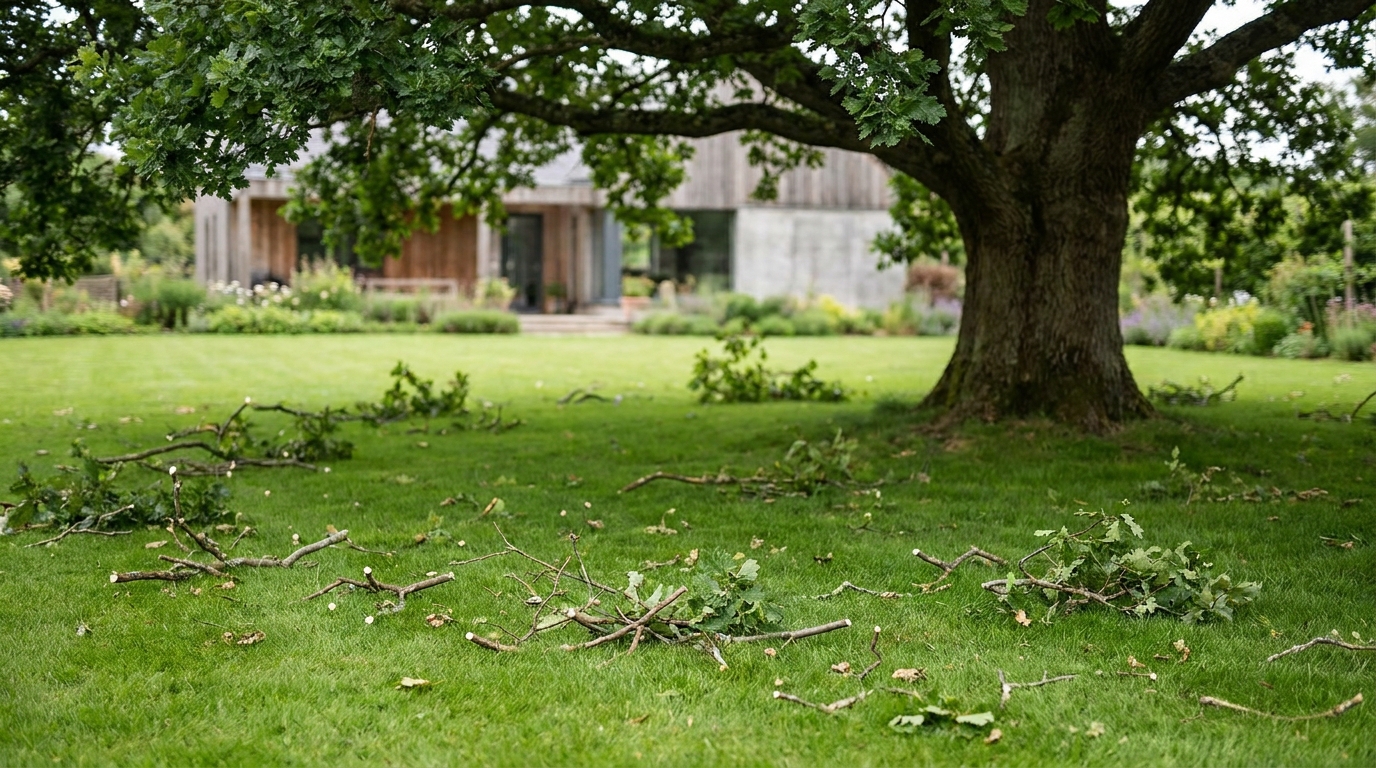
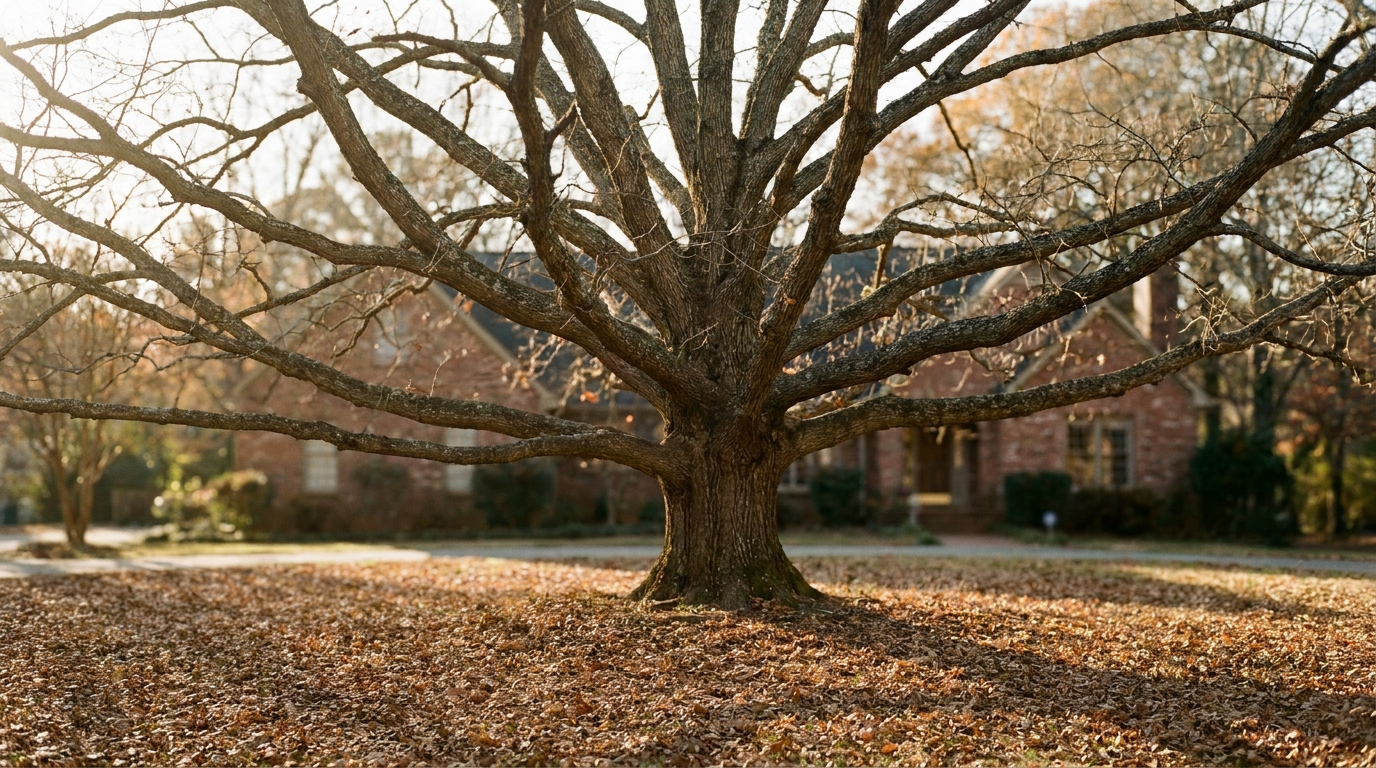
Late October lawns around Waxhaw, Weddington, and Indian Land often fill with pencil-thick twigs that still have leaves on them. In most cases that litter is twig girdler damage, the work of a native longhorned beetle, not a crown that is dying from the top down. The beetle, Oncideres cingulata, chews a neat ring around a small branch so the tip dies and breaks off, while the rest of a healthy shade tree keeps its foliage [4]. A mature oak, elm, or hickory that is otherwise full and green usually does not need a spray or a removal. Gathering the twigs is the useful step. The honest exceptions are a young tree, a pecan or hickory that has been cut hard, and a tree that is already in poor health [1][5][7].
What the sticks on the grass actually mean
Someone walks out to mow and finds a scatter of small branches under one tree. A 2021 Mississippi State University Extension note described that scene under pecan and hickory: dozens of pencil-sized twigs, about one to three feet long, that had not been there the week before [5]. Squirrels and wind are the usual guesses, and both can be right.
North Carolina Cooperative Extension described the insect in an October 2021 note after small branches had to be cleared off a large pecan before mowing [1]. The beetle is mottled grayish brown, with long antennae. It favors pecan and hickory, and it also uses oak and other hardwoods with fairly smooth bark, including dogwood, elm, hackberry, honeylocust, linden, persimmon, poplar, redbud, and some flowering fruit trees [1]. University of Maryland Extension, updated in October 2024, lists a similar set and calls the twig girdler native [4]. It is part of the hardwood woods here, from Union County into Lancaster, Fort Mill, Tega Cay, and Rock Hill.
Missouri Extension, in a guide reviewed in April 2022, says adults typically emerge from mid-August through early October [6]. The 2021 North Carolina note puts emergence in late August to early October and says the adults live 6 to 10 weeks [1]. Females spend that window chewing rings and laying eggs. The twigs then drop from their own weight or from wind [6].
Not every twig on a lawn is a girdler. A second native beetle, the twig pruner, drops branches that look similar from across the yard and different in your hand. If the same tree has large dead limbs, a thinning crown, or fungus on the trunk, the little sticks are not the whole story.
How to tell a girdler cut from a storm break
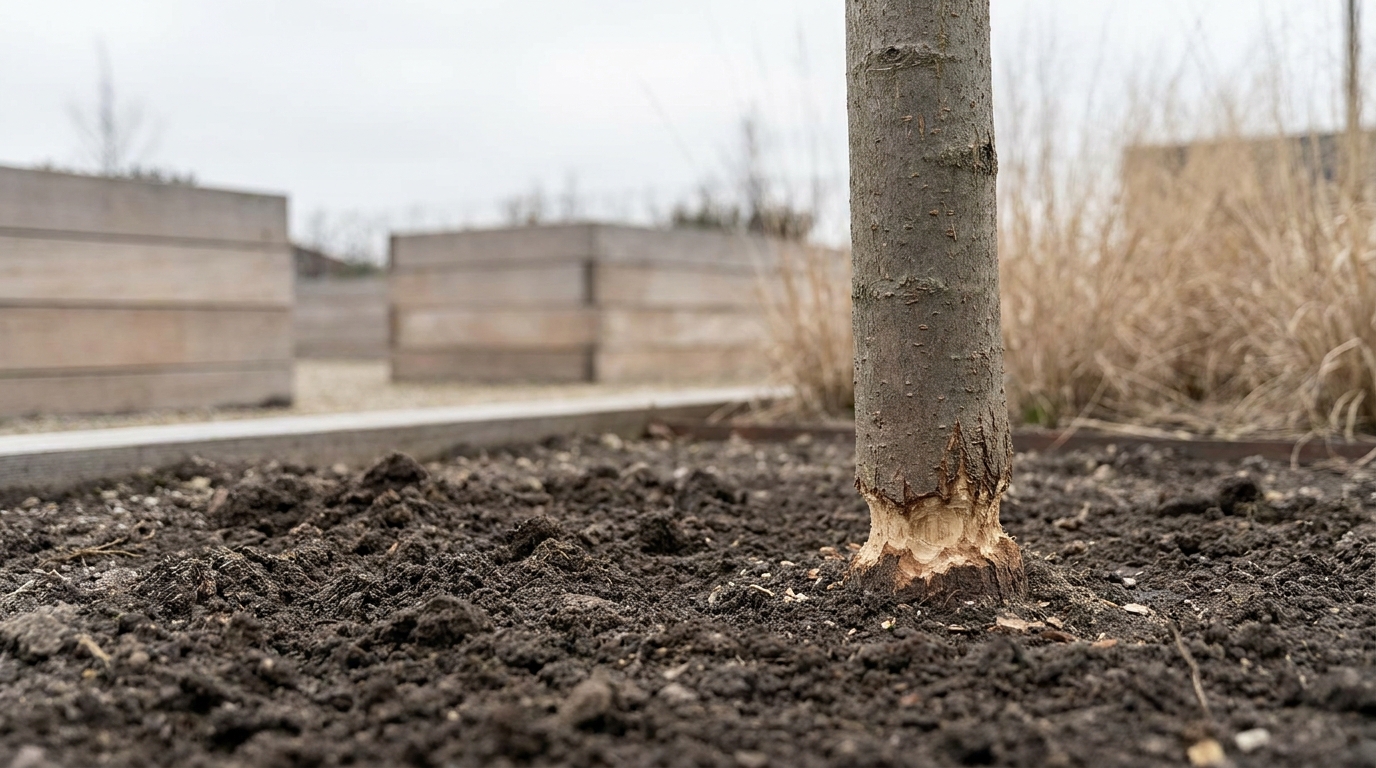
Look at the end that used to meet the tree. A girdler cut is strangely tidy. Maryland Extension says the ends look as though a beaver chewed them, only at twig scale [4]. Mississippi State describes a cut that looks sawn, straight and clean, except for a toothpick-sized bit in the center where the wood finally snapped [5]. Virginia Tech, in a publication dated October 20, 2025, says the female gnaws a straight cut around the twig, leaves a small center core, and cuts through both bark and wood with a faint bevel and a rough chewed edge [3]. Missouri's guide describes the same end: smooth near the bark, ragged at the center break [6]. University of Florida adds that the cut runs across the twig, with a jagged break toward one side and small bark notches parallel to the cut [2].
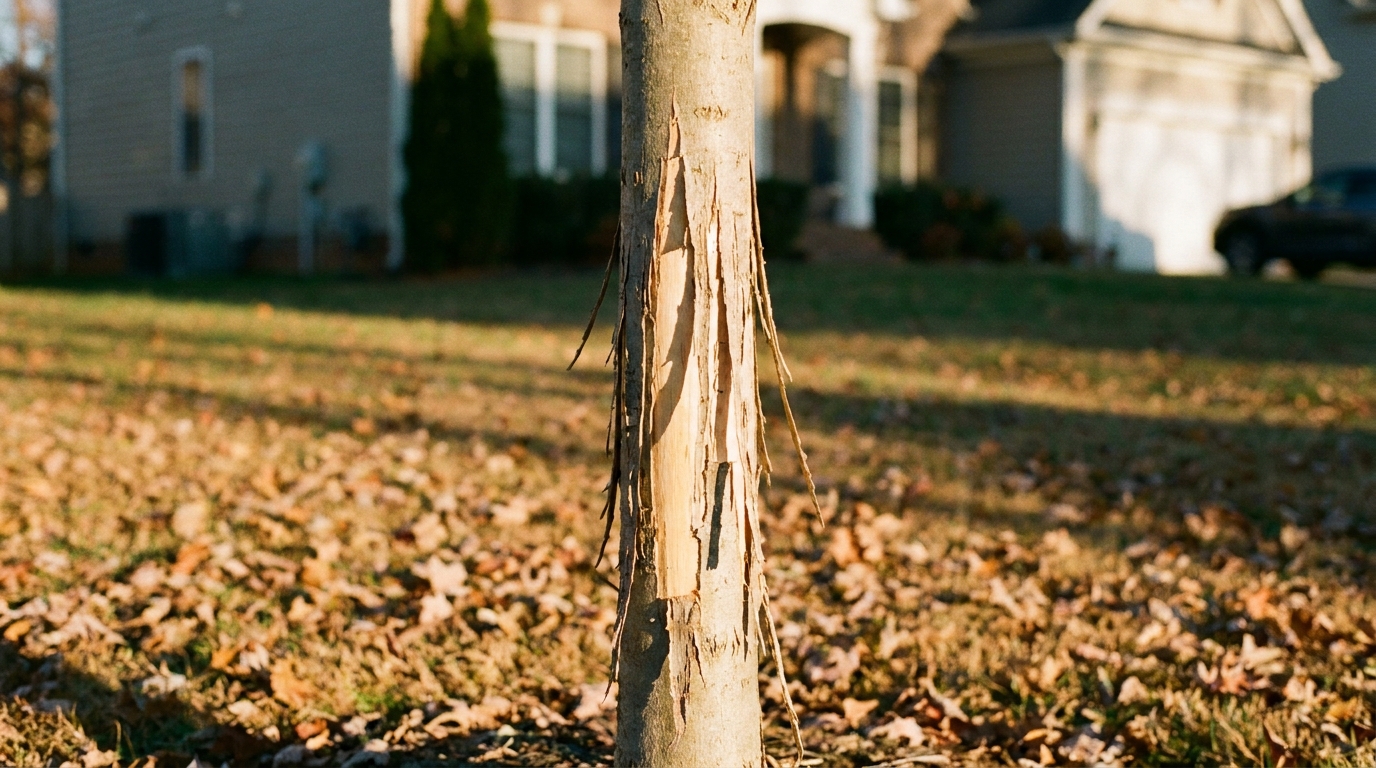
Wind can finish the drop. The girdled portion usually falls because of wind or its own weight, after the beetle has already made the ring [6]. A limb that failed in a thunderstorm is usually torn, fibrous, and angled, without that groove. If the ring is missing, do not call the mess twig girdler damage and walk away.
The leaves are easy to misread. The beetle girdles the twig while the leaves are still on it, so the piece keeps those leaves for a while, and then the leaves die [1]. A stick that fell yesterday may still look green. One that has been down a week is more often brown. Tips still hanging in the crown do the same thing until wind breaks the last bit of wood [6]. Brown leaves on those hanging tips are not, by themselves, a dying tree.
A second beetle, and a different cut
On oaks, the common mix-up is the twig pruner. Virginia Tech says the girdler favors pecan and hickory, while the pruner is more often found on oak [3]. The girdler adult works from the outside in, and the pruner larva cuts from the inside out, tunneling down the twig and stopping at the bark [5]. The broken end then shows smooth wood inside, ragged bark outside, and an oval opening plugged with frass [3].
Size separates them too. Girdlers use twigs about 1/4 to 1/2 inch across, and Virginia Tech puts a typical girdle at about 0.4 inch (10 mm) [3][4]. Pruner branches run larger. An NC State fact sheet reviewed on March 7, 2025, puts them at about 5/8 to 2 inches, with a small oval hole often packed with frass [8]. Missouri's guide says about 1/2 inch to 2 inches, with a smooth concave cut [6]. A broom-handle piece with a cupped hollow end is a pruner, not a girdler.
That NC State sheet is also the stress warning, and it is about the pruner. The insect is normally considered a secondary invader of declining trees, and it also attacks healthy twigs. Trees under stress seem more attractive to those adults than healthy trees, and drought may make young trees attractive [8]. A thin oak dropping inch-thick branches with packed oval holes deserves a real look. A leafy hickory shedding pencil twigs usually does not.
What the beetle is doing, and what the tree needs
The cut feeds the young. The larva cannot develop in healthy sapwood or in green, high-moisture twigs, so the female rings the branch and typically lays three to six eggs in the portion that will die and dry [6][7]. There is one generation a year. Larvae overwinter in the twigs. Pupation in the 2021 North Carolina account occurs during August and September and lasts 12 to 14 days, and new adults emerge the next late summer [1][6]. Maryland's 2024 update describes the adult as about 3/4 inch long, gray, with two dark bands and antennae longer than the body, and the mature larva as a white roundheaded borer about 1 inch long [4]. A 2025 University of Florida profile by Miranda Barnes and Jiri Hulcr says this species most commonly girdles hickories and pecans across the eastern United States, along with persimmon, elm, honey locust, and some oaks [2].
For a large established shade tree, this is usually a nuisance, not a removal. The 2021 North Carolina note says damage on large pecans is typically cosmetic, though the twigs are a mower hazard. Young trees are sometimes heavily damaged, repeated terminal cuts can fork or crook the stem, and heavily infested pecans can lose fruiting wood and yield fewer nuts the following year or longer [1]. Insecticides are rarely justified in landscapes [1]. Mississippi State, also in 2021, says low to moderate pruning has little adverse effect on large trees, while young landscape trees and young orchard pecans can be cut hard enough to hurt later growth [5]. Missouri's 2022 review adds that repeated attacks can deform young trees and leave a crown looking ragged [6]. That 2025 University of Florida profile also says published studies have not produced a solid set of numbers on the loss, that the damage is small next to other common pecan pests, and that treatment is unnecessary in urban backyards where growth rate is not the concern [2]. Gardening Solutions says the damage is usually not life threatening to healthy trees [7].
A healthy shade tree in Waxhaw or Charlotte usually needs the twigs picked up and nothing more. Look closer if the tree is young and losing its main tips year after year [1][6], if a pecan or hickory is buried in fallen fruiting wood [1][5], or if it was already thin, dry, or carrying larger deadwood [7]. Stressed trees are more attractive to twig pruner adults, so do not assume every stick is a girdler [8]. Skip the spray. Maryland Extension says there is no insecticidal control, and Virginia Tech says spraying has not shown much promise [3][4].
What to do with the twigs
Gather the twigs on the ground, and any you can reach in the tree without climbing [1][7]. Larvae spend the winter in that wood. North Carolina says to destroy them through fall, winter, and spring, and to do the same in a nearby oak or hickory woods that has a history of heavy damage [1]. Missouri says begin in September, or no later than May [6]. Maryland says finish before adults emerge beginning in August [4].
Chipping, bagging for disposal, or burning where it is allowed will kill the larvae. University of Florida lists burning, burying, chipping, or dry heat [2]. Gardening Solutions also lists a hot, dry spot or burial in a moist one [7]. A damp kindling pile against the shed until next summer saves the insects. Cleanup is less effective beside woods that already hold both beetles, but it still keeps sticks out of the mower [3][5].
Do not mow the litter. North Carolina flags the pieces as a mower hazard [1]. Do not climb for flagged tips, and do not "fix" this by cutting the healthy crown back. One light year under a mature oak is a rake. A heavy drop every October, or a new tree losing its leader, is worth a look, because repeated tip loss is what bends young trees [6].
Practical takeaways
- Match the cut before you name the problem. A girdler leaves a smooth outside ring, a small broken center, and often little notches in the bark [2][4][5]. A pruner leaves a cupped or oval end, smooth wood inside, and ragged bark [3][8]. A storm break is a torn, fibrous end with no chewed ring.
- Leaves still on the twig, green or brown, fit a girdler, because the cut happens while foliage is attached and the leaves die afterward [1].
- On a healthy, established shade tree, pick up and destroy the twigs and skip the spray. Pencil wood on the lawn is not a dying crown [2][4][7].
- Look closer at young trees, at pecans and hickories buried in fallen tips, and at any tree that was already thin, dry, or carrying larger deadwood [1][5][8].
- Raking one lawn will not clear the woods next door. It keeps larvae out of the mower and can lower the number that come out under that tree [3][5].
How we can help
Have more questions or want to get in touch?
If the cuts do not match what is described here, or the tree is young, heavy with pecan or hickory litter, or already stressed, our team can walk the property and tell you whether this is a rake-up or something that needs pruning or removal. Reach Clark's Tree Care through our contact page, or call (980) 247-TREE. We work from Waxhaw across Union County and greater Charlotte, including Lancaster, Indian Land, Fort Mill, Tega Cay, and Rock Hill.
Citations
- N.C. Cooperative Extension, Pamlico County Center, "Pecan Twig Girdlers" (2021-10-29)
- University of Florida IFAS, "Twig Girdler: Oncideres spp. (Insecta: Coleoptera: Cerambycidae: Onciderini)" (2025-07-11)
- Virginia Cooperative Extension, "Twig Girdler/Twig Pruner" (2025-10-20)
- University of Maryland Extension, "Twig Girdlers and Twig Pruners on Trees" (2024-10-18)
- Mississippi State University Extension, "Twig Girdler, Vol. 7, No. 24" (2021)
- University of Missouri Extension, "Twig Girdler and Twig Pruner" (2022-04)
- University of Florida IFAS Gardening Solutions, "Twig Girdlers" (2026)
- NC State Extension, "Twig Pruner" (2025-03-07)