crape myrtle bark scale Waxhaw: crust is scale, film is mold
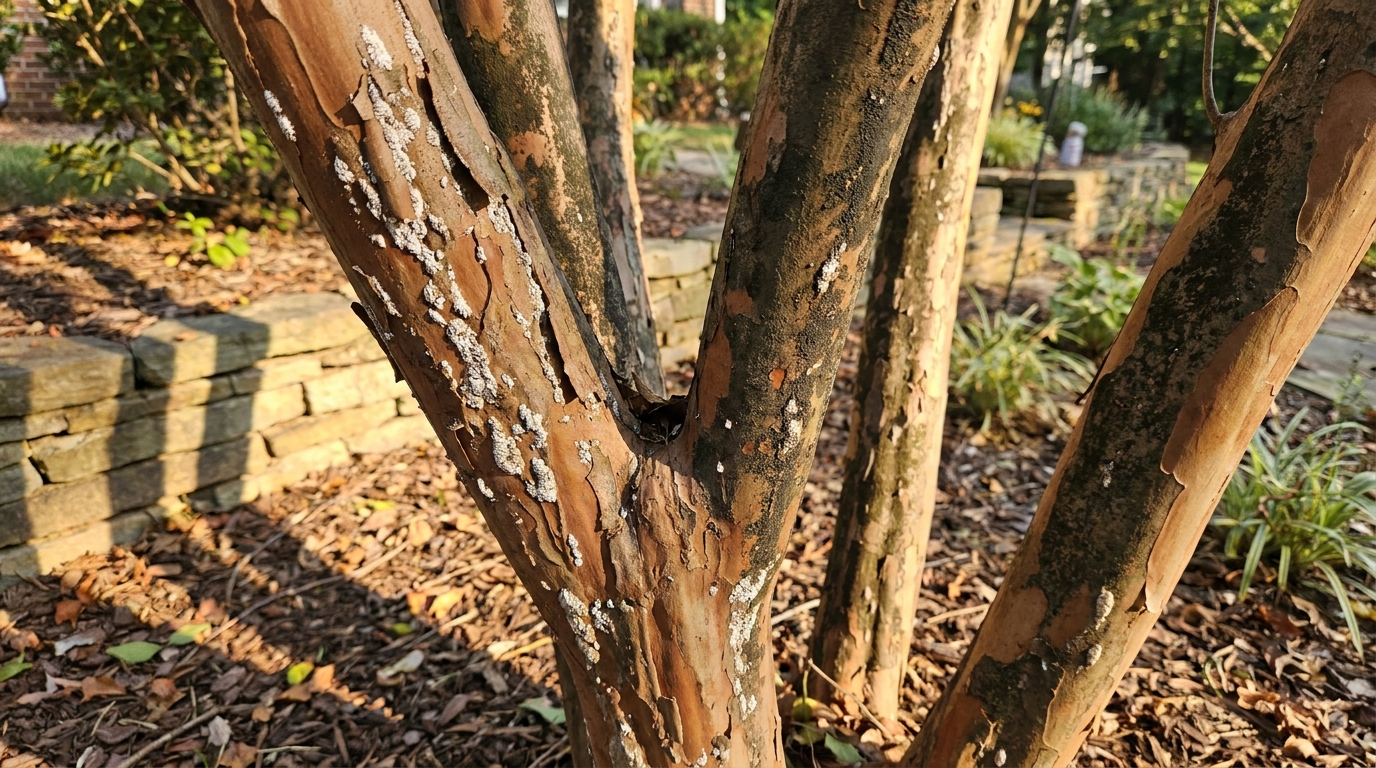
The white crust on a crape myrtle in Waxhaw is crape myrtle bark scale, and the black film on the bark and leaves is sooty mold growing on the insect's honeydew, not a stain soaked into the wood [1][2]. The insect is a felt scale, Acanthococcus lagerstroemiae, formerly called Eriococcus lagerstroemiae in older writing [7]. It feeds on sap and drips a sugary waste, and the black coating is a fungus living on that drip, not the bug itself [1]. You can wipe the soot and sometimes scrub off white bumps, but the tree stays infested if the crust returns and the surfaces under the crown turn sticky again [1][3].
What the white crust and the black film are
Adult females sit on the bark under a white or gray waxy cover and build fluffy egg cases that NC State Extension compares to cotton swabs [1]. A 2023 NC State factsheet puts a typical egg sac at about 1/8 inch long and 1/16 inch thick, so a light case can look like white grit in rough bark [6]. Nymphs among the adults are pink or orange, with more or less wax as they age [1]. Newly hatched crawlers are tiny and pink. They are the stage that walks to a new spot, then settles and feeds [1][2].
They use piercing-sucking mouthparts on phloem sap and pass the extra sugar out as honeydew [1][4]. Sooty mold grows on that sugar. The mold is the black, powdery film on leaves, stems, and other surfaces [1]. It is not a bark canker, and it is not the insect wearing a dark coat [1][2]. A heavy colony can blacken a patio, a car, or the mulch under the canopy even when nobody spilled anything [1][3].
This is already a Carolinas problem. Clemson Cooperative Extension traces it to crape myrtles in Texas in 2004, then through the Southeast, including North Carolina, mostly on shipped plants [2]. The same factsheet says it was confirmed in South Carolina in 2019 and is still spreading there [2]. NC State's 2025 homeowner note says that in many parts of North Carolina every life stage can be found through the year, with at least two generations, and likely more in warmer places and in towns [1].
Crape myrtle is the host people notice. Clemson also says to check nearby American beautyberry, pomegranate, persimmon, edible fig, boxwood, cleyera, privet, and raspberry, and to look down the whole row, not only the tree by the sign [2].
How to tell scale and sooty mold from a washable stain
A washable stain stays gone, or at least stays dull, after you clean it. Scale leaves a living colony. Use the location, a scrape test, and the sticky residue before you decide it is only dirt, mildew, or irrigation film.
Bark scale builds in branch crotches, around pruning cuts, under loose peeling bark, and along stems and trunks [2]. Light infestations often start in bark furrows and branch forks [5]. Paint overspray and mineral film do not pick those hiding spots. The white pieces are separate waxy bumps or a felted crust, not a smooth pale wash [1][2].
Scrape one bump. Penn State Extension, on a page updated in May 2025, says crushing a suspected egg sac leaves a pink streak [3]. Clemson uses the same check after a treatment: a living scale bleeds reddish fluid, and a dead one does not [2]. A 2018 University of Florida profile, revised in 2022, says dead scales are dry and flaky, while live ones exude a ruby pink color [7]. Lichen, dried paint, and mineral crust do not bleed.
Then check for sugar. If ants, wasps, bees, or flies are working the bark, or a table under the crown feels tacky, something is feeding [5]. Sooty mold follows that honeydew, and it often wipes off, which is why a rain or a bucket of soapy water can look like a cure [1][3]. If the white bumps are back in the crotches a few weeks later and the black film returns, the wash only cleaned the mess.
Black leaves by themselves are not proof. Crape myrtle aphids also make honeydew and sooty mold, and they feed on leaves and tender tips rather than woody bark [2][4]. A 2022 University of Georgia circular says aphids are on the leaves, while these bark scales are on the bark [4]. The Florida profile adds that bark scale is very rarely on leaves [7]. Clean bark plus black leaves can be aphids. White felt in the crotches is bark scale, even if both pests share the tree.
Do not kill every white fuzzy speck. Some lady beetle larvae wear a waxy coat that mimics the scale, but they move and settled scale does not [1]. University of Maryland Extension says the larvae look larger and fluffier [5]. If it walks, leave it. NC State warns that mosquito sprays can kill these helpers and lead to pest outbreaks [1].
What a heavy infestation does to the tree
Light colonies are mostly a mess: honeydew, soot, and a dirty look [1]. Clemson calls the usual case aesthetic damage that may not kill the plant [2]. Penn State says the scale rarely kills crape myrtles outright, but it can shrink flowers, stunt growth, cause branch dieback, and cover the tree in sooty mold [3].
Heavier feeding does more. NC State's 2025 note says heavy infestations can reduce growth and flowering and leave the plant weakened [1]. Trees may leaf out late, flower clusters can be smaller, and bark may peel early [2]. University of Maryland Extension reports leaf drop, poor bloom, branch dieback, and, in southern states, plants that died [5]. The 2022 Georgia circular says a severe infestation can kill the tree [4]. A black trunk is not an automatic removal. It is also not something to ignore for years.
Shade and hard cutting explain why one tree looks worse than its neighbor. Clemson says full-sun plants often carry smaller infestations, while shaded plants typically have more crawlers [2]. Maryland notes that over-pruning gives the scale more places to settle, and that extra nitrogen may boost the population [5].
What actually knocks the insect back
Washing lowers numbers. It does not finish the job. NC State calls a pressure washer or a hose an inexpensive, non-toxic way to knock scales off bark [1]. Penn State says a soapy scrub with a stiff brush will not clear an infestation alone, though it cuts the colony and exposes what remains [3]. A 2022 University of Georgia circular says brushing is unlikely to last [4]. Clemson explains the limit: the scale feeds under loose, peeling bark [2]. Stay on wood you can reach from the ground. The black film is mold on honeydew, and it returns until the insects drop [1]. A 2023 NC State factsheet notes that horticultural oil also helps weather that mold away [6].
Pruning removes insects you can see, if the cuts are selective. NC State says to remove heavily infested branches and stems [1]. The Georgia circular says pruning infested side branches may shrink the population [4]. University of Maryland Extension says an over-pruned crape myrtle gives scale more places to settle [5]. If a few limbs are crusted and the crown is otherwise sound, take those limbs. Shearing every stem into a knuckle is not control.
Clemson describes a harder reset for a plant that is highly infested when the owner will not use insecticide. Cut it flush with the ground, keep three equally spaced sprouts, mulch, and fertilize those sprouts on April 1 and again in mid-May, on that South Carolina calendar [2]. The factsheet says the plant can flower again within three years [2]. Bag the wood for the trash, or burn it where burning is allowed. Do not set it on the curb for ordinary brush pickup, because that moves the insect [2]. That ground-level cut is for a ruined multi-stem plant. It is not yearly maintenance, and it is a different job from removing a large tree over a roof or a walk.
Oils and soaps work on crawlers, the pink nymphs that have not built a full wax cover. NC State's 2025 note says horticultural oils and insecticidal soaps can reduce abundance, especially then [1]. The 2023 factsheet puts the better contact-spray windows in late spring and late summer, when new nymphs are outside the egg sac [6]. The 2022 Georgia circular is colder on oil: control was inconsistent, and oil was generally ineffective outside the spring crawler peak, which that page places in April or May on the Gulf Coast [4]. Penn State says more than one application may be needed where generations overlap [3].
Clemson's factsheet, updated in 2024 with its pesticide list refreshed in 2026, is the nearest set of numbers [2]. For crawlers it describes bifenthrin mixed with 2% horticultural oil in late April or May, and again in late summer, with the bifenthrin rate taken from the product label [2]. Apply horticultural oil only above 45 degrees F and below 90 degrees F, and only with no rain forecast for 24 hours [2]. Those figures are for South Carolina. The label still controls the mix. Do not strengthen it because the trunk looks worse.
Soil systemics last longer, and they can reach flowers. Imidacloprid is the product most home stores sell, and NC State warns that this neonicotinoid may contaminate flower parts bees visit [1]. Clemson lists a spring soil drench or granular treatment of dinotefuran or imidacloprid as new growth begins, and says it may provide control for at least one year if you dose by the label, using plant height or trunk diameter [2]. Penn State's 2025 article points to dinotefuran as the active ingredient that has looked most effective in the work summarized there [3]. Do not drench every tree just in case, do not spray on a windy day, and keep spray off open blooms [1][2].
We do not sell that spray or drench. Pruning and removal are the part of this problem our crew can take on, and a saw does not replace the timing on those extension pages.
Tall crowns make spraying a coverage problem and a safety problem. Clemson says a tall crape myrtle is hard to coat and hazardous for the person trying [2]. University of Maryland Extension says a large population may take more than one year, that some products belong with a professional applicator, and that removing the plant is reasonable if you will not use pesticides and scrubbing is not enough [5]. Lady beetles, including the twice-stabbed lady beetle, and lacewing larvae already feed on this scale [1]. Clemson says those predators can work, though their numbers take time [2]. Maryland reported that in 2024 many populations it watched collapsed or dropped sharply, apparently because predators caught up [5]. Sprays that kill them work against you [1][3].
When to look around Waxhaw
Do not copy a Gulf Coast calendar onto Union County without checking it. A 2023 NC State factsheet says eggs are laid in late April, hatch about three weeks later in early May, and that the next generation hatches in September [6]. Nymphs overwinter, feeding through the bark [6]. Clemson, just south of us, describes pink crawlers from mid- to late April through May, with a second peak in late summer, and says eggs can also overwinter inside the white sacs [2]. The 2022 Georgia circular puts Gulf Coast peaks nearer mid-May and mid-October, and notes that local temperature shifts the dates [4]. Look as new growth starts, look again in late summer, and look after leaf drop, when white crust on bare wood is easy to see [2][6].
Wrap double-sided tape on a small branch if you need to time a contact spray. Crawlers stick. Older, settled scales generally do not [2][4]. Scrape a bump the same day. Reddish fluid means it is alive [2]. NC State finds every life stage through the year in many parts of the state, so one spray date will not clear a Waxhaw tree [1]. Maryland's 2026 update says overlapping generations can mean more than one check, and a large colony can take more than a year [5].
Two other misses keep the problem moving. Loose brush set on the curb gives crawlers a ride to the next yard, so bag that wood [2]. A new crape myrtle with white felt in the crotches brings the insect home, which is why Clemson and Georgia both start with inspection at the nursery and in the yard [2][4]. If someone does spray bifenthrin, Clemson says to do it in the very late evening and to keep drift off nearby flowers [2].
Practical takeaways
- White felt in the crotches and on the trunk, plus a black film, is crape myrtle bark scale and sooty mold. A pink or reddish smear when you scrape a bump means the insect is alive [2][3].
- Black leaves alone can be crape myrtle aphids. Check the bark before you decide which pest you have [2][4].
- A hose or a soapy brush lowers the numbers and cleans soot. Scale under loose bark survives that wash [1][2][3].
- Cut out the worst limbs and bag or destroy that wood. Do not leave it for loose brush pickup, and do not stub the whole crown as a routine [1][2][5].
- Oils and insecticidal soaps are aimed at crawlers [1]. Clemson's factsheet, with its 2026 pesticide list, describes bifenthrin mixed with 2% horticultural oil in late April or May and again in late summer, only above 45 degrees F and below 90 degrees F, and only as the product label allows [2].
- A spring soil drench of dinotefuran or imidacloprid can last longer. Imidacloprid may show up in flowers that bees visit, so follow the label and do not treat casually [1][2].
- If the tree is thinning, blooming poorly, and armored in scale, pruning or removal is a fair next step. Scrubbing will not rebuild a tree that has declined for years [3][5].
How we can help
Have more questions or want to get in touch? We do not spray for crape myrtle bark scale, and a pruning visit does not replace the insecticide steps on the extension pages above. If the white crust is heavy on a few limbs, or a crape myrtle in Waxhaw is thinning, blooming poorly, and sitting over a roof, a drive, or a walk, our team can look at whether that wood should be pruned or whether the tree should come out. Call (980) 247-TREE or use the contact page. We will walk the property with you and put the price in writing before any work is scheduled. The same offer stands across Union County and for yards around Charlotte where these trees line the street and the soot is showing up on the cars.
Citations
- NC State Extension, "Biology and Management of Crape Myrtle Bark Scale for Homeowners" (2025-08-08)
- Clemson Cooperative Extension, Home & Garden Information Center, "Crapemyrtle Bark Scale in South Carolina" (document updated 2024-09; pesticide list updated 2026-09)
- Penn State Extension, "Crapemyrtle Bark Scale" (2025-05-19)
- University of Georgia Cooperative Extension, "Crape Myrtle Bark Scale: An Emerging Invasive Pest in the Nursery and Landscape" (Circular 1234, 2022-01-21)
- University of Maryland Extension, "Crapemyrtle Bark Scale in Home Gardens" (2026-03-13)
- NC State Extension, "Crapemyrtle Bark Scale" (PDIC factsheet, 2023-11-08)
- University of Florida IFAS Extension, "Crapemyrtle Bark Scale Acanthococcus (=Eriococcus) lagerstroemiae (Kuwana)" (EENY-711; original publication 2018-07, revised 2022-01-26)