Oaks that keep brown leaves in winter can be healthy
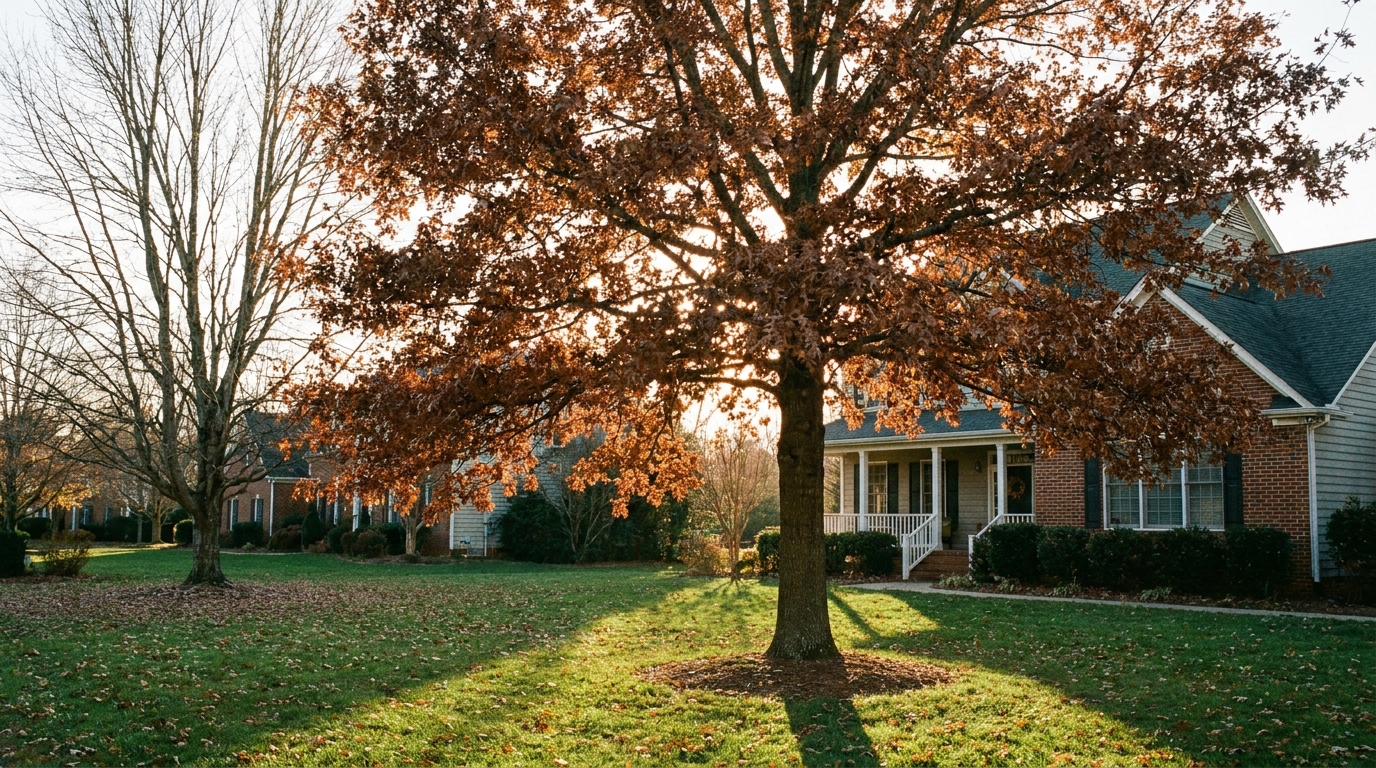
Oaks that keep brown leaves in winter around Waxhaw are usually still wearing last year's foliage, dead and dry, on twigs that never finished dropping it. That habit is called marcescence, and it is common on pin oaks, on some other red oaks, and on young trees of several oak species [1][3]. The leaves are dead. A crown full of them is not, by itself, a dead tree, hypoxylon canker, or bacterial leaf scorch [5][6].
What those brown leaves actually are
Most other shade trees finish the year by letting go. They build a separation layer, called an abscission layer, at the base of each leaf stalk. Shorter days and colder weather trigger a band of special cells there. That band cuts off water and nutrients, and the leaf falls [1].
Oaks that keep brown leaves skip the last step, or only half-finish it. Illinois Extension puts it this way: in species that retain dead leaves through winter, the abscission layer is delayed or only partly formed, so the leaf stays attached for a while longer [1]. The leaf still dies on schedule. It dries and turns brown. What fails is the release. The petiole, the short stalk that joins the leaf to the twig, stays fastened.
A 2022 University of Maryland Extension article traces the word marcescence to the Latin marcescere, "to fade," and explains that on these trees the separation other species finish in autumn waits until spring [2]. When new growth starts, the expanding buds push the old leaves off, and the branches fill in with green [2]. Those brown flakes on the driveway are the tree finishing a fall job, not a sudden death at bud break.
Which oaks around Waxhaw and Union County do this
NC State Extension's overview of the oak genus notes that many oaks hold onto their leaves into winter [4]. The habit is not equally strong on every tree. Illinois Extension says it tends to be more prominent on juvenile trees and on the lower branches of mature trees [1]. The 2022 Maryland article describes the same split: sometimes the tree is young and holds foliage all over, and sometimes an older, taller tree keeps leaves only on the lower limbs [2].
Pin oak is the yard tree we get called about most. NC State Extension's pin oak profile says young trees, and the lower branches of older trees, hold leaves throughout winter, and it describes pin oak as a popular shade and street tree and one of the faster-growing red oaks [3]. Lower limbs angle down, and the leaves usually have five to seven pointed lobes with deep sinuses [3]. A brown coat through the winter is ordinary on that tree, especially while it is young [3].
Other red oaks and white oaks can hold some dead leaves too, again more often on young wood and lower limbs [1][4]. An older oak that goes bare up high and keeps a skirt of brown leaves down low is showing that pattern, not a disease moving up the trunk. American beech, hornbeam, hophornbeam, and witch-hazel do the same thing in the woods [1][2]. If the neighboring shade trees are bare and the oak is the one still brown, that fits the pattern [1][4].
Water oak is a different case, and it is common in Coastal Plain and Piedmont bottomland forests in North Carolina [9]. NC State says it is sometimes considered an evergreen in the Deep South [9]. A water oak that still looks green in January is not doing the same thing as a pin oak rattling with brown paper leaves. Water oak is also weaker-wooded than many other oaks, and its limbs are at real risk of breakage in high wind and in winter snow and ice [9].
Why a living oak would keep dead leaves
Illinois Extension says why the trait persists is unclear, and it offers theories rather than a settled cause [1]. A 2022 Maryland article says the same: the process has a name, and scientists are still unsure why it exists [2]. Dead leaves may shield buds from drying wind [1]. They may also hide buds from deer, or discourage browsing with dry tissue and noise [1][2]. Leaves that drop in spring, instead of autumn, may return nutrients when growth starts and shade the soil [1][2]. None of that is settled. The brown coat is not a symptom you peel off.
There is a downside. Illinois Extension notes that held leaves add surface area, so wind and ice have more to catch, and that yard trees may break more readily than trees in the woods where the habit developed [1]. Penn State Extension, in a September 2026 article, notes that a wet storm catching hardwoods while leaves are still on can break branches and trunks, because snow and ice shed poorly from a leafy crown [7]. Look at limbs over the house after an ice storm. Do not condemn a healthy pin oak in January for wearing brown leaves.
How to tell a holding oak from a tree that is actually dead
Start with the pattern, from the ground. On a young pin oak or other young oak, the brown leaves often cover most of the crown [1][3]. On a mature oak, they are often on the lower limbs, while the upper crown is bare [1][2]. The leaves are dry and still attached across those twigs. They are not one scorched tip, and they are not a pile of bark at the base.
Next, look at the buds. The 2022 Maryland explanation says the expanding buds are what finally push the old leaves off [2]. On a holding oak, those buds are still on twigs you can reach.
For a closer check, scratch a young twig lightly. Do not gouge a big limb. Penn State notes that oaks keep chlorophyll under the thin bark of young twigs, and that a small scratch shows a green layer [7]. Check more than one twig. One dead low limb, shaded out years ago, does not make a dead oak. If you never find that green layer, the crown needs a real look [7].
Loose bark, a limb already broken and lodged overhead, or a large dead top with cracks, crumbling sapwood, or woodpecker activity are structural problems, not a leaf habit. A 2025 USDA Forest Service field guide tells crews to look for those signs on large dead tops and branches [8]. Do not strip the brown leaves. They will release when the buds swell [2]. If the upper crown is too high to judge, ask us to look before anyone talks about removal.
A short contrast with two problems that are not this
Two oak diseases get named every time a leaf turns brown. Neither one is a winter-long coat of dead leaves on an otherwise intact crown.
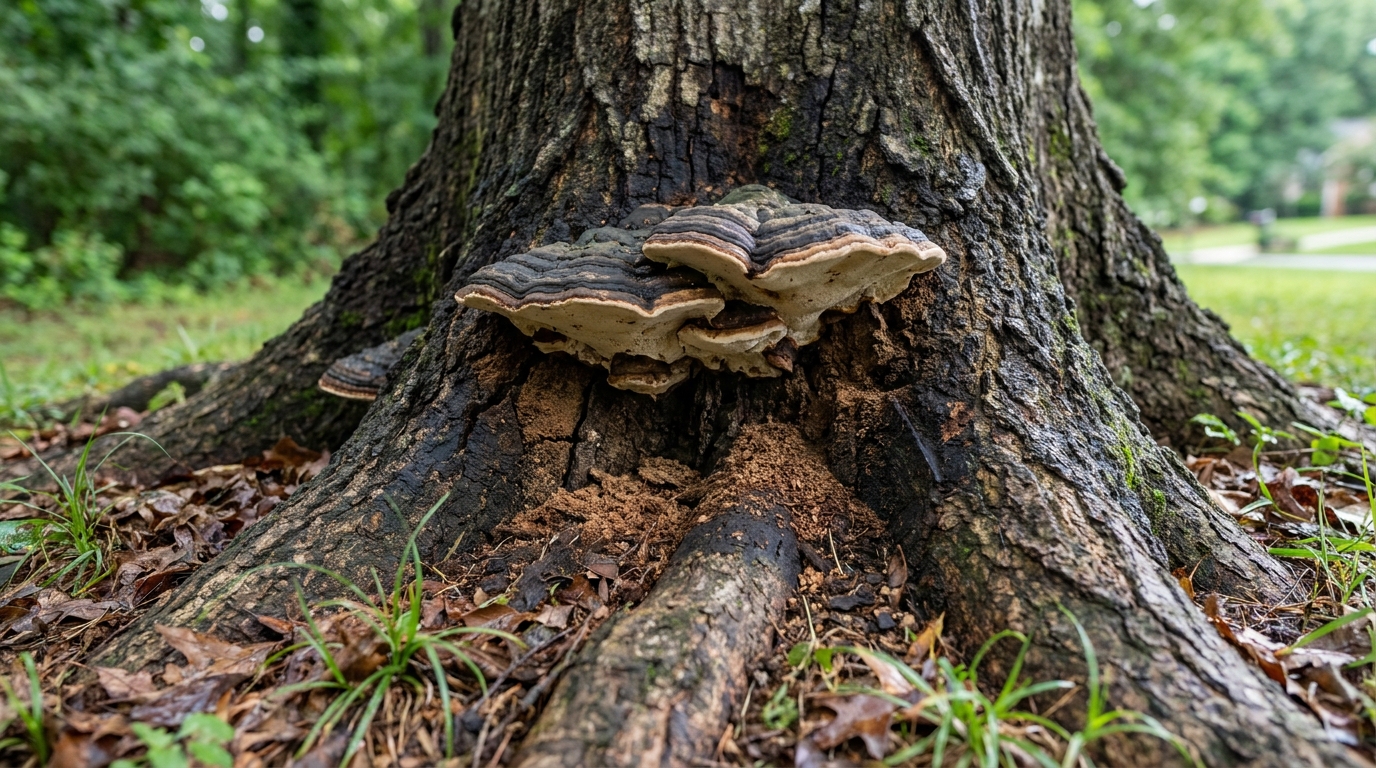
Hypoxylon canker, now called Biscogniauxia canker, turns damaging when an oak is already stressed by drought, injury, or a poor site [5]. NC State Extension, in a 2025 review, says the easiest sign is the fungal mat under the bark, which knocks the bark off. The mat may look reddish brown or tan and powdery, then black, then gray [5]. Early symptoms can include a thinning crown, dieback, wilted or scorched leaves, and late bud break, and red oaks are more susceptible than white oaks [5]. Bark on the ground and a smooth tan, black, or gray patch are not a pin oak simply holding brown leaves.
Bacterial leaf scorch is a summer problem. A 2022 NC State Extension guide describes it as a disease caused by the bacterium Xylella fastidiosa, seen most often on red oak, white oak, pin oak, and shingle oak [6]. Symptoms usually show in mid to late summer: leaf tips and edges burn brown, a yellow margin separates dead tissue from green, and leaves may drop [6]. It often starts on one part of the crown, and it gets worse year by year [6]. Scorch is a growing-season injury on leaves that were green. Marcescence is a winter leftover, the whole blade already dead, with no yellow halo and no midsummer start.
August scorch that worsens each year, or bark sloughing to a dark mat, is not ordinary winter leaf holding. Brown leaves in January, with green under the young bark, is the holding habit [1][3][7].
When a dead limb over the roof or drive is the job
A living oak can carry dead wood, and a dead oak can still wear a few brown leaves. We sort them by what would hit the ground. Extra leaf area means more wind and ice load [1][7]. After ice, look before you park under the tree. A limb that cracked or lodged overhead has already failed.
A 2025 USDA Forest Service field guide, written for developed sites in Oregon and Washington forests rather than Piedmont yards, tells crews to examine dead tops and branches about 3 inches across and larger, because those parts on live trees eventually break and fall [8]. They often rot in place first and may be held by little sound wood [8]. Free-hanging branches should come out, and large cracks mean the highest chance of failure [8]. That 3-inch figure is the guide's threshold for a hard look, not a promise that a smaller stub is harmless over a play set. A heavy limb over a bedroom or a drive is the piece we care about.
One dead limb on a live oak, over a roof, drive, walk, or parking area, is a pruning job. We cut the dead wood back to a sound lateral or the trunk and leave the live crown. You do not remove the tree because one limb died. You do remove that limb if it can hurt someone or come through a roof. The same limb over an empty side yard can wait.
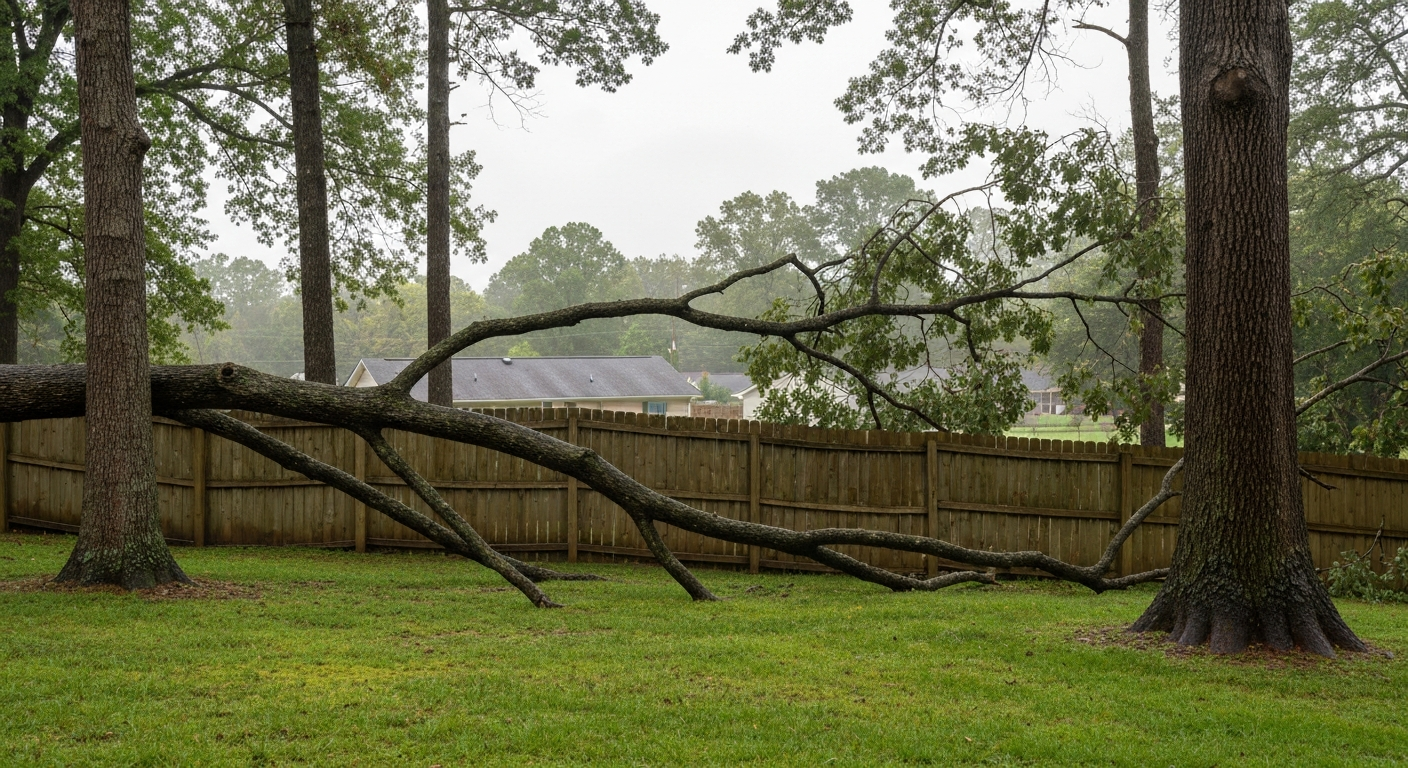
A hanging broken limb is not a ladder project. Pulling on it from underneath is how people get hurt. That is storm work. We can take it down, including with a crane when the piece has to come off over the house and the drop has to be controlled.
A tree dead through the trunk, or dead in so much of the crown that what remains cannot stand over a target, is a removal. Bark off to expose a hypoxylon mat, with dieback and a crown that will not leaf, pushes us that way [5]. A pin oak that is only holding brown leaves, with green under the young bark and buds in place, is not on that list [1][2][3][7]. If the whole tree comes out, we can grind the stump.
Drought is one of the stresses NC State lists before hypoxylon turns damaging, so water a dry yard tree, and still take a dead limb out of the strike zone [5]. NC State's water oak profile separately flags weak wood and breakage in wind and ice, so a dead or split limb over a drive is a pruning visit even when the rest of the crown is lively [9]. We will not top a sound oak for winter color. It can drop those leaves when the buds swell [2].
What to do between now and bud break
On a dry day, match the pattern: a young crown brown top to bottom, or an older oak brown only on the lower limbs [1][3]. A bare, cracked, or hanging limb over the roof or drive is the exception, and that is the call. On a twig you can reach, look for the buds that will push the old leaves off, and scratch a fingertip of thin bark [2][7]. Green underneath is the living-twig sign Penn State describes [7]. Leave the brown leaves. Rake what falls, and expect another drop at bud swell [2]. After ice, a fresh crack or a limb resting in the crown matters more than leaves that have been brown since December [1][7]. Photos help us sort easy cases. They do not replace a ground look when the target is a house.
Practical takeaways
- Brown leaves that hang on oaks through winter in Waxhaw and Union County are usually dead leaves still attached. The habit is common on pin oaks, some other red oaks, and young trees [1][3][4].
- A young crown may stay full. An older oak often keeps leaves on the lower limbs only. Buds stay on the twigs, and a light scratch on young bark shows green [1][2][7].
- Hypoxylon shows bark coming off and a tan, black, or gray fungal mat, plus thinning and dieback. Bacterial leaf scorch shows in mid to late summer as burned edges with a yellow margin, often on part of the crown [5][6].
- Held leaves can catch more wind and ice. Check limbs after a storm. Do not remove a healthy oak for brown leaves alone [1][7].
- A large dead limb or a hung-up broken limb over a roof or drive is a pruning or removal job. Brown leaves on live twigs are not [8].
How we can help
Have more questions or want to get in touch?
If you are unsure whether an oak is only holding old leaves, or a dead limb over the roof or drive needs to come off, our team can look at it from the ground and say which it is. We prune dead wood, take down trees that are actually dead or too damaged to leave over a house, and handle storm-broken limbs, including crane work when the drop has to stay off the roof. Reach us through our contact page, or see how we handle tree trimming, tree removal, and storm damage.
Citations
- Illinois Extension, "The stubborn beauty of oak leaves: marcescence explained" (2024-12-06)
- University of Maryland Extension, "The Mystery of Marcescence" (2022-03-01)
- NC State Extension Gardener Plant Toolbox, "Quercus palustris (Pin Oak)" (n.d.)
- NC State Extension Gardener Plant Toolbox, "Quercus (Oak, Oaks)" (n.d.)
- NC State Extension, "Biscogniauxia (Hypoxylon) Canker" (2025-09-30)
- NC State Extension, "Common Disease Pests of Oak in North Carolina" (2022-04-05)
- Penn State Extension, "Silent Survivors: The Winter Life of Trees" (2026-09-17)
- USDA Forest Service, "Field Guide for Tree Risk Assessments and Hazard Tree Mitigation on Developed Recreation Sites, Worksites, and Road Systems in Oregon and Washington Forests" (2025-12)
- NC State Extension Gardener Plant Toolbox, "Quercus nigra (Water Oak)" (n.d.)