Lichen on Tree Bark Is Not a Disease
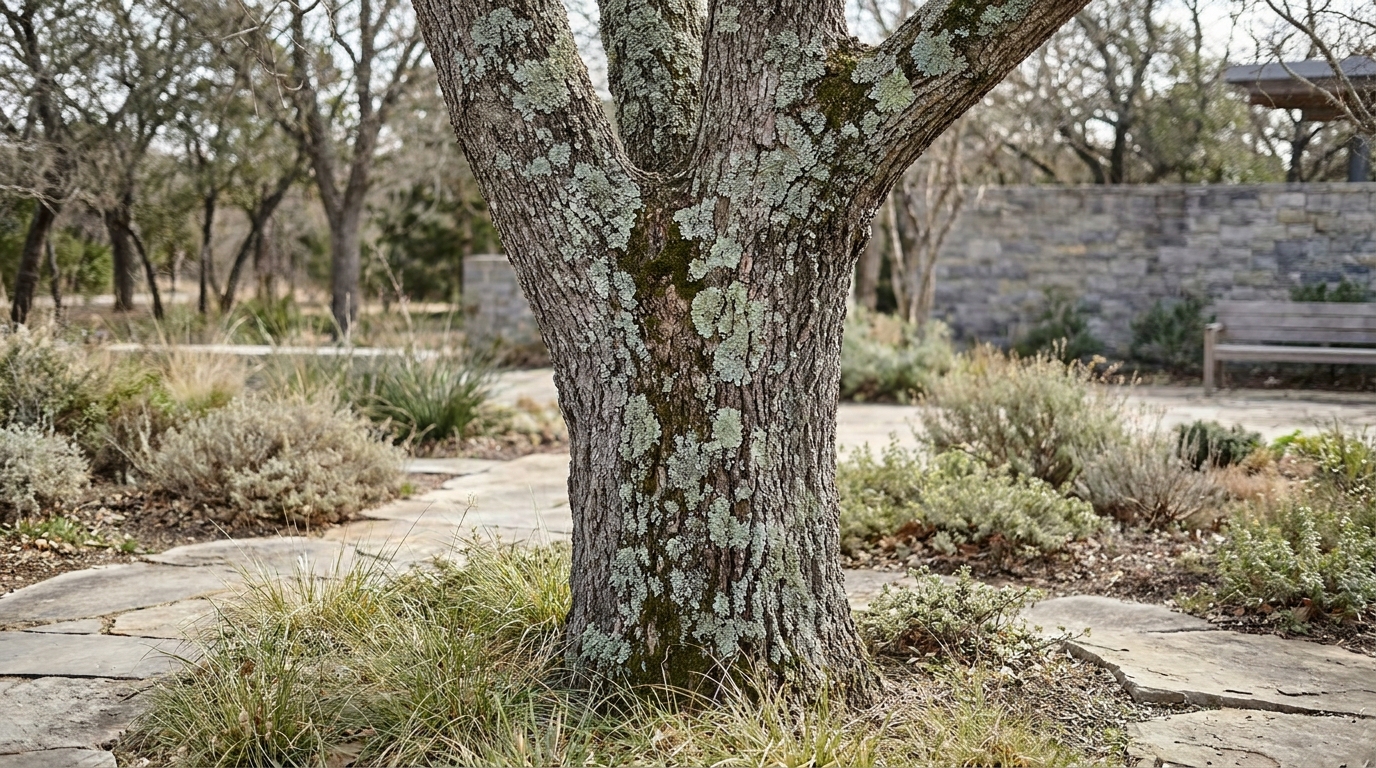
After the leaves drop, gray-green patches on bare trunks stand out around Waxhaw, the rest of Union County, and just over the line in Indian Land, Fort Mill, Tega Cay, and Rock Hill, and most of the time those patches are lichen on tree bark, not a disease. Lichen grows on the surface as a living partnership, not a parasite, and it does not eat the tree [1][2]. It is not a problem you spray off.
What the gray-green patches are
A lichen is not one organism. The U.S. Forest Service describes it as a partnership between a fungus and an alga. The alga may be a green alga, a cyanobacterium, or both, and it makes the food by photosynthesis [3]. University of Florida IFAS Extension says the pair does not obtain any part of its living from the tree or shrub, and it is not a parasite [1].
The same growth lives on things with no sap. Extension notes from Brunswick County, Henderson County, and Iowa record lichens on rocks. Iowa State also lists dead wood, soil, and tombstones [4][5][6]. A growth that can live on a rock is not feeding on your oak.
It stays on the outside. An August 2025 Rutgers Cooperative Extension fact sheet says lichens make their own food with sunlight, do not feed on the bark, and remain on the outer surface [2]. Their rhizines typically do not reach deep enough into the inner bark to harm the tree [2]. The Forest Service adds that lichens have no roots, stems, or leaves [3].
Trunk colors usually run gray-green to bluish green. Other species are orange, yellow, or black [6]. Three forms show up, sometimes on one tree. Crustose lichen is flat and tight. Foliose lichen is leaf-like and slightly raised. Fruticose lichen is bushy or hair-like [2][4][6]. Iowa State notes that a moistened foliose patch can turn somewhat rubbery and can be lifted [6].
Why you notice them after the leaves fall
We hear this once the leaves are down. A March 2022 Union County Extension note says lichen stands out then, because it is often the only green left on the bark [8]. Rutgers says lichens grow about one to a few millimeters a year, and separate patches slowly grow together [2]. A 2021 Clemson Extension article on the myth that lichens kill trees says growth is slow enough that, by the time a branch looks covered, the lichen has been there a while [10].
Leaves shade a hardwood trunk all summer. After they drop, more sun hits the bark [2]. Iowa State says many lichens grow rapidly in full sun, which is why they are common on dead or dying trees [6].
Lichen also needs bark that stays put. Henderson County Extension, in an alert updated in December 2024, says growing stems shed outer bark as they thicken, so lichen holds where that shedding has slowed [5]. Maryland Extension, on a page updated in February 2023, says lichen rarely establishes on a fast-growing tree for that reason, while a mature, declining, or less vigorous tree may carry more because growth is slower. The lichen does not cause the decline [7]. Clemson's 2021 article adds that lichens favor surfaces that change slowly, so they are more common on oaks and pecans than on faster-growing pines [10].
A heavy coat is a clue, and the lichen is still not the cause
Lichen is not proof the tree is dying. A trunk covered in it is not proof the tree is fine.
NC State's 2021 FAQ finds lichens on healthy plants and more often on stressed ones, because slow growth, less bark shedding, and a thin crown give them a stable surface and more light [9]. The same page says they are not harmful, do not cause the decline, and do not need control [9]. UF/IFAS says some lichen is normal, and that a great deal of it may signal decline from other factors, not from the lichen [1]. Iowa State, on a page last reviewed in April 2024, says they do not infect the tree or cause disease [6]. Henderson County calls them harmless, and a sign of weakness, not a cause [5].
Clemson's 2021 article lists too much or too little water or light, planting too deep, and insects or disease, and it says the lichen is not the stress [10].
Air quality is a separate point. Union County's 2022 note says lichens are sensitive to nitrogen and sulfur emissions and to lead and mercury, and that seeing them is a good sign for the air [8]. Rutgers says most lichens are sensitive to air pollution, and that lichens on a healthy tree fit with relatively clean air [2]. Maryland's 2023 page says they are extremely sensitive to sulfur dioxide and are scarce where that pollutant is heavy [7]. Cleaner air explains why lichen can live on a Waxhaw oak. It does not explain a crown that has opened up.
One pattern should change the next step. Rutgers says lichens are not the cause of stress, and that they can share dead wood with fungi that are actually decaying it. A heavy coat on damaged or dead wood can be a warning of that other problem [2]. Brunswick County Extension says lichen does not feed on or damage the plant, but it colonizes a branch that is already stressed, diseased, or dead, and a pervasive colony may be reason for a closer look [4]. That look is at the branch, not a spray for the crust.
Lichen is not moss
From the street, moss and lichen both look like a green film. They are not the same organism. The Forest Service says that although people call both non-vascular plants, only mosses are plants, and lichens are not built like mosses [3]. Union County's 2022 note says lichens are often mistaken for moss, and they are not moss and not related to any plant [8].
"Reindeer moss" is a fruticose lichen, not a moss. Brunswick County Extension says so, and the Forest Service shows it beside real moss [3][4]. Real moss is still not a trunk disease. Maryland Extension says algae and moss live on bark without harming it, in any moist shady spot, not only the north side, and that no control is necessary [7]. Moss likes damp shade. Lichen increases where more light reaches the wood [1]. Neither one is a reason to strip bark.
Not the white crust and black film on a crape myrtle
Crape myrtle bark scale is an insect. NC State's August 2025 homeowner note says adult females sit under a white or gray waxy cover and make fluffy white egg cases that look like cotton swabs [11]. They feed on phloem sap and excrete honeydew. That sugar feeds sooty mold, the black film on leaves and stems. A heavy infestation can reduce growth and flowering [11].
Lichen does not drip sugar, and it does not blacken leaves by feeding. Its usual bark color is gray-green or bluish, not white felt plus a black film [1][11]. We already separated that insect from aphids, and from a stain that washes off, in our crape myrtle bark scale article. White crust plus black sooty film is an insect and a mold. Gray-green patches with no honeydew are lichen.
Not the flat crust left when oak bark falls off
Lichen sits on bark that is still attached. Hypoxylon canker, which NC State now files under the fungus Biscogniauxia, forms under the bark. The fact sheet revised in September 2025 says spore mats, called stromata, push the bark off [12]. Early mats are reddish brown or tan and powdery. They may harden to black, and later turn gray. The page's photo of that later stage is described as a silver-gray mat on the wood [12]. You are touching fungus on bare wood, not a leafy crust on intact bark.
Oaks under stress are the usual hosts, and the crown can thin before much bark falls [12]. If bark is on the ground and the wood carries that flat crust, stop calling it lichen, especially if the stem stands over a house, a drive, or a play area. We covered what that means in Union County, and why a spray will not cure a trunk infection, in our hypoxylon canker article.
What to do, and what not to put on the bark
Do not spray the lichen. NC State's 2021 FAQ says control is not necessary and that lichens do not cause the decline [9]. Maryland's 2023 page says lichen, algae, and moss need no control [7]. Clemson's 2021 article reported that no chemicals are labeled for use on lichens, and that the useful step is to find the stress on the tree [10]. We do not sell a lichen spray.
Do not scrape, pressure-wash, or wire-brush the trunk. Iowa State says a moistened foliose lichen can be lifted [6]. Use that as a check on one spot, not as a way to clean the bark. Stripping the trunk wounds the tree. Lichen is suited to bark that stays put and to trunks in more light [5][9].
Do look up. Lichen on the older wood of a full crown is ordinary, including on healthy trees [2][9]. Dead limbs over a roof, a driveway, or a walk are a different job, and the lichen on that dead wood is a passenger [2][4]. If you change conditions, change water or light [9][10], or planting depth [10], not a product for the crust. Skip the ladder. A high patch is not worth a fall, and a dead limb over the house is a rope or bucket prune, not a ground cut made to knock the crust off.
Practical takeaways
- Gray-green or leafy patches on intact bark are lichen. They sit on the surface, make their own food, and do not feed on the tree [1][2][3].
- You notice them after leaf drop because the leaves are gone [8]. Growth is about one to a few millimeters a year, so a covered limb has usually carried lichen for a long time [2].
- Some lichen on a healthy tree is normal. A heavy coat can mean stable bark or a thin crown letting light in. The lichen is the clue, not the cause [1][5][7][9].
- Lichen on a sound tree can also fit with cleaner air [2][8]. That does not clear a thinning crown.
- Moss is a plant and likes damp shade. Lichen is not moss. Neither one needs a bark treatment [3][7].
- White felt plus black sooty film on a crape myrtle is bark scale. A flat tan, black, or gray crust on oak wood where the bark fell off is hypoxylon canker [11][12].
- Do not spray, scrape, or pressure-wash lichen off. If dead limbs hang over a target, deal with the wood [2][9][10].
How we can help
Have more questions or want to get in touch?
If the patches are lichen and the crown is sound, leave the bark alone. If the crown is thin, dead limbs hang over the house or the drive, or you are not sure you are looking at lichen rather than scale or a canker, our team can walk the tree with you. Call (980) 247-TREE or send a note through our contact page. Where the useful work is deadwood in an otherwise sound crown, that is trimming and pruning, not a spray.
Citations
- UF/IFAS Extension Charlotte County, "Don't worry about it!" (2025-10-02)
- Rutgers Cooperative Extension, "Tree-Dwelling Lichens" (2025-08)
- U.S. Forest Service, "About Lichens" (n.d.)
- N.C. Cooperative Extension, Brunswick County, "What's This Growing on My Tree?!" (2024-12-27)
- N.C. Cooperative Extension, Henderson County, "Pest Alert - Lichens Are Harmless to Trees" (2024-12-06)
- Iowa State University Extension and Outreach, "Lichens" (2024-04)
- University of Maryland Extension, "Lichen, Algae, and Moss on Trees" (2023-02-27)
- N.C. Cooperative Extension, Union County, "Does Your Tree Have Lichens?" (2022-03-04)
- NC State Extension, "FAQ: Lichens" (2021-04-12)
- Clemson Cooperative Extension, Home & Garden Information Center, "Gardening Myths: Lichens Kill Trees" (2021-02-22)
- NC State Extension, "Biology and Management of Crape Myrtle Bark Scale for Homeowners" (2025-08-08)
- NC State Extension, "Biscogniauxia (Hypoxylon) Canker" (2025-09-30)