Pine Needle Drop in Fall: Inner Needles Are Usually Normal
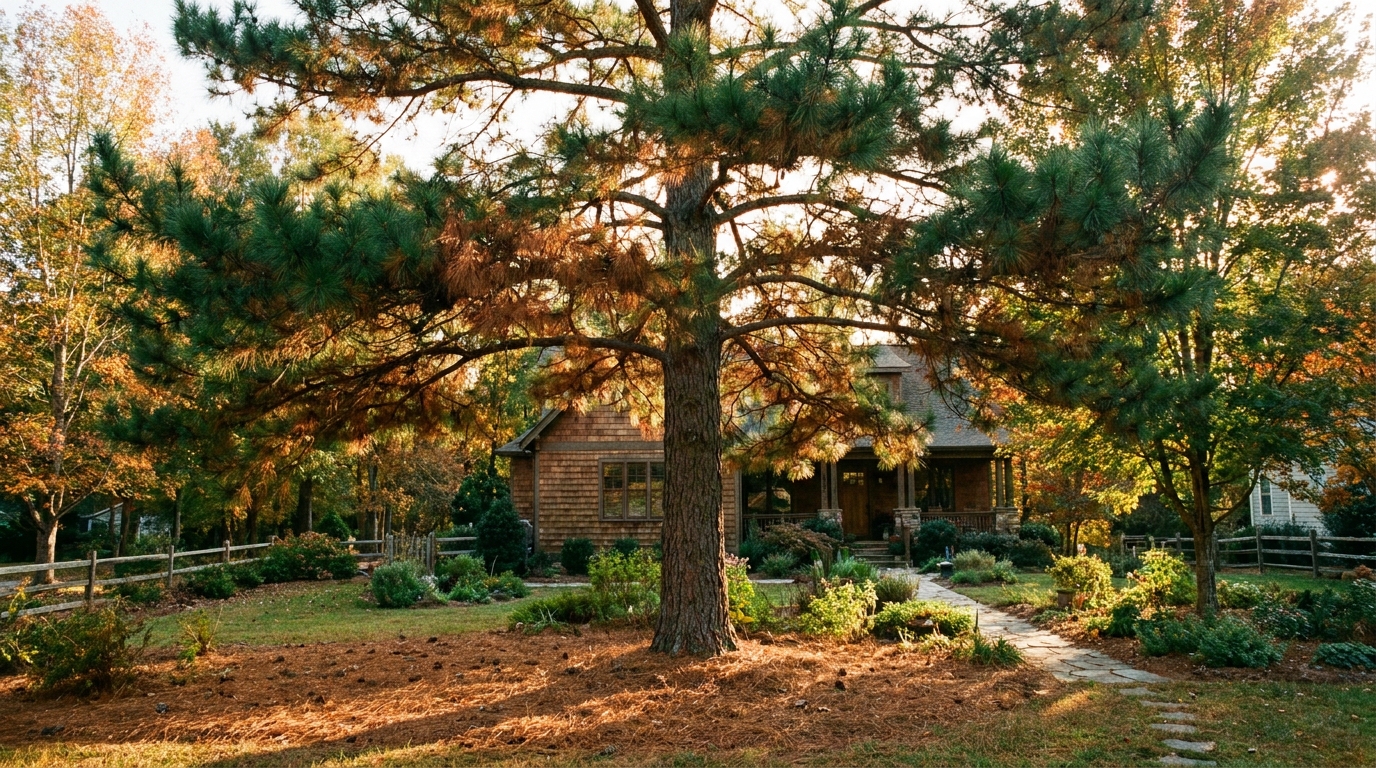
Brown needles packed on the inside of a pine this fall are usually normal pine needle drop, not a tree that is dying. Pines shed their oldest interior needles in autumn while the newest needles at the branch tips stay green [1]. N.C. Cooperative Extension puts the same point in plain language: it is natural for pines to shed those interior needles at this time of year, so the brown sleeve by itself is not a reason to panic [2].
What you are seeing in the yard
Walk up to a branch instead of judging the tree from the street. On a normal shed, the color change sits back from the growing tips. Needles closer to the trunk turn yellow, tan, or rusty brown. Needles at the end of the branch stay green. University of Wisconsin Extension describes that line as an abrupt change from innermost yellow or brown to green farther out, and calls the boundary good news [1]. The drop is spread through the inner crown, not limited to one dying limb.
That is pine needle drop in fall. It can look sudden. Older needles sometimes yellow and brown together, and a tree that was solid green in August can look tired by October [1]. Homeowners in Waxhaw and across Union County call every autumn about a brown interior and a carpet of needles.
The needles on the ground are pine straw. They fell because those particular needles were finished, not because the whole tree failed. If you tug a yellow interior needle and it slips off easily, that also fits the normal pattern. A 2018 Virginia Department of Forestry field note described pines whose older interior needles turned yellow, came off when pulled or brushed, and left green needles at the branch ends [6].
Why the inner needles turn brown
Needles are leaves. They last longer than a maple leaf, and they do not last forever. A 2021 University of Georgia Extension note put the general span at 2 to 5 years, depending on the species [3]. A 2020 Purdue plant diagnostic note used a similar range, about 2 to 4 years, and said the oldest foliage is the set that turns yellow or brown and dies each year [4]. White pine and arborvitae often change faster than species that shed a little at a time, which is why the color shift is so easy to see [4].
Shade is part of why the loss starts on the inside. As a conifer gets larger, the interior of the crown gets darker. Henderson County's N.C. Cooperative Extension office explains that a needle exists to catch light, and once it sits in shade the plant stops supplying it with water and nutrients, so it turns brown [5]. That office calls interior browning a natural part of the tree getting larger and older [5].
New needles form at the tips in spring. Through the summer the tree carries this year's needles and at least one older set. In fall it lets the oldest set go. The 2018 Virginia note describes that cycle directly: the yellow interior needles are last year's, the green tips are this year's, and the tree spends the winter on the newer set [6].
Mississippi State University Extension, in a pine straw guide reviewed in October 2025, says a pine typically holds its needles for about 2 years and then sheds them as new ones grow [7]. The same guide says the greatest needle fall runs from September through December [7]. For longleaf pine, NC State Extension says foliage typically stays on the tree for about two growing seasons, roughly a year and a half, and that the heaviest shedding under normal weather comes in September and October [8].
Loblolly pines around Waxhaw
A common pine on Union County lots is loblolly, Pinus taeda. NC State Extension lists it for the Piedmont, along with the Coastal Plain and the mountains, and notes that it is often the pine left standing when houses are built among existing trees [9]. It may grow 60 to 90 feet tall, with a spread of about 20 to 40 feet [9]. The needles come in bundles of three and run about 6 to 10 inches long [9]. Those needles drop during the tree's third year [9].
That third-year drop is why a loblolly can look thin inside and still be fine. You should still see a full green brush at the tips. NC State's quick description of the species notes needles clustered at the tips of twigs that are bare below [9]. In October that inner stretch is brown first, then empty. Both stages are normal if the tips stay green and the change is even through the crown.
Loblolly is also a fire-prone tree. NC State rates it highly flammable and says it should not be planted inside the defensible space around a home [9]. Planting is not a service we offer, and a normal shed is not a reason to remove a healthy pine. If a large loblolly already stands against the house, keep the new straw off the roof, out of the gutters, and from piling against the siding. That concern is fuel and placement, not the color of old needles.
Why some years look worse
Not every fall looks the same, and a heavier carpet does not automatically mean the tree has failed. Wisconsin Extension notes that some years the drop simply draws more attention, and that Austrian, red, and Scots pines often go brown rather than bright yellow while still showing that sharp line between old needles and green tips [1].
Eastern white pine is the one that startles people. A 2021 University of Georgia Extension note said this species can shed up to one-half of its needles in early fall, and that the needles generally last only about two years [3]. By the second autumn the older needles go straw yellow, then brown, then drop, while the branch tips stay green [3]. A yellow interior on a white pine screen in a Waxhaw yard is often that normal show, not a new blight.
A hard summer can add to the mess. The 2020 Purdue note said drought and similar stress can make a tree lose more than one year's foliage at a time, or discolor faster than a tree that had an easy season [4]. The limit in that note is the youngest growth. As long as the youngest foliage stays green, that extra needle loss does not by itself mean the tree's health is gone [4]. Georgia's 2021 note adds a related point: after a lush growing year, a poorer year grows fewer new needles, so there is less green to hide the old brown ones, and the tree looks sicker than it is [3].
A thick carpet under a Waxhaw or Indian Trail pine, with the tips still green, is a raking job. It is not a reason to schedule a removal.
When the browning is not normal
Normal drop has a few tells you can see without a lab. The color is fairly even on the old inner needles. University of Minnesota Extension describes seasonal needle drop as older inner needles turning completely yellow, without spots, and then falling, usually in fall [10]. The needles that drop may already be two or more years old, depending on the species [10]. Spots, bands, or a speckle that is not a solid color are a different problem. Clean inner browning in fall, with green tips, is the seasonal shed. Odd markings, or browning that includes this year's tips, is not.
Wisconsin Extension makes the same split from the other direction. If new growth is the part turning off-color, if whole branches die, if only the lower crown is failing, or if the browning shows up outside the fall window, do not write it off as needle drop [1]. University of Georgia Extension says disease, transplant shock, and roots that stay wet usually affect the new foliage at the tips as well as the old needles [3]. Green tips are the reassuring check. Brown tips are the check that failed.
Bark beetles are the other worry we hear, and they do not look like this carpet of old needles. During an attack by southern pine beetle or Ips engraver beetles, NC State Extension says the needles fade from green to yellow to red, the red-topped look people notice from a distance, and the tree may push out popcorn-like pitch tubes where sap hardens around a beetle's entry hole [11]. A stressed pine may not have the sap to make those tubes, so pitch tubes are not always present [11]. Fine boring dust caught in the bark cracks is the other outside clue we look for on those attacks. Fall needle drop does not fade this year's tips from the top down, and it does not leave pitch tubes on the trunk.
On Ips engravers in particular, yellowing or reddening in the crown is often the first sign people notice, and a pitch tube can form if the tree still has enough sap [12]. By the time that crown color is obvious, NC State Extension says most of the beetles have often already emerged, and the tree is highly likely past saving [12]. The residential step described there is to cut the infested tree down [12]. That is a crew job when the pine stands over a house, a drive, or a line. A spray visit is not something we offer, and neither is a beetle treatment program. If the top is fading, or you find pitch tubes or boring dust, removal is the safe call. Our earlier note on Ips and southern pine beetle damage in Union County is the longer comparison. This page only draws the line: green tips and brown inner needles are not that problem.
A storm-broken pine is a different job. Loblolly is prone to wind damage [9]. A split trunk, a hanging limb, or a fresh lean toward the house is not fixed by explaining needle drop. That is storm and emergency work, and sometimes full removal. Large deadwood that could fall is a trimming question. Shearing green tips off a healthy pine, just to hide brown inner needles, is not. Those needles will drop on their own.
What to do with the needles on the ground
You can leave a layer under the pine. Mississippi State University Extension points out that pine straw carries nutrients that go back into the soil as the needles break down, and that raking a stand bare year after year can work against the site [7]. A yard tree is not a pine-straw plantation, but the same idea holds. You do not need to scrape the root zone down to bare dirt every October.
You also do not have to live with needles in the wrong places. Pine straw is a common mulch because it does not float and wash away the way bark chips can, and it adds nutrients as it breaks down [7]. Rake thick mats off the lawn if they are burying the grass, pull needles out of the gutters, and keep a deep dry pile from sitting against the foundation. A modest layer in beds is a fair use of what the tree just dropped.
You do not need fertilizer or a pesticide because the inner needles turned. Nothing in the normal fall pattern calls for that, and neither is a service we offer. If you are unsure, check several branches on more than one side. Green tips and brown interiors, in fall, across the whole crown, means you can wait. Brown tips, a red top, pitch tubes, boring dust, spots on the needles, or a fresh lean means do not wait on the season to fix it.
Practical takeaways
- Pine needle drop in fall hits the oldest inner needles. This year's tips should stay green [1].
- Loblolly needles drop during the tree's third year [9]. The greatest needle fall on pines runs from September through December [7].
- A 2020 Purdue note said drought can push off more than one year's foliage, but that loss does not by itself ruin the tree if the youngest needles stay green [4].
- A 2021 Georgia note said eastern white pine may shed up to half its needles in early fall [3].
- Normal drop is older inner needles turning yellow without spots, usually in fall [10]. If new growth fades, whole branches die, or the browning shows up outside fall, do not call it seasonal needle drop [1].
- Needles that fade from green to yellow to red, and popcorn-like pitch tubes, are bark-beetle signs rather than fall needle drop [11]. NC State Extension says an engraver-infested pine in that condition should be cut down [12].
- NC State rates loblolly highly flammable and says not to plant it inside the defensible space around a home [9]. Keep dry straw off the roof and away from the siding anyway.
- Loblolly is susceptible to wind damage [9]. A split or newly leaning pine is a storm or removal problem even when some needles are only the normal shed.
How we can help
Have more questions or want to get in touch?
If the inner needles are the only change, you probably do not need a crew. If the top is fading, the bark shows pitch tubes or boring dust, or a pine is split or leaning over the house, our team can take the tree down, including crane-assisted removal when the drop zone is tight. Start with our contact page, or see how we handle tree removal when a pine is no longer safe to leave standing.
Citations
- University of Wisconsin-Madison Division of Extension, "Seasonal Needle Drop Normal on Evergreens" (2025-09-29)
- N.C. Cooperative Extension, Sampson County, "Fall Greetings from Your Master Gardener Friends!" (2026-09-30)
- University of Georgia Extension, "Evergreens shed needles in the fall" (2021-11-18)
- Purdue University Plant and Pest Diagnostic Laboratory, "Dying Conifers - NOT!" (2020-11-02)
- N.C. Cooperative Extension, Henderson County, "Plant Health Alert - Browning Needles in Conifers" (2026-07-02)
- Virginia Department of Forestry, "Field Notes: Pine Yellows" (2018-12-17)
- Mississippi State University Extension, "Pine Straw: Harvesting the Product" (2025-10)
- NC State Extension, "Managing Longleaf Pine Straw" (2025-03-03)
- NC State Extension Gardener Plant Toolbox, "Pinus taeda (Loblolly Pine)" (n.d.)
- University of Minnesota Extension, "Pine: Needles drop prematurely" (n.d.)
- NC State Extension, "Pine Bark Beetles" (2022-08-04)
- NC State Extension, "Pine Engraver Beetles" (2024-05-15)