Proper Tree Mulching and Root-Zone Health: How to Avoid the Mulch Volcano in Waxhaw, NC
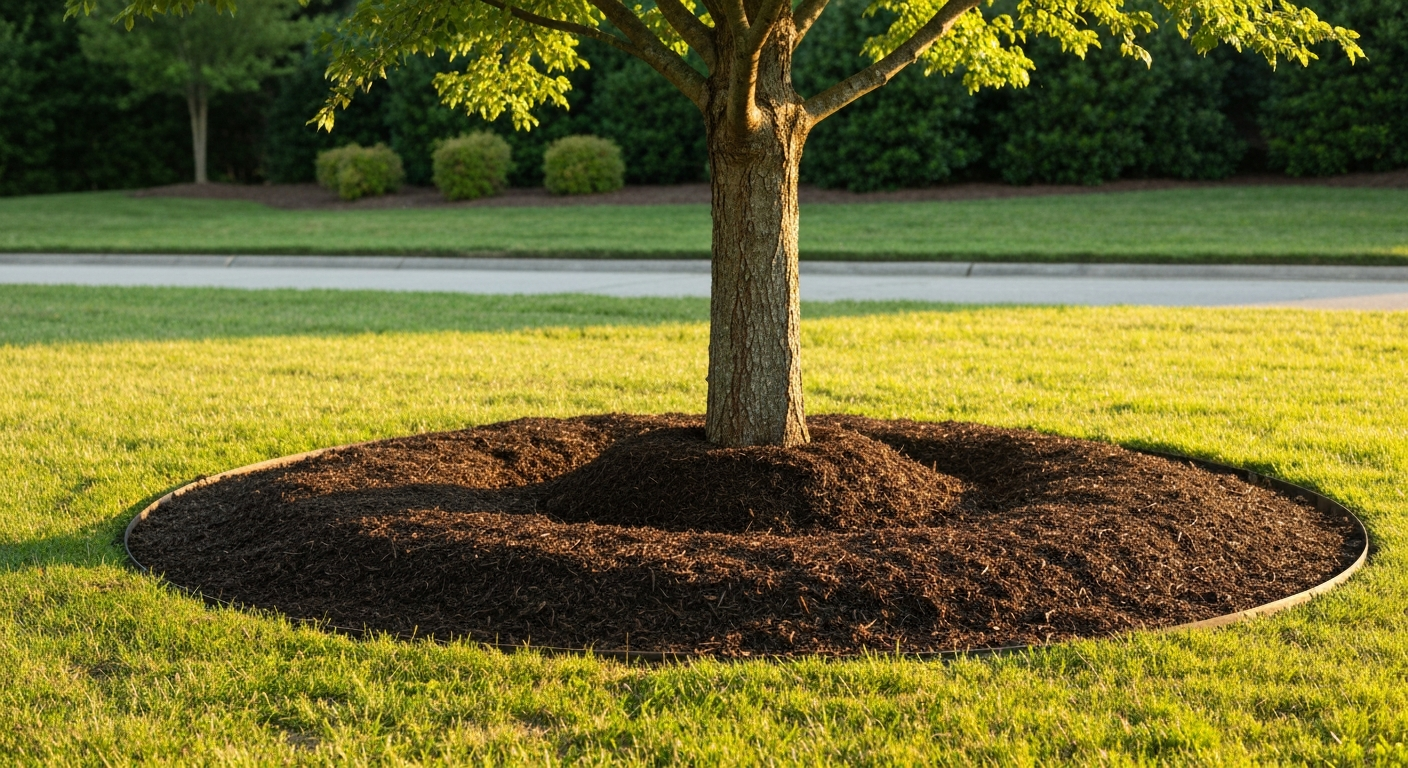
Proper tree mulching is one of the most valuable things you can do for a tree here in the Waxhaw and Union County area, and it is also one of the easiest things to get wrong. Done well, mulch is a wide, flat ring of organic material, roughly 2 to 4 inches deep, spread out and pulled back from the trunk so the root flare stays in view. Done poorly, it becomes a "mulch volcano," a cone of material piled against the bark that can slowly weaken or even kill an otherwise healthy tree. The good news for NC Piedmont homeowners is that the difference between a mulch ring that helps and a mulch volcano that harms comes down to just a few inches and where you put them.
What proper tree mulching looks like
The industry standard is a layer of mulch about 2 to 4 inches (5 to 10 cm) deep. A 2026 systematic review published in the International Society of Arboriculture journal Arboriculture & Urban Forestry describes 2 to 4 inches as the best-practice recommendation for trees. Clemson Cooperative Extension agrees that a 2- to 4-inch layer spread out toward the drip line is ideal.
Texture matters too. The International Society of Arboriculture advises applying fine-textured mulches in a 2- to 3-inch layer and coarse materials such as arborist wood chips in a 3- to 4-inch layer, kept near but not touching the trunk and extended out toward the drip line, with a ring of at least a 3-foot radius for most trees. Shape it like a flat donut, never a cone. An easy rule to remember for mature trees is the University of Vermont Extension 3-3-3 method: keep mulch at least 3 inches back from the trunk, no more than 3 inches deep, and about 3 feet in diameter.
How deep should tree mulch be?
Two to 4 inches is the number to remember. It is worth being honest, though, about what the science does and does not say about deeper mulch, because the popular warning that "any deep pile of mulch will kill your tree" is stronger than the evidence supports. The 2026 ISA systematic review examined 11 peer-reviewed studies published between 1989 and 2023 and found the effect of very deep mulch to be mixed and inconclusive. No study found that planting within 2 to 4 inches of mulch harmed tree survival, and one unpublished study found that even 18 inches of coarse mulch caused no measurable harm.
That same review did find evidence that depths over about 4 inches can have negative effects, and Clemson notes that more than 4 inches can create oxygen and moisture problems in the root zone. So the takeaway is not that mulch is risky. Two to 4 inches is the safe, well-supported target, and the clearest, best-documented harm does not come from depth alone. It comes from mulch piled against the tree, the mulch volcano.
The mulch volcano is the real hazard to avoid
A mulch volcano is mulch piled high against the trunk in a cone shape, and it is the single most common mulching mistake homeowners make. University of Vermont Extension describes how this cone buries the root flare and blocks the oxygen exchange roots need, traps moisture against the bark in a way that invites decay and gives pests and disease an entry point, and creates cover for rodents such as voles that gnaw and girdle the trunk. Piling more than 4 inches of mulch on the trunk can also encourage adventitious roots, which grow out of the trunk instead of the root system and can slowly girdle (strangle) the tree over time.
Rutgers Cooperative Extension adds that suffocation of the roots is the most common way over-mulching kills a tree or shrub, that mulch piled directly against the trunk kills the inner bark, and that the inside of a deep pile can reach 120 to 140 degrees Fahrenheit, hot enough to damage bark. Closer to home, the Union County Center of N.C. Cooperative Extension warns that a buried trunk flare, most often caused by piling mulch against the trunk, leads to stem-girdling roots and premature tree death, and notes it is especially common in new housing developments. That is a real risk in fast-growing parts of Union County like Waxhaw and Weddington, where young landscape trees are often over-mulched right after planting.
| Feature | Proper mulch ring | Mulch volcano |
|---|---|---|
| Shape | Wide, flat donut | Tall cone against the trunk |
| Depth | 2 to 4 inches | Often 6 inches or more, piled up |
| Trunk contact | Pulled back; root flare visible | Buried against the bark |
| Root zone | Oxygen and water reach the roots | Roots suffocate; bark stays wet |
| Long-term effect | Healthier growth | Decay, girdling roots, decline or death |
How far to keep mulch from the trunk
Every authority agrees on the core rule: mulch should never touch the trunk, and the root flare, where the trunk widens and meets the roots, must stay visible above the soil. The exact clearance distance is where sources differ, so treat it as a range rather than one magic number.
| Source | Trunk clearance recommendation |
|---|---|
| UVM Extension (3-3-3 rule) | At least 3 inches back from the trunk |
| Rutgers Cooperative Extension | 3 to 5 inches for young trees; 8 to 12 inches for mature trees |
Other university extension programs land in between, generally advising anywhere from a few inches up to about 6 inches of clearance. The exact number matters less than the principle they share: never let mulch touch the bark, and pull it back until you can see the trunk widen at the base.
How to fix a tree that already has a mulch volcano
If you look at your trees and see a cone of mulch swallowing the trunk, you can usually undo the damage, especially if you catch it early. Rutgers Cooperative Extension recommends pulling the mulch and any built-up soil back until the entire root flare and the top of the main roots are exposed, then leaving that area open to the air. For a young tree, a garden rake and your hands are usually enough. For a mature tree, where roots may already have grown up into the pile, professional arborists use a pneumatic air spade to loosen and remove material without wounding the roots. If you are not sure whether your tree's flare is buried, or you are dealing with an established tree, it is worth having a local Waxhaw tree care crew take a look before the girdling roots set in.
The best mulch for trees in the North Carolina Piedmont
The best mulches for trees are organic materials that break down over time and feed the soil. The International Society of Arboriculture recommends arborist wood chips, shredded hardwood or softwood bark, and pine needles (pine straw), and calls fresh arborist wood chips an excellent material. Pine straw and shredded bark are both common, well-suited organic mulches for yards across the NC Piedmont. Whatever you choose, keep fine-textured mulch to a 2- to 3-inch layer and coarse materials like wood chips to 3 to 4 inches.
Applied correctly, an organic mulch ring does real work for a tree. The USDA Forest Service notes that organic mulch helps the soil hold moisture, moderates soil temperature, suppresses weeds, and improves soil structure over time. (Good mulching pairs with good watering habits, which we cover in our guide to summer heat and drought stress.) The point of proper tree mulching is not to stop mulching. It is to mulch in a way that helps rather than harms.
Frequently asked questions about mulching around trees
How much mulch should I put around a tree?
Aim for a ring 2 to 4 inches deep and at least 3 feet across, shaped like a flat donut rather than a cone. Keep the mulch pulled back from the trunk so the root flare stays visible.
What is a mulch volcano, and why is it bad for trees?
A mulch volcano is mulch piled in a cone against the trunk. It buries the root flare and cuts off oxygen, traps moisture that rots the bark, encourages girdling roots, and gives rodents cover to chew the trunk, all of which can slowly weaken or kill the tree.
How far should mulch be kept away from the tree trunk?
Never let mulch touch the bark. UVM's 3-3-3 rule keeps mulch at least 3 inches back, while other extension programs suggest anywhere from a few inches up to 8 to 12 inches for large mature trees. The rule they all share is to keep the root flare visible.
Can too much mulch kill a tree?
Yes, but the nuance matters. Peer-reviewed evidence on very deep mulch by itself is mixed, and no study found a 2- to 4-inch layer harmful. The well-documented killer is mulch piled against the trunk, which suffocates roots and rots the inner bark over time.
Should mulch cover the root flare?
No. The root flare must stay visible above the soil. A buried flare is a leading cause of premature tree death, especially in newer neighborhoods where trees were mulched heavily at planting.
What is the best mulch for trees in the North Carolina Piedmont?
Organic mulches such as arborist wood chips, shredded hardwood bark, and pine needles (pine straw) are all good, regionally suitable choices. Use 2 to 3 inches of fine mulch or 3 to 4 inches of coarse wood chips.
How often should I refresh tree mulch?
Before adding more, check the depth you already have. Top up only enough to keep the ring at 2 to 4 inches total, and break up any matted or crusted layer so water and air can pass through, rather than piling fresh mulch on top of old.
Get proper mulching help in Waxhaw and Union County
Have more questions or want to get in touch? Mulching looks simple, but a buried root flare or a young tree strangled by girdling roots is easy to miss until the damage is done. From routine tree trimming to checking that your mulch rings are the right depth, the Clarks Tree Care team helps homeowners across Waxhaw, Weddington, and the rest of Union County keep their trees healthy. Prefer to speak with a member of our team? Give us a call at (980) 247-8733, or reach us through our contact page. We look forward to hearing from you.
Citations
- Arboriculture & Urban Forestry (International Society of Arboriculture). "Does Excess Mulch Depth Lead to Poor Tree Growth, Root Girdling, and Decay? A Systematic Literature Review" (2026)
- Clemson Cooperative Extension, Home & Garden Information Center. "Tree Maintenance" (February 21, 2025)
- International Society of Arboriculture (TreesAreGood). "Proper Mulching Techniques" (2021)
- University of Vermont Extension. "Beware the Mulch Volcano" (May 11, 2026)
- Rutgers New Jersey Agricultural Experiment Station. "FS099: Problems With Over-Mulching Trees and Shrubs" (2021)
- N.C. Cooperative Extension, Union County Center. "Trunk Flare" (January 24, 2023)
- USDA Forest Service, Northern Research Station. "Mulching (if done right) Benefits Trees and Shrubs!" (2016)