Bacterial Leaf Scorch in Oak Trees: Why Union County Oaks Brown in Late Summer
If your oak is browning along the leaf edges in late July or August, it is easy to blame the heat. In Union County, though, that late-summer scorch is not always drought. It can be bacterial leaf scorch, a chronic, insect-spread disease that clogs an oak's water-carrying tissue and slowly starves the leaves, producing browning that looks almost identical to thirst. The disease has no cure, it returns worse every year, and it is eventually fatal. The reassuring part is that a browning oak is not a same-day death sentence, and there are honest clues that help you separate disease from drought before you call for a lab test.
Key takeaways
- Bacterial leaf scorch is a disease of oak trees caused by the bacterium Xylella fastidiosa. It lives inside the tree's water-conducting (xylem) tissue, so the browning it causes closely mimics drought.
- In North and South Carolina, foliar symptoms first appear in late July and early August, exactly when Piedmont homeowners tend to blame the heat.
- Two clues point toward disease rather than drought: a yellow (sometimes reddish) band between the dead and living leaf tissue, and browning that starts on older, lower, interior leaves and is often confined to one part of the canopy. Neither clue is a guaranteed diagnosis, so a laboratory test is the only way to confirm it.
- There is no cure. Trunk injections of an antibiotic can suppress symptoms for a season, but they must be repeated every year and never eradicate the bacterium.
- Infected oaks decline gradually, over roughly 5 to 10 years. Good management means slowing that decline and removing the tree once it becomes a hazard.
What bacterial leaf scorch is, and why it looks like drought
Bacterial leaf scorch is caused by Xylella fastidiosa, a bacterium that lives only inside a tree's xylem, the network of cells that carries water up from the roots. According to Clemson Cooperative Extension, it is a xylem-limited bacterium, and the University of Delaware Cooperative Extension describes it the same way, as a small, xylem-limited organism. As the bacteria multiply, they clog those water-conducting cells so that water cannot move past the point of infection, as The Morton Arboretum explains. The result is a tree that is effectively cut off from part of its own water supply, so the leaf edges dry out and brown just as they would in a true drought. That shared plumbing problem is exactly why the two are so easy to confuse. The Morton Arboretum notes that Xylella fastidiosa has a very broad host range, affecting well over 100 species of landscape plants, but on oaks it is a serious, progressive disease.
Why are my oak leaves turning brown in late summer?
Timing is a big part of the confusion. NC State Extension reports that in North and South Carolina, foliar symptoms first appear in late July and early August as a brown or red discoloration around the margin of the leaf. The University of Delaware adds that the bacterium multiplies as the weather warms and reaches a peak by late summer, which is why symptoms usually surface in late summer or early fall. In other words, the disease shows itself at the same hot, dry point in the season when ordinary drought also browns leaves, so a homeowner who sees crispy oak leaves in August has honest reason to blame the weather. Our guide to summer heat and drought stress in Waxhaw covers what genuine drought stress looks like and how to water correctly. Across Union County and the southern Charlotte metro, oaks are among the most common shade trees in local yards, so this browning is worth a closer look before you write it off.
Oak leaf scorch vs drought: how to tell the difference
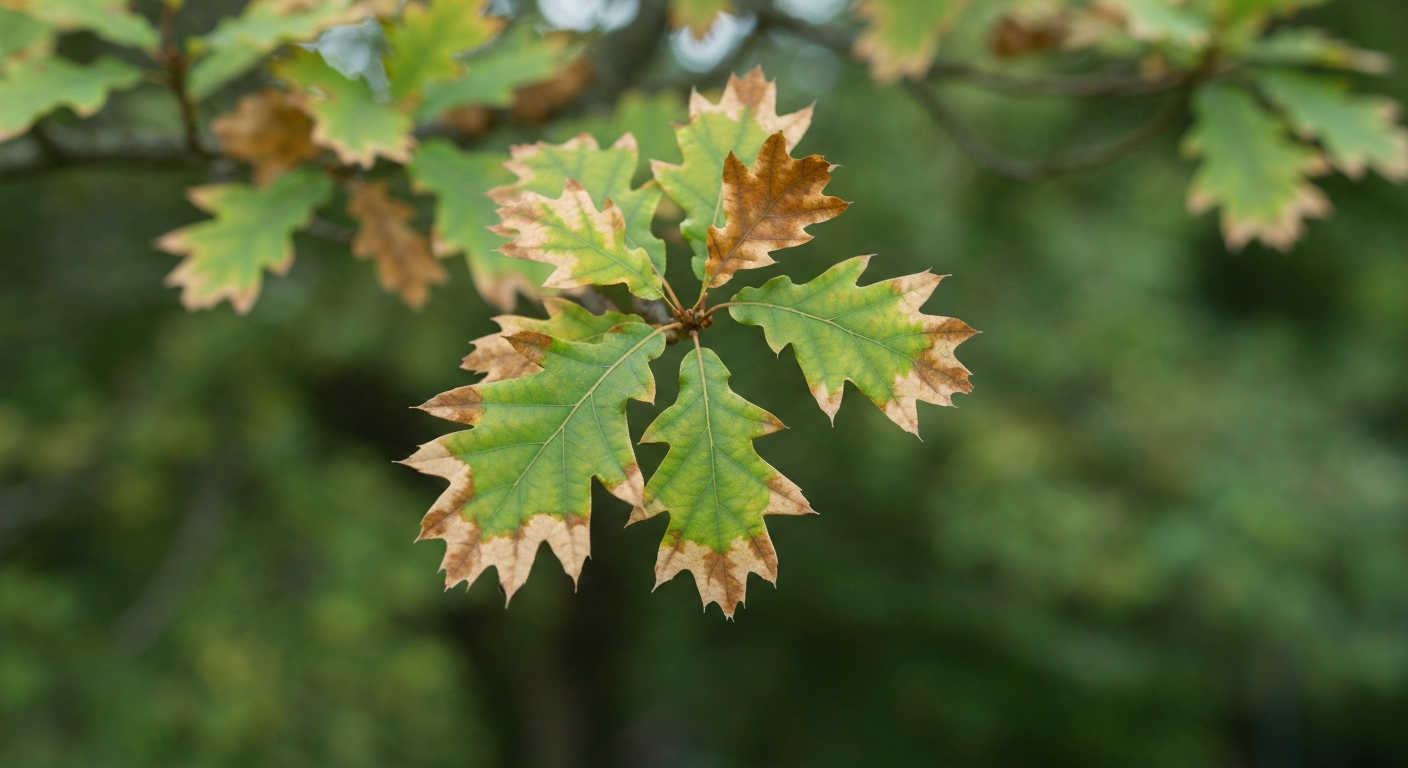
There are two useful clues. The first is a color band. The University of Delaware notes that the marginal browning is often accompanied by a yellow band toward the inside of the discolored area, and the Morton Arboretum describes dead areas that are sometimes encircled with a yellow or red band or halo. Ordinary drought or environmental scorch usually does not produce that band. As Virginia Cooperative Extension puts it, no yellow band is typically observed when marginal leaf scorch is caused by other problems such as drought, root disease, or salt injury.
The second clue is the pattern. According to the University of Maryland Extension, bacterial leaf scorch tends to appear first on the lower branches and on the older, interior leaves, while drought scorch is more uniform and shows up first on the upper branches and the younger leaves near the tips. Disease browning is often irregular and concentrated in one part of the canopy rather than spread evenly through the whole crown.
Both of these are clues, not verdicts. Virginia Cooperative Extension is careful to say the yellow band is not always present, and the Morton Arboretum states plainly that bacterial leaf scorch cannot be diagnosed in the field by looking at symptoms, and that diagnosis requires a lab test. So the honest way to use the table below is to let it raise your suspicion, then confirm with a laboratory test on symptomatic leaves rather than treating a browning oak on a hunch.
| What you are looking at | Bacterial leaf scorch | Ordinary drought or heat scorch |
|---|---|---|
| Underlying cause | A xylem-limited bacterium spread by insects | Lack of soil moisture during heat and dry spells |
| Color band | Often a yellow or reddish band between the dead margin and green tissue | Usually no band along the browning edge |
| Where it starts | Older, lower, interior leaves, often in one part of the canopy | Younger leaves near the branch tips, more evenly across the tree |
| Over time | Returns and worsens every year, ultimately fatal | Often recovers with deep watering and a return of normal rainfall |
| Confirming it | Requires a laboratory test on symptomatic leaves | Read from soil moisture, weather, and watering history |
Which oaks are most at risk in Union County
Not every tree is equally vulnerable. The University of Delaware notes that the disease is especially damaging to oaks in the red oak group. Body-confirmed susceptible species include pin, willow, northern red, southern red, scarlet, shingle, and Shumard oak. NC State Extension specifically names pin oak and southern red oak among affected trees in the Carolinas, and Clemson Cooperative Extension lists bur, pin, red, shingle, and white oak. The Morton Arboretum's broader host list also includes bur, white, post, swamp white, and black oak. That matters locally because Piedmont landscapes across Union County lean heavily on red-oak-group shade trees, so many of the large oaks shading yards and streets here fall squarely in the most susceptible group.
How the disease spreads, and why there is no spray to prevent it
Bacterial leaf scorch does not travel on the wind or through the soil the way many fungal diseases do. The University of Delaware explains that the bacterium is carried from plant to plant by small xylem-feeding insects such as leafhoppers, sharpshooters, and spittlebugs. These insects feed on the sap inside the water-conducting tissue, pick up the bacterium from an infected tree, and inject it into a healthy one. Clemson Cooperative Extension and NC State Extension describe the same leafhopper and spittlebug vectors. Because the disease is moved by insects and lives deep inside the xylem, there is no spray or soil treatment that reliably prevents infection, which is a big reason the University of Delaware calls control or cure almost impossible once a tree is infected.
Bacterial leaf scorch treatment: what actually helps
Start with the hard truth: there is no cure. The University of Missouri Extension states flatly that there is no cure for bacterial leaf scorch on oak, and the Morton Arboretum describes the disease as chronic and fatal.
You may read about antibiotic injections, and it is worth understanding what they do and do not do. Clemson Cooperative Extension describes annual root-flare injections of oxytetracycline used to reduce symptoms by suppressing the pathogen, not to cure the tree. Virginia Cooperative Extension likewise says the antibiotic injection has been shown to slow the disease but will not cure the tree, and the Morton Arboretum points out that these injections do not kill the bacterial cells already inside the plant. In practice that means the treatment suppresses symptoms for a season, must be reapplied every year, and never eradicates the bacterium. Its value is genuinely debated. Some extension sources present it as a legitimate season-long symptom suppressant for high-value specimen trees, while the University of Delaware is blunter, calling antibiotics expensive and not very effective. This is a specialist antibiotic treatment offered by some arborists, and at best it buys time on a prized tree rather than saving it. It is not something Clark's Tree Care sells, because no treatment we or anyone else can offer will cure this disease.
What genuinely helps is supportive care that keeps a diagnosed oak as healthy as possible for as long as possible. The University of Delaware and the University of Missouri Extension both point to reducing stress on the tree: watering deeply during drought, keeping the root zone healthy, and pruning out affected or dead limbs. That is where honest, hands-on tree care makes a difference. Proper watering during a dry Piedmont summer, correct mulching (never the deep mulch volcano that harms roots), and careful pruning will not stop the disease, but they help a declining oak hold on and stay safer while it does.
| Source | Reported timeframe | What it describes |
|---|---|---|
| University of Delaware Cooperative Extension | About 5 to 7 years | Time from infection to tree death |
| University of Missouri Extension | About 5 to 8 years | Time until infected oaks die |
| Clemson Cooperative Extension | About 5 to 10 years | Gradual decline before a tree needs removal |
When an infected oak should be removed
Removal is a judgment call, not an automatic verdict on the day of diagnosis. The sources genuinely differ. NC State Extension takes the firmer line, advising that infected trees should be removed as soon as possible after a proper diagnosis is made. The University of Missouri Extension is more measured, noting that if the tree is not a hazard it can be left in place and cared for by limiting stress, and that removing it does not seem to make a difference in preventing spread across a landscape. Clemson Cooperative Extension frames the decline as a gradual process that may take 5 to 10 years before a tree needs to be removed.
The sensible middle ground is to treat removal as a hazard and decline decision that plays out over years. Early on, a diagnosed oak that is still structurally sound can often be monitored and supported. As the disease progresses, dead and brittle limbs, and eventually a failing trunk, turn the tree into a genuine safety risk over a driveway, a roof, or a play area. That is the point where removal becomes the safe choice, the same treat, watch, or remove logic we walk through for another local threat in our post on the emerald ash borer in Waxhaw and Union County.
What to do if you think your oak has bacterial leaf scorch
- Do not assume it is drought, and do not assume the worst either. Late-summer browning has more than one cause.
- Look for the clues: a yellow or reddish band inside the browned margin, and browning that starts on older, lower, interior leaves in one part of the canopy.
- Get a laboratory test to confirm it. The University of Missouri Extension advises collecting leaves that are still green but show scorch symptoms, and late summer into early fall is the right window because bacterial populations are highest then.
- Keep the tree as healthy as you can while you decide: water deeply during drought, mulch correctly, and prune out dead or affected limbs.
- Have a professional reassess the tree as it declines, so a growing hazard is caught before a limb or trunk fails.
This is the kind of problem where an experienced local crew earns its keep. Clark's Tree Care can help you tell disease from drought, point you toward a lab test to confirm it, provide the supportive care that slows an infected oak's decline, and safely remove the tree if and when it becomes a hazard. What we will not do is promise a cure, because bacterial leaf scorch does not have one.
Have more questions or want to get in touch? If a browning oak in Waxhaw or anywhere in Union County has you worried, we can help you sort disease from drought and keep an eye on the tree as it ages so it never becomes a hazard in your yard. Contact the Clark's Tree Care team for a straightforward, safety first assessment. We look forward to hearing from you.
Citations
- Clemson Cooperative Extension, "Oak Diseases & Insect Pests in South Carolina" (updated 2026-02-13)
- University of Delaware Cooperative Extension, "Bacterial Leaf Scorch" (revised 2025-02)
- The Morton Arboretum, "Bacterial Leaf Scorch" (maintained reference, undated)
- NC State Extension, "Scorch Diseases on Shade Trees" (2024-09-23)
- Virginia Cooperative Extension (Virginia Tech), "Bacterial Leaf Scorch of Landscape Trees" (2024-02-02)
- University of Maryland Extension, "Bacterial Leaf Scorch of Trees" (2023-02-28)
- University of Missouri Extension, "MU Extension, MDC continue to offer free testing for oak diseases" (2026-06-22)